Benefits of Tailored Resume Applications for Job Seekers

A tailored resume application is a customized version of your resume written specifically for one job posting, matching your skills and achievements to that employer’s exact requirements. Job seekers who understand the benefits of tailored resume applications gain a measurable edge: applicants who tailor their resumes see a 115% higher interview success rate compared to those who send a generic document. That number is not a rounding error. It means you are roughly twice as likely to land an interview when you take the time to customize. Jobalign’s platform is built around this single insight, automating the process so you can apply to more roles without sacrificing quality.
1. How tailored resume applications help you pass ATS filters
Applicant Tracking Systems, or ATS, are software programs that scan resumes before a human ever reads them. ATS systems filter resumes based on keyword matching, comparing your document against the language in the job description. Approximately 75% of resumes are rejected at this stage. That rejection happens before a recruiter sees your name.

Tailoring your resume to each job description directly addresses this problem. When you mirror the exact terms an employer uses, the ATS scores your resume higher and passes it through to a human reviewer. Generic resumes fail because they use broad language that rarely matches the specific phrasing in any one job posting.
Here is what effective ATS tailoring looks like in practice:
- Copy the job title exactly as written in the posting and use it in your resume summary.
- Pull three to five hard skills directly from the job description and place them in your skills section.
- Use the same acronyms the employer uses. If the posting says “PMP,” do not write “Project Management Professional.”
- Include industry-specific tools and software mentioned in the posting, such as Salesforce, Tableau, or Python.
- Avoid graphics, tables, and text boxes. ATS software often cannot read them.
Pro Tip: Run your tailored resume through a plain text test. Paste it into Notepad or a basic text editor. If the formatting breaks apart or sections disappear, your ATS readability needs work. Fix the structure before you apply.
A solid resume customization workflow treats keyword matching as a first step, not an afterthought.
2. How tailoring shows recruiters you are the right fit
Passing the ATS is only half the battle. Once a human recruiter reads your resume, they decide in seconds whether to call you. Tailoring your resume to the job demonstrates genuine enthusiasm and thoughtfulness, which directly improves recruiter perception. 83% of recruiters prefer candidates who tailor their resumes and cover letters to specific roles. That preference is not arbitrary. Recruiters can tell immediately when a resume was written for a different job.
A tailored resume tells a story that fits the role. Your summary does not describe what you want. It describes what you bring to this specific employer’s problem. Your experience section does not list everything you have ever done. It highlights the work that maps directly to the job’s core responsibilities.
Here is what strong alignment looks like from a recruiter’s perspective:
- Your resume summary references the company’s industry or mission.
- Your top three bullet points under each role address the skills listed in the job description.
- Your accomplishments use numbers that reflect the scale of the employer’s business.
- Your language matches the tone of the job posting, formal for corporate roles and direct for startups.
Recruiters spend an average of six to seven seconds on an initial resume scan. A tailored document makes those seconds count by putting the most relevant information exactly where they expect to find it.
3. Top practical ways to tailor each resume section
Tailoring a resume does not mean rewriting it from scratch every time. It means making targeted edits to specific sections so the document speaks directly to the role. Here is how to approach each part.
Resume summary
Your summary is the first thing a recruiter reads. Rewrite it for every application. Use the job title from the posting and reference one or two of the employer’s stated priorities. Keep it to three sentences maximum.
Skills section
Customizing your skills section to reflect relevant job criteria makes it easier for recruiters to scan and find matches. Pull the required and preferred skills directly from the job description. List them in the same order the employer prioritizes them, placing the most critical skills first.
Experience and accomplishments
This is where most job seekers leave points on the table. Tailoring accomplishments to the job ad increases your application’s relevance significantly. For each role you list, choose the two or three bullet points that best match the new job’s requirements. Reframe the others or remove them entirely.
Use this process for each accomplishment bullet:
- Read the job description and identify the top three outcomes the employer wants.
- Find a past accomplishment that produced a similar outcome.
- Rewrite the bullet to lead with the result, using a number whenever possible.
- Use the same verb tense and terminology the job description uses.
- Cut any bullet that does not connect to the role’s core requirements.
Keywords and formatting
Place your most important keywords in the top third of the resume. ATS systems weight early content more heavily. Use a clean, single-column format with standard section headings like “Experience,” “Education,” and “Skills.” Avoid creative section titles that ATS software may not recognize.
Pro Tip: Keep a master resume with every role, skill, and accomplishment you have ever had. When you tailor for a new job, copy from the master and edit down. You will never start from a blank page, and you will never accidentally delete something you need later.
Learning how to tailor your resume with AI can cut this process from an hour to under ten minutes.
4. How to track and manage multiple tailored resumes
Sending tailored resumes to multiple employers creates an organization challenge. Without a system, you lose track of which version you sent where, and you cannot identify what is working.
Tracking tailored resume versions improves both efficiency and interview outcomes. When you know which version of your resume generated a callback, you can replicate that approach for similar roles.
Here is a simple tracking system you can set up today:
- Create a folder for each job application. Name it with the company name and job title.
- Save the tailored resume PDF and the original job description in the same folder.
- Log each application in a spreadsheet with columns for company, role, date applied, resume version, and outcome.
- Note which keywords you emphasized in each version.
- Review your spreadsheet monthly to spot patterns in which versions get responses.
| Tracking column | What to record |
|---|---|
| Company and role | Exact job title and employer name |
| Date applied | Month and day you submitted |
| Resume version | File name or version number |
| Keywords emphasized | Top three to five terms you prioritized |
| Outcome | No response, phone screen, interview, or offer |
This table takes five minutes to update per application. Over time, it becomes a personal data set that shows you exactly which tailoring choices produce results.
Pro Tip: Color-code your spreadsheet rows by outcome. Green for interviews, yellow for phone screens, gray for no response. After ten applications, the pattern becomes obvious at a glance.
5. When tailored resume applications matter most
Tailoring always helps, but tailored resumes are especially impactful in competitive industries and roles with many applicants. Knowing when to invest extra time in customization helps you focus your energy where it counts.
Tailoring delivers the highest return in these situations:
- Competitive industries. Technology, finance, consulting, and healthcare roles routinely attract hundreds of applicants. A generic resume disappears in that volume.
- Roles requiring specific certifications. If a job requires PMP, CPA, or AWS certification, your resume must surface those credentials immediately and in the employer’s exact language.
- Career transitions. When your background does not map directly to the role, tailoring lets you reframe transferable skills so they read as relevant rather than adjacent.
- Senior or specialized positions. The higher the role, the more specific the requirements. A tailored resume shows you understand the scope of the job, not just the title.
- Small companies and startups. Hiring managers at smaller organizations often read every resume personally. A document that speaks directly to their specific problem stands out immediately.
Generic resumes underperform most in these exact scenarios. A one-size-fits-all document signals low effort to the people who care most about finding the right candidate.
Key takeaways
Tailored resume applications consistently outperform generic ones because they align your specific skills and accomplishments with each employer’s exact requirements, satisfying both ATS filters and human reviewers.
| Point | Details |
|---|---|
| ATS keyword matching | Mirror the job description’s exact language to pass automated screening filters. |
| Recruiter preference | 83% of recruiters favor tailored applications, making customization a baseline expectation. |
| Section-by-section edits | Rewrite your summary, skills, and top accomplishments for every new application. |
| Version tracking | Log each tailored resume in a spreadsheet to identify which approaches generate interviews. |
| High-impact scenarios | Competitive industries, career transitions, and senior roles benefit most from tailoring. |
What I have learned from watching tailored resumes work in practice
The most common mistake I see job seekers make is treating tailoring as optional. They spend hours perfecting one beautiful resume and then send it to fifty employers unchanged. The logic feels sound. Why redo work you already did? But that thinking misunderstands what a resume actually is.
A resume is not a biography. It is a response to a specific question an employer is asking. Every job description is that question. A generic resume answers a question nobody asked.
The job seekers I have watched land interviews fastest are not the ones with the most impressive backgrounds. They are the ones who read job descriptions carefully and reflect the employer’s language back at them. A recent graduate with a 3.2 GPA who tailors every application will outperform a 4.0 student sending the same resume everywhere. The data backs this up, and the logic is simple. Relevance beats credentials when a recruiter has 200 resumes to review.
The other thing I have noticed is that tailoring improves your preparation for the interview itself. When you spend time aligning your accomplishments to a job’s requirements, you arrive at the interview already knowing which stories to tell. The resume work becomes interview prep. That is a return on investment most job seekers never account for.
— Johan
Jobalign makes resume tailoring fast and repeatable
Tailoring every resume manually takes time. Jobalign automates the process by syncing with your LinkedIn profile and generating a customized, ATS-ready resume for each job you apply to.
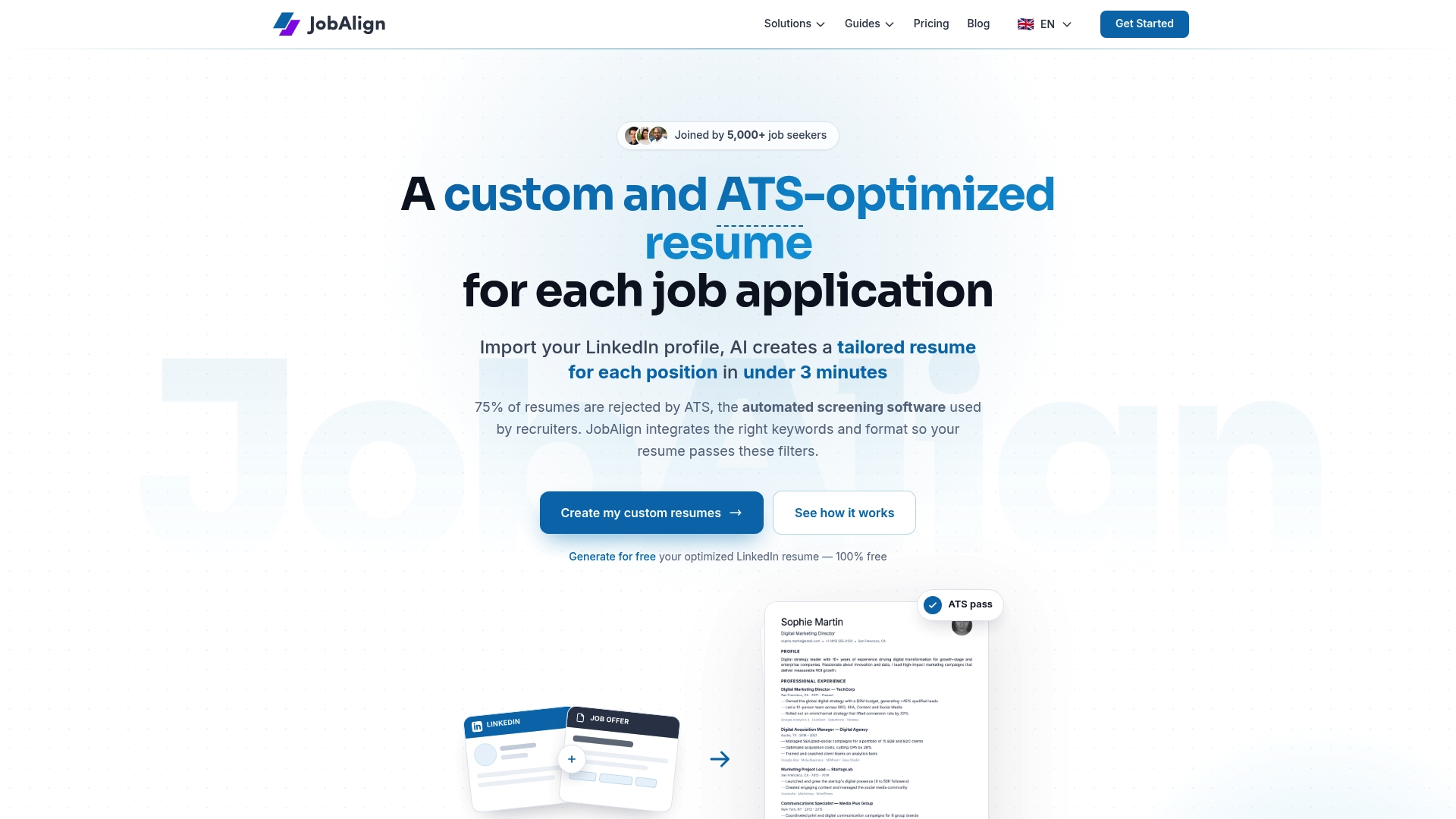
Jobalign’s technology matches your experience to the job description’s keywords and formats the output in a clean, machine-readable style. The platform reports an 87% ATS pass rate for resumes it generates. You get a tailored resume per posting without starting from scratch each time. If you are applying to multiple roles and want every application to reflect the specific job, Jobalign’s resume generator is the most direct path to doing that at scale.
FAQ
What is a tailored resume?
A tailored resume is a customized version of your resume written specifically for one job posting, using the employer’s language and highlighting the accomplishments most relevant to that role.
How much does tailoring a resume improve interview chances?
Applicants who tailor their resumes see a 115% higher interview rate compared to those who send generic documents, roughly doubling their chances of getting called.
How do I tailor my resume to a job description?
Copy key terms from the job posting into your skills section and summary, rewrite your top accomplishment bullets to reflect the role’s priorities, and use the exact job title the employer lists.
Should I tailor my resume for every single application?
Yes, especially for roles in competitive industries or positions requiring specific skills. Tailoring is most impactful when many applicants are competing for the same role.
How do I keep track of multiple tailored resume versions?
Create a folder for each application containing the tailored resume and the job description, then log each submission in a spreadsheet tracking the company, role, keywords used, and outcome.