How to Align Your Resume with Job Requirements

Aligning your resume with job requirements is the most direct way to pass Applicant Tracking System (ATS) filters and land interviews. In the recruiting world, this practice is called targeted resume writing, and it goes far beyond swapping a few words. Approximately 75% of resumes are rejected by ATS before a human ever reads them. That number means most job seekers are losing before the game even starts. The good news: a focused, repeatable process fixes this problem without requiring you to rewrite your entire resume from scratch.
What are the key elements of a job description to focus on?
The job description is your blueprint. Hiring managers appreciate candidates who mirror their priorities back to them, and the job posting tells you exactly what those priorities are.
Start by reading the posting twice. On the first pass, read for the big picture. On the second pass, pull out specific terms and sort them into four categories:
- Hard skills: Technical abilities the role requires (e.g., SQL, project management, financial modeling)
- Soft skills: Behavioral traits the employer emphasizes (e.g., communication, collaboration, adaptability)
- Qualifications: Degrees, certifications, or years of experience listed as requirements
- Core problems: The underlying challenge the role exists to solve (e.g., “scale our sales pipeline” or “reduce customer churn”)
Pay close attention to repetition. If a word or phrase appears three times in the posting, the employer considers it critical. Best practice is to parse the job description into these four lists before touching your resume. That separation keeps your tailoring targeted rather than scattered.
Pro Tip: Copy the job description into a plain text document and highlight every skill, qualification, and keyword. Then rank them by how often they appear. The top five are your non-negotiables.
How do you map your existing skills to job requirements?
Mapping is the step most job seekers skip, and skipping it is why their tailored resumes still feel generic. The goal is to match each key job requirement to a specific bullet point or experience already on your resume.

A simple three-column table makes this fast and clear:
| Job Requirement | Your Resume Match | Match Quality |
|---|---|---|
| Python scripting | Built data pipeline using Python at Acme Corp | Strong |
| Cross-functional collaboration | Led weekly syncs with 4 departments | Strong |
| Budget management | Assisted with $50K project budget | Medium |
| Salesforce CRM | No direct experience listed | None |
Strong matches go into your resume as-is, or with minor keyword adjustments. Medium matches need a rewrite to surface the relevant detail. “None” matches tell you where a skills section addition or a brief mention in your summary might help, if it is honest.
The best way to tailor is by extracting and mirroring top skills and qualifications prioritized in the job post. This mapping exercise makes that extraction concrete and fast.
Pro Tip: Do not force a “None” match into your resume. Fabricating experience destroys credibility in interviews. If a skill is genuinely missing, acknowledge it in a cover letter instead.
You do not need to overhaul every line. Rewriting every bullet leads to burnout and a less effective resume. Focus your energy on the five to seven items that carry the most weight.
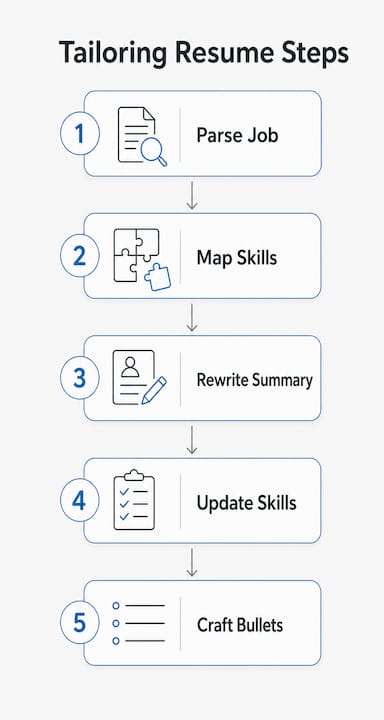
How to tailor your resume content step by step
This is where the real work happens. The process breaks into three distinct areas: your professional summary, your skills section, and your bullet points. Tackle them in that order.
Rewrite your professional summary first
The first 2–3 lines of your professional summary decide whether a recruiter keeps reading. That is not an exaggeration. A focused summary that mirrors the role’s job title and top skills is the single highest-leverage update you can make.
Write one sentence that names your professional identity using the exact job title from the posting. Follow it with one sentence that lists your top two or three relevant skills. End with one sentence that states your most relevant achievement or goal. Three sentences. Done.
Update your skills section
Your skills section functions as an ATS keyword list. Place the exact terms from the job description here, in the order they appear in the posting. ATS resume keywords placement matters because most ATS platforms score resumes by keyword frequency and location.
Remove skills that have no connection to this role. A bloated skills section dilutes the signal. Keep it tight and relevant.
Rewrite 3–5 bullet points with measurable impact
Using quantifiable data in bullet points impresses hiring managers by concretely showing your impact. Numbers give recruiters something to hold onto.
Follow this structure for each bullet:
- Start with a strong action verb that matches the job description’s language
- Name the task or project in one phrase
- Add a measurable result (percentage, dollar amount, volume, or time saved)
- Include one keyword from the job posting naturally within the sentence
For example, transform “Managed social media accounts” into “Grew LinkedIn following by 40% in six months by executing a content calendar aligned with product launch goals.” The second version answers what you did, how much it mattered, and signals relevant skills.
Pro Tip: Experts recommend a 15-minute workflow for tailoring each application: 3 minutes parsing the job description, 3 minutes mapping experience, 5 minutes rewriting 3–5 bullets, 2 minutes updating skills, and 1 minute updating your summary. Set a timer. It keeps you focused.
How do you verify your tailored resume passes ATS filters?
Tailoring is not finished when you stop writing. A quick verification pass catches the errors that cost you interviews.
Run through this checklist before submitting:
- Role title match: Does your summary include the exact job title from the posting?
- Top keyword presence: Do your top five extracted keywords appear at least once each?
- Metrics check: Are all numbers in your bullets accurate and verifiable?
- Buzzword audit: Have you removed hollow phrases like “leveraged,” “spearheaded,” or “passionate”? Recruiters prefer concrete keywords and measurable achievements over vague descriptors.
- Format check: Is your resume in a machine-readable style? Avoid tables, text boxes, headers, and footers that ATS parsers cannot read.
- Length check: Is your resume one page for under 10 years of experience, or two pages maximum for more?
Hiring managers spend around 7 seconds on an initial resume scan. That means your name, summary, and first two bullets carry the entire first impression. If those elements do not immediately signal fit, the rest of the resume does not get read.
Watch out for over-tailoring. Stuffing every keyword from the job description into your resume reads as unnatural to both ATS systems and human reviewers. Use keywords where they fit organically. A good rule: if reading the sentence aloud sounds awkward, rewrite it.
Pro Tip: Paste your tailored resume into a plain text editor and remove all formatting. If the content still reads clearly and logically, your ATS parsing will be clean. If it looks scrambled, your original format has hidden parsing problems.
You can also use resume tailoring guides built specifically for ATS compatibility to cross-check your work. For a broader look at how recruitment platforms evaluate candidates, hiring platform comparisons reveal what employers actually prioritize when sourcing talent.
Key Takeaways
Tailoring your resume to each job posting is the single most effective way to pass ATS filters and earn a recruiter’s attention in the first seven seconds.
| Point | Details |
|---|---|
| Parse the job description first | Sort requirements into hard skills, soft skills, qualifications, and core problems before editing. |
| Map before you write | Match each key job requirement to a specific resume bullet to identify strong, medium, and missing matches. |
| Prioritize summary and top bullets | The first 2–3 lines of your summary and your top bullets carry the most weight with recruiters and ATS. |
| Use exact keywords, not synonyms | ATS systems match literal strings, so mirror the job posting’s exact phrasing in your skills and bullets. |
| Verify before submitting | Confirm keyword presence, remove buzzwords, and check that your format is machine-readable. |
Why I think most job seekers tailor too much or too little
After years of watching job seekers apply for roles, I have noticed a consistent pattern: people either send the same generic resume to every posting, or they spend three hours rewriting every line for a single application. Both approaches fail.
The generic resume fails because ATS systems are literal. They look for exact keyword matches, and a resume written for “everyone” is optimized for no one. The over-tailored resume fails for a different reason. When you rewrite everything, you lose the authentic voice and specific achievements that make you memorable. You also burn out after five applications and start cutting corners.
The real answer is selective tailoring. Pick the roles you genuinely want and spend 15 focused minutes on each one. Change your summary, update your skills section, and rewrite three to five bullets. Leave the rest alone. Selective tailoring avoids burnout and retains resume authenticity while keeping your ATS keyword alignment sharp.
One more thing: accuracy matters more than most people realize. Factual accuracy in quantifiable metrics is crucial. Inflated numbers get probed in interviews, and the credibility damage is hard to recover from. Keep every number honest. A real result, even a modest one, beats a fabricated one every time.
— Johan
How JobAlign takes the manual work out of resume tailoring
Tailoring a resume manually works, but it takes discipline and time. JobAlign automates the most tedious parts of the process. The platform syncs directly with your LinkedIn profile, extracts your relevant experience and skills, and generates a tailored resume for each job application in minutes. You do not need to start from a blank page or copy-paste between documents.
JobAlign’s technology is built around ATS compatibility, which is why it reports an 87% success rate at passing ATS filters. If you apply to multiple roles each week, the time savings compound fast. You get a clean, keyword-matched, machine-readable resume for every application without the repetitive editing cycle. For job seekers who want results without the manual grind, it is a practical solution worth trying.
FAQ
What does it mean to align your resume with job requirements?
Aligning your resume with job requirements means customizing your summary, skills, and bullet points to reflect the specific keywords, qualifications, and priorities listed in a job posting. The goal is to signal fit to both ATS systems and human recruiters.
How many bullet points should I rewrite for each application?
Rewrite 3–5 bullet points per application, focusing on the ones most relevant to the role’s top requirements. Rewriting every bullet wastes time and often weakens the resume’s overall coherence.
Does keyword stuffing help with ATS?
Keyword stuffing hurts more than it helps. ATS systems flag unnatural keyword density, and human reviewers reject resumes that read as forced. Use each key term once or twice in context.
How long should tailoring a resume take?
A focused tailoring session takes about 15 minutes per application. Spend roughly 3 minutes parsing the job description, 5 minutes rewriting key bullets, and the remaining time updating your summary and skills section.
What is the biggest mistake job seekers make when tailoring resumes?
The most common mistake is using synonyms instead of exact keywords. ATS systems match literal strings, so “managed budgets” will not trigger a match for “budget management.” Mirror the job description’s exact phrasing wherever it fits naturally.