Resume Length What Works: Your 2026 Career Guide

Optimal resume length is defined by your career stage and the relevance of your content to the target job, not by a fixed page count. Research from a study of 7,712 resumes shows that two-page resumes score 8.6/10 with hiring professionals, compared to 7.1/10 for one-page versions among experienced candidates. Separately, resumes containing 475–600 words generate twice the callbacks of resumes outside that range. Understanding resume length what works means moving past the “one page always wins” myth and applying data-driven guidelines based on where you are in your career.
What is the recommended resume length for different experience levels?
Resume length should be a direct result of content quality and career stage, not an arbitrary target. The experience-tiered approach gives you a clear framework: match your page count and word count to the depth of experience you actually have.

Entry-level candidates (0–2 years)
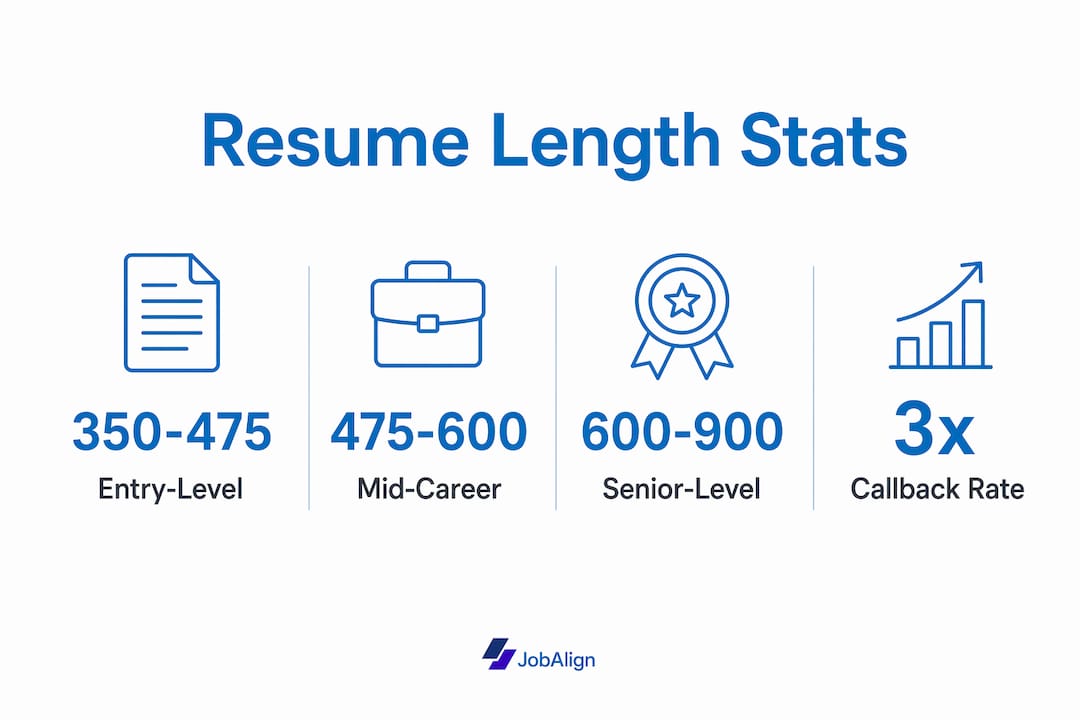
One page is the right call here. Your experience base does not yet justify a second page, and recruiters expect brevity from early-career applicants. Aim for 350–475 words. That range keeps your resume tight without leaving it looking sparse.
- Focus on internships, academic projects, and transferable skills.
- List relevant coursework only if it directly supports the role.
- Use a clean, single-column layout to maximize readability.
- Avoid padding with generic soft skills like “team player” or “hard worker.”
Mid-career candidates (2–10 years)
One to two pages works well here, with a target of 475–600 words. This is the sweet spot where the word count research is most decisive. If you push to a second page, apply the page-2 fullness test: page 2 should be at least two-thirds full of relevant content. A half-empty second page signals poor editing, not deep experience.
- Lead with your two or three most recent roles.
- Quantify achievements with numbers, percentages, or dollar figures.
- Cut roles older than ten years unless they are directly relevant.
Senior and executive candidates (10+ years)
Two pages is the standard, and in some cases a third page is justified. Two-page resumes earn 2.9x more callbacks for managerial candidates. Senior candidates should compress early-career roles into brief summaries and use the freed space to quantify leadership impact. Target 550–700 words.
Industry exceptions exist. Federal government resumes (called federal CVs) routinely run three to five pages. Academic CVs follow a different standard entirely and grow with publications and grants. Finance roles at the director level often expect two full pages of detailed deal history.
Pro Tip: If your second page has fewer than two-thirds of content filled, either cut to one page or add a relevant section like certifications, publications, or a key projects block.
How does word count affect resume effectiveness compared to page count?
Word count predicts interview callback rates more reliably than page count. A tightly formatted one-page resume can hold 500 words, while a loosely formatted two-pager might contain only 350. Formatting and word count together determine readability and recruiter engagement far better than page numbers alone.
The table below shows how word count maps to career stage and expected outcomes.
| Career stage | Target word count | Expected outcome |
|---|---|---|
| Entry-level (0–2 years) | 350–475 words | Clean, focused impression for junior roles |
| Mid-career (2–10 years) | 475–600 words | Highest callback rate based on 2026 research |
| Senior/executive (10+ years) | 550–700+ words | Demonstrates depth without padding |
Loose formatting inflates perceived length without adding value. Wide margins, large fonts, and excessive white space push word count down while pushing page count up. That combination hurts you on both fronts: recruiters see a thin document, and ATS systems find fewer keywords to score.
Pro Tip: Set your margins to 0.75 inches on all sides and use an 10.5 or 11-point font. This gives you more usable space without making the page feel cramped.
Why does content relevance matter more than strict length rules?
Relevance beats length every time. Recruiters spend an average of 11.2 seconds on an initial resume review, scanning for proof that you fit the role. Padding your resume with unrelated jobs, generic responsibilities, or outdated skills buries the qualifications that actually matter.
Adding pages only helps when the content on those pages is directly relevant to the target job. A third page of irrelevant internships from fifteen years ago does not strengthen your application. It dilutes it.
Tailoring your resume for each application is the single most effective way to control both length and relevance. Here is how to decide what stays and what goes:
- Keep it if the experience directly supports a requirement in the job description.
- Cut it if it has not been relevant to any role you have held in the last five years.
- Condense it if it provides useful context but is not a primary selling point.
- Quantify it if you are keeping it. Numbers make achievements scannable and credible.
- Mirror the job description language to align your resume with the specific keywords the employer used.
You can find practical guidance on resume tailoring strategies that apply these principles across different industries and experience levels.
How to optimize your resume length and format for ATS
Applicant Tracking Systems scan your resume before a human ever sees it. Approximately 75% of resumes are rejected by ATS before reaching a recruiter. Length and formatting both affect how well an ATS parses your content.
Concise, scannable resumes remain the standard even as ATS technology advances. A resume that is too long without relevant keywords gives the system less signal per word. A resume that is too short may not contain enough keyword matches to score well.
Follow these formatting rules to pass both ATS filters and human review:
- Use standard section headings: “Work Experience,” “Education,” “Skills.” Avoid creative labels like “My Story” or “Where I’ve Been.”
- Save your file as a .docx or PDF, depending on what the job posting specifies.
- Avoid tables, text boxes, headers, and footers. ATS systems often skip content inside these elements.
- Place keywords from the job description naturally throughout your bullet points, not just in a skills block.
- Keep bullet points to one or two lines. Long paragraphs reduce scannability for both ATS and humans.
Understanding how ATS screening works helps you make smarter decisions about which keywords to prioritize and where to place them.
Pro Tip: Run your resume through an ATS keyword check before submitting. Compare your resume’s language directly against the job description and add missing terms where they fit naturally.
Practical steps for deciding your resume length
Getting your resume to the right length is an editing process, not a guessing game. Work through these steps in order.
- Start with a brain dump. Write out every role, achievement, and skill without worrying about length. You need raw material before you can edit.
- Apply the career-stage filter. Use the experience tiers above to set your target word count and page limit.
- Run the relevance test. For each bullet point, ask: does this directly support a requirement in the job description? If not, cut or condense it.
- Apply the page-2 fullness test. If you are at two pages, check that page 2 is at least two-thirds full. If it is not, cut back to one page or add a relevant section.
- Quantify your top achievements. Replace vague descriptions with numbers. “Managed a team” becomes “Managed a team of 12 engineers across three product lines.”
- Check your word count. Paste your resume text into a word counter. If you are outside your target range, edit until you land within it.
- Review formatting last. Adjust margins and font size only after content editing is complete. Formatting should serve content, not substitute for it.
For additional guidance on resume tips for 2026, including how to structure each section for maximum recruiter impact, we have a detailed breakdown worth bookmarking.
Key Takeaways
Resume length is most effective when it reflects your career stage, targets 475–600 words for mid-career roles, and prioritizes relevant content over raw page count.
| Point | Details |
|---|---|
| Career-stage tiers | Match page count to experience: one page for 0–2 years, one to two for 2–10, two for 10+. |
| Word count over page count | Resumes with 475–600 words generate twice the callbacks of those outside this range. |
| Page-2 fullness test | A second page must be at least two-thirds full of relevant content to justify its existence. |
| Relevance beats length | Recruiters spend 11.2 seconds scanning for fit; padding buries your strongest qualifications. |
| ATS formatting rules | Use standard headings, avoid text boxes, and mirror job description keywords throughout. |
The one-page rule is outdated advice
I have reviewed a lot of resume guidance over the years, and the “always keep it to one page” rule is the most persistent piece of bad advice in the industry. It made sense decades ago when printing costs and physical filing mattered. It does not hold up against current recruiter behavior data.
The research is clear. Experienced candidates who compress everything onto one page often sacrifice their strongest achievements to meet an arbitrary limit. That is the wrong trade. A two-page resume that is tight, relevant, and well-formatted will outperform a cramped one-pager almost every time for candidates with five or more years of experience.
What I find job seekers get wrong most often is the opposite problem: they add a second page to look more experienced, then fill it with filler. Generic job duties, outdated roles, and soft skill lists do not impress recruiters. They signal that you did not edit carefully.
The real skill is intentional editing. Every line on your resume should earn its place by proving you can do the specific job you are applying for. If a bullet point does not connect to the job description, it is costing you space and recruiter attention. Cut it, and use that space for a quantified achievement that does connect.
The best resume practices are not about hitting a page count. They are about making every word count.
— Johan
Jobalign makes resume length decisions easier
Getting resume length right for every application is hard when you are applying to multiple jobs with different requirements. Jobalign’s LinkedIn resume generator syncs with your LinkedIn profile and builds a tailored, ATS-optimized resume for each specific job posting. It pulls only the experiences and skills relevant to that role, which naturally keeps your resume within the right word count and page range. Jobalign reports an 87% ATS pass rate for resumes it generates. You can also browse ATS-ready resume examples by job type to see how length and formatting translate across different industries and career stages.
FAQ
How long should a resume be for most job seekers?
Most job seekers should target one page for 0–2 years of experience and one to two pages for 2–10 years. Candidates with 10 or more years of relevant experience typically need two pages.
What is the ideal word count for a resume?
Resumes containing 475–600 words generate twice the interview callbacks compared to resumes outside this range, making word count a more reliable target than page count alone.
Does a two-page resume hurt your chances with ATS?
A two-page resume does not hurt ATS performance if it is formatted correctly and filled with relevant keywords. ATS systems parse content, not page numbers, so relevance and formatting matter more than length.
What is the page-2 fullness test?
The page-2 fullness test requires that your second page be at least two-thirds full of relevant content. A trailing half-page signals poor editing and weakens your overall impression with recruiters.
Should senior candidates always use two pages?
Two-page resumes earn 2.9x more callbacks for managerial candidates, so yes, senior and executive job seekers should plan for two pages. Compress early-career roles into brief summaries and use the space to quantify leadership achievements.