The Role of Professional Summary Explained for Job Seekers

A professional summary is a concise paragraph, placed at the top of your resume directly under your contact information, that highlights your key skills, achievements, and relevant experience for a specific role. The role of professional summary explained simply: it tells recruiters in seconds why you are worth reading further. Recruiters scan resumes for just seconds, and a well-crafted summary captures their attention by presenting your strongest qualifications upfront. Get this section right, and every other part of your resume gets a fair shot. Get it wrong, and your application may never be read at all.
Why does a professional summary matter for your application?
The importance of a professional summary goes beyond first impressions. It functions as a rapid introduction that signals your fit for the role before a recruiter reads a single bullet point in your work history. A focused summary improves recruiter interest and encourages continued reading. That effect compounds in competitive markets where hundreds of applications arrive for a single opening.
The second reason the summary matters is Applicant Tracking Systems, or ATS. Most large employers route resumes through ATS software before a human ever sees them. Keyword optimization in professional summaries increases resume visibility and relevance inside these systems. Approximately 75% of resumes are rejected by ATS before reaching a recruiter, according to Jobalign’s own data. Placing the right keywords in your summary gives your resume its best chance of clearing that filter.

A professional summary also does something a resume objective cannot. A resume objective focuses on what the candidate wants, while a professional summary focuses on what they offer. Employers prioritize what you bring to the role. Framing your opening around your value, not your goals, immediately aligns you with how hiring managers think.
Here is what a strong summary accomplishes at a glance:
- Signals role fit within the first few lines of your resume
- Passes ATS keyword scans by mirroring job description language
- Differentiates you from candidates with similar experience levels
- Gives recruiters a reason to read your full work history
Pro Tip: Paste the job description into a text tool and identify the three to five most repeated skills or qualifications. Use those exact words in your summary. ATS software matches strings, not synonyms.
How does experience level change your professional summary?
Not every job seeker should write the same type of summary. The structure, tone, and content shift significantly depending on how much relevant experience you have.
Professionals with five or more years of relevant experience in the same field should use a results-heavy summary. That means quantified achievements, specific job titles, and industry-recognized skills. A senior marketing manager, for example, might open with: “Results-driven marketing leader with eight years driving B2B demand generation, including a 40% pipeline increase at a SaaS company.” Every word earns its place.
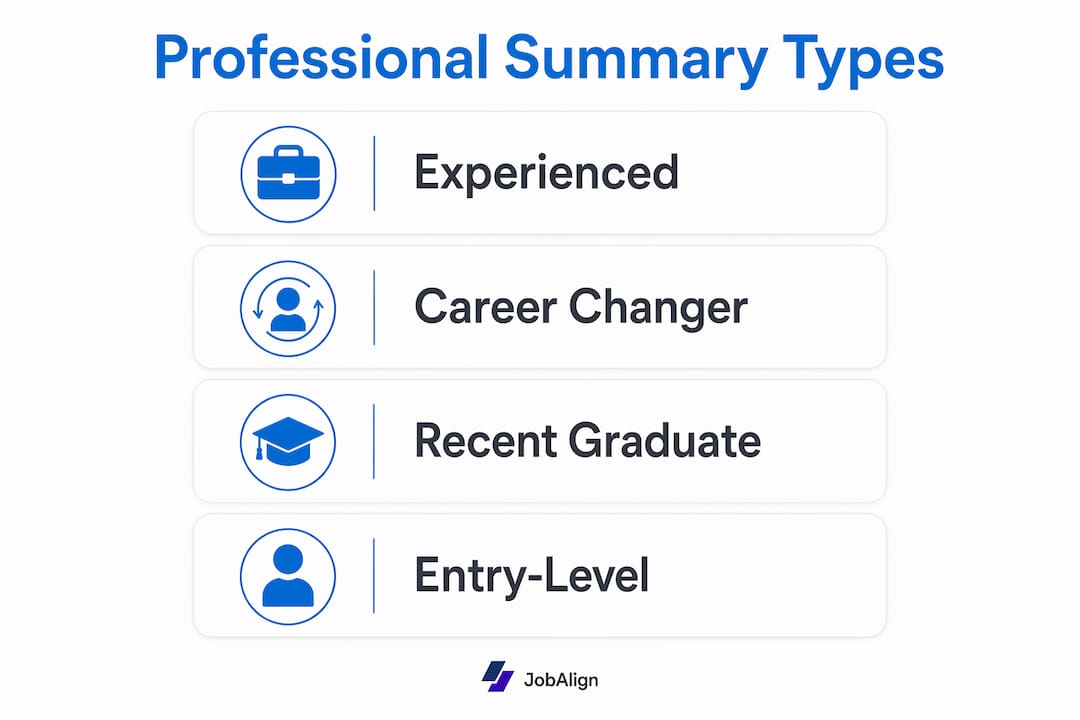
Recent graduates and career changers need a different approach. Personal statements focusing on transferable skills and motivation work better for this group than a results-heavy format. A recent finance graduate might write: “Detail-oriented finance graduate with hands-on experience in financial modeling through a competitive internship at a regional investment firm, seeking to apply analytical skills in a corporate treasury role.” The tone is forward-looking, not backward-looking.
There is also a case for skipping the summary entirely. Job seekers with fewer than two years of experience may hurt their application if their summary restates obvious information without concrete achievements. If you have no internships, no notable projects, and no measurable results to reference, a summary can read as filler. In that case, let your education and skills sections carry the opening.
| Career stage | Recommended format | Core focus |
|---|---|---|
| Experienced professional (5+ years) | Results-heavy summary | Quantified achievements, specific titles |
| Recent graduate | Personal statement style | Transferable skills, academic projects |
| Career changer | Transferable skills summary | Relevant overlap, motivation, new direction |
| Entry-level with strong internship | Brief achievement summary | One or two concrete results |
Pro Tip: If you are a career changer, lead with the skill that transfers most directly to the new role. Do not open with your old job title. Open with the capability the employer actually needs.
What are best practices for writing a powerful professional summary?
Writing a strong summary follows a clear process. These steps apply whether you are an experienced professional or a recent graduate.
-
Write your summary last. Writing the summary after completing the main resume body lets you pull concrete achievements and verified skills directly from your content. You will write a sharper summary when you have the full picture in front of you.
-
Keep it to two to four sentences. A summary is not a biography. It is a hook. Two focused sentences beat a paragraph of vague claims every time. Recruiters do not have time for more, and ATS systems do not reward length.
-
Mirror the job description. Use the exact language the employer uses. If the posting says “cross-functional collaboration,” use that phrase, not “teamwork.” This serves both the ATS keyword scan and the human reader who wrote the job description.
-
Lead with your strongest qualifier. Your most impressive credential, whether that is a job title, a measurable result, or a specialized certification, belongs in the first sentence. Do not bury it.
-
Include at least one quantified result. Numbers anchor your claims. “Increased sales by 30%” is more credible than “strong sales background.” Even a single metric transforms a generic statement into evidence.
-
Cut anything generic. Phrases like “hardworking team player” or “excellent communicator” appear on thousands of resumes. They add no signal. Replace them with specific skills or results that only you can claim.
Common mistakes to avoid:
- Copying the same summary across every application without tailoring it
- Using first-person pronouns (“I am a dedicated professional”)
- Including irrelevant experience that does not connect to the target role
- Writing in passive voice (“responsibilities included”) instead of active voice (“led,” “built,” “delivered”)
Pro Tip: Read your summary aloud. If it sounds like a job posting rather than a person, rewrite it. The best summaries sound like a confident professional speaking directly to a hiring manager.
Can you see examples of effective professional summaries?
Concrete examples make the difference between understanding a concept and actually applying it. Here are four sample summaries, each built for a different career stage, along with a breakdown of why each one works.
Experienced professional (project manager, 10 years): “PMP-certified project manager with 10 years delivering enterprise software implementations on time and under budget. Led cross-functional teams of up to 25 across three continents, reducing average project overrun by 18%.”
This works because it leads with a recognized credential (PMP), uses a quantified result, and names a specific scope of work. Technical recruiters scanning for ATS keywords in developer and project roles will find exactly what they need.
Recent graduate (marketing, no full-time experience): “Marketing graduate with hands-on experience in social media strategy and content creation through a semester-long agency internship. Passionate about data-driven campaigns and eager to contribute to a growth-focused team.”
This works because it anchors the summary in a real experience (the internship), names two specific skills, and uses forward-looking language appropriate for an entry-level candidate.
Career changer (teacher moving into corporate training): “Former high school educator with seven years of curriculum design and classroom facilitation, transitioning into corporate learning and development. Skilled in adult learning principles, LMS platforms, and performance-based assessment.”
This works because it reframes teaching experience using corporate vocabulary. The candidate does not hide their background. They translate it.
Entry-level with a notable achievement: “Computer science graduate who built a machine-learning model that reduced customer churn prediction error by 22% in a capstone project. Seeking a junior data analyst role where Python and SQL skills can drive business decisions.”
This works because one strong result replaces the need for years of experience. A summary of qualifications in bullet format can also work here for candidates with multiple strong projects to list.
| Example type | Key strength | What makes it stand out |
|---|---|---|
| Experienced professional | Quantified result + credential | Specific scope and measurable impact |
| Recent graduate | Real experience anchor | Internship grounds the claims |
| Career changer | Vocabulary translation | Reframes old skills in new language |
| Entry-level achiever | Single strong result | One metric replaces years of experience |
Adapt these templates to your own background. The structure matters more than the exact wording. What technical recruiters look for in summaries is specificity, relevance, and evidence. Generic templates without personalization fail all three tests.
Key Takeaways
A professional summary is the single highest-impact section of your resume because it determines whether a recruiter reads further and whether ATS software ranks your application as relevant.
| Point | Details |
|---|---|
| Position and purpose | Place your summary at the top of the resume to signal fit within the first seconds of review. |
| ATS keyword alignment | Mirror job description language in your summary to pass automated filters before a human reads your resume. |
| Tailor by experience level | Use results-heavy summaries for 5+ years of experience; use transferable skills framing for graduates and career changers. |
| Write it last | Draft your summary after completing the resume body so you can draw from verified achievements. |
| Skip it when it adds nothing | Omit the summary if you lack concrete anchors like internships or measurable results. |
Why most job seekers misuse the professional summary
Here is what I have observed after years of watching job seekers struggle with this section: most people treat the summary as an introduction to themselves rather than a pitch to the employer. That single misunderstanding produces every bad summary I have ever read.
The summary is not about who you are. It is about what you solve. The moment you write “I am a passionate and dedicated professional,” you have already lost the recruiter. Passion is not a qualification. Dedication is not a result. Neither tells a hiring manager what problem you fix.
The other mistake I see constantly is the copy-paste summary. One version, sent to every employer, tailored to no one. This approach fails on two levels. First, it rarely contains the exact keywords the ATS is scanning for. Second, it signals to a human reader that you did not bother to read their job description. Both outcomes hurt you.
The summary also sits in an interesting relationship with your LinkedIn profile and cover letter. Sara Duerr notes that the summary’s density and focus distinguish it from the cover letter, which is intended for personal narrative and context. Your LinkedIn headline and About section serve a different purpose again. Treat each as a separate tool with a separate job. Do not copy your LinkedIn About section into your resume summary and call it done.
My honest advice: write your summary as if you have 15 seconds with the hiring manager in an elevator. What is the one thing you want them to remember? Build your summary around that single claim. Then add one number to prove it. That is the whole formula. Everything else is noise.
— Johan
How Jobalign helps you build a summary that actually gets read
Writing a tailored summary for every application takes time, and most job seekers either skip the tailoring or default to a generic template. Jobalign’s LinkedIn resume generator solves this by syncing directly with your LinkedIn profile and building a customized resume, including a targeted professional summary, for each job you apply to. The platform’s ATS optimization technology carries an 87% success rate in passing automated filters. You get a fresh resume for every posting without complicated setup. If you want to see what a properly tailored summary looks like for your background, build your resume with Jobalign and compare it to what you have now.
FAQ
What is a professional summary on a resume?
A professional summary is a two-to-four sentence paragraph at the top of your resume that highlights your most relevant skills, experience, and achievements for a specific role. It is the first section recruiters read and the primary signal ATS software uses to rank your application.
How is a professional summary different from a resume objective?
A resume objective states what you want from a job, while a professional summary states what you offer an employer. Employers prioritize what candidates bring to the role, making the summary the stronger choice for most job seekers.
Should recent graduates include a professional summary?
Recent graduates benefit from a personal statement style that focuses on transferable skills, academic projects, and internship experience. Candidates with fewer than two years of experience and no concrete achievements should consider omitting the summary entirely to avoid restating obvious information.
How long should a professional summary be?
A professional summary should be two to four sentences. Brevity signals confidence and respects the recruiter’s time. Longer summaries dilute the impact of your strongest qualifications.
How do I tailor my professional summary for ATS?
Mirror the exact language from the job description in your summary, including specific skill names, job titles, and industry terms. ATS software matches strings, so synonyms and paraphrases often fail to register as matches.