The Role of Testimonials in Freelancer Resumes

Testimonials in freelancer resumes are specific client endorsements that validate your skills and achievements, making your candidacy more credible than self-reported claims alone. The role of testimonials in freelancer resumes goes far beyond a nice quote at the bottom of the page. Websites featuring testimonials see 34% higher conversion rates, and the same trust psychology applies directly to hiring decisions. When a recruiter reads that a past client saw measurable results from your work, your resume stops being a list of claims and becomes a record of verified outcomes.
How do testimonials bridge the trust gap in freelancer resumes?
Recruiters face a fundamental problem with freelancer applications: every candidate describes themselves as skilled, reliable, and results-driven. There is no employer on record to call. There is no performance review to request. Self-promotion without verification is easy to dismiss.

Social proof lowers perceived hiring risk by shifting the burden of proof from you to your clients. When a hiring manager reads a testimonial, they are not evaluating your opinion of yourself. They are reading someone else’s experience. That shift changes the entire dynamic of the application.
Specific, authentic testimonials do three things that bullet points cannot:
- They confirm that a real person paid you to do the work and was satisfied with the result.
- They translate your skills into business outcomes a recruiter can understand.
- They reduce the mental leap a hiring manager must make from “this person claims X” to “this person delivered X.”
“Recruiters trust peer endorsements significantly more than self-promotion. A testimonial from a verified client carries the weight of a reference without requiring a phone call.”
The psychological term for this is social proof, a concept documented extensively in consumer behavior research and now well established in hiring contexts. Recruiters treat peer validation as a shortcut for assessing risk. A freelancer with three strong client quotes signals lower hiring risk than one with none, even when their listed skills are identical.
Think of it this way: a testimonial turns your past client’s success into a predictive indicator of your future performance. That is exactly what a recruiter needs to justify moving your application forward.
What are best practices for incorporating testimonials in freelancer resumes?
The format and placement of testimonials matter as much as their content. A poorly placed quote creates clutter. A well-placed one reinforces your strongest work at exactly the right moment.
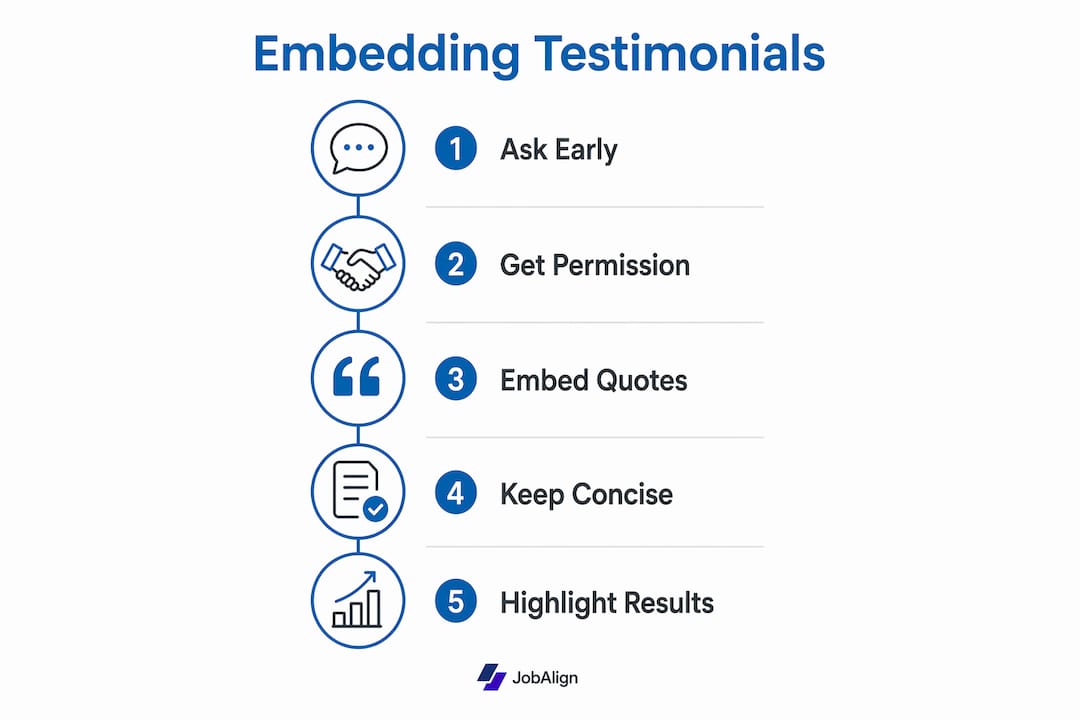
Follow these steps to embed testimonials effectively:
-
Group your freelance work into a unified “Professional Experience” block. Listing 3–5 strong client engagements under one section, rather than scattering them across the resume, gives recruiters a clean, readable career picture. It also signals that your freelance work was deliberate, not accidental.
-
Place one or two concise testimonials directly beneath the relevant project bullets. Never drop a quote at the end of the resume in a standalone section. Embedding it beneath the project it validates keeps the context clear and maintains ATS compatibility by avoiding formatting that parsers cannot read.
-
Use outcome-driven quotes, not character praise. “She delivered the redesign two weeks early and our conversion rate jumped 22%” is a testimonial. “Great to work with!” is noise. Outcome-driven testimonials with measurable results are far more persuasive than vague endorsements.
-
Get written permission before including any client name or quote. When a client cannot be named due to confidentiality, use a descriptor like “VP of Product at a Series A fintech” instead. Written permission protects both parties and keeps your resume legally and ethically sound.
-
Keep the total count to 3–5 testimonials across the full resume. Conversion impact peaks at around five testimonials and flattens after that. More quotes do not build more trust. They create visual noise that dilutes the strongest ones.
-
Rotate testimonials based on the role you are targeting. If you are applying for UX work, lead with your design client quotes. If you are targeting content strategy, swap in your editorial testimonials. Tailoring your resume version to the application is standard freelancer resume practice in 2026.
-
Link to your LinkedIn profile or portfolio when the format allows. A recruiter who wants more context should be able to find it in one click. LinkedIn recommendations reinforce the same testimonials in a verified, public format.
Pro Tip: Ask clients for testimonials immediately after project completion, while the results are fresh and the relationship is warm. A request sent two weeks after delivery gets a far higher response rate than one sent six months later.
Which common mistakes reduce the effectiveness of testimonials in freelancer resumes?
Most freelancers who use testimonials make at least one of these errors. Each one reduces the credibility the testimonial was meant to build.
-
Using vague praise. “Highly recommend” and “a pleasure to work with” tell a recruiter nothing about what you actually did. Modern hiring managers filter vague claims as noise and move on. Replace character praise with outcome statements.
-
Overloading the resume with quotes. Three strong testimonials outperform ten mediocre ones every time. Clutter signals poor editorial judgment, which is itself a red flag for roles requiring communication skills.
-
Including quotes without permission. Using a client’s name or words without written consent is an ethical violation and, in some cases, a legal one. Always confirm in writing before the resume goes out.
-
Misaligning testimonials with the target role. A quote about your speed as a data entry contractor does not help your application for a senior analytics position. Every testimonial you include should reinforce the specific value you are offering this employer.
-
Placing testimonials in a separate “References” section. This is the most common structural mistake. ATS systems often skip or misparse standalone reference sections. Embedding testimonials beneath project bullets keeps them contextual and machine-readable.
-
Ignoring ATS constraints entirely. Approximately 75% of resumes are rejected by ATS before a human ever reads them. A testimonial buried in a text box, table cell, or header will not be parsed. Plain text, standard fonts, and clean formatting are non-negotiable.
Pro Tip: Before sending any resume, paste the full text into a plain text editor. If the testimonials read clearly in that format, they will survive most ATS parsers.
How do testimonials create a cohesive career narrative across diverse freelance projects?
Freelancers often struggle with one specific resume problem: their work history looks scattered. A brand identity project here, a content audit there, a six-month UX engagement somewhere else. To a recruiter scanning quickly, that reads as random gigs rather than a deliberate career.
Testimonials help freelancers build a cohesive narrative from varied projects by connecting outcomes across different clients. When three different clients all describe you as someone who “clarified complex problems and delivered clean solutions,” a pattern emerges. That pattern is your professional identity.
Grouping freelance projects under a unified section with embedded testimonials helps recruiters see a career arc instead of a list of jobs. The testimonials act as connective tissue between projects that might otherwise appear unrelated.
Here is how to use testimonials strategically for career storytelling:
- Select testimonials that share a common theme. If your strength is turning ambiguous briefs into clear deliverables, find quotes from clients who describe exactly that, regardless of the industry.
- Tailor your resume version to the target sector. A fintech client’s testimonial carries more weight in a fintech application than a retail one. Build two or three resume versions and match the testimonials to the audience.
- Use client attribution to signal the caliber of your work. “Director of Engineering at a Series B SaaS company” tells a recruiter more than a first name alone.
- Let the testimonials answer the “so what” question. Every project bullet should describe what you did. The testimonial beneath it should describe why it mattered.
For tech freelancers specifically, the way testimonials link projects into a career narrative mirrors the kind of storytelling described in full stack developer career guides, where demonstrating breadth through verified outcomes is more persuasive than listing technologies.
| Narrative goal | Testimonial strategy |
|---|---|
| Prove consistent quality | Select quotes that mention reliability or results across different clients |
| Signal niche expertise | Use testimonials from clients in your target industry |
| Show career progression | Order testimonials chronologically with increasing scope |
| Demonstrate soft skills | Include quotes that mention communication, clarity, or leadership |
Key Takeaways
Testimonials are the single most credible element a freelancer can add to a resume because they replace self-promotion with verified client outcomes.
| Point | Details |
|---|---|
| Embed, don’t append | Place testimonials beneath relevant project bullets, never in a standalone references section. |
| Outcomes beat praise | Use quotes that mention specific results, not generic character endorsements. |
| Limit to 3–5 quotes | More testimonials dilute impact; quality and relevance matter more than volume. |
| Get written permission | Always confirm consent before using a client’s name or words on your resume. |
| Align to the target role | Rotate testimonials by application to match the skills and outcomes each employer values. |
Why most freelancers are sitting on their most persuasive resume asset
I have reviewed hundreds of freelancer resumes over the years, and the pattern is almost universal: the candidate has done genuinely impressive work, their clients loved them, and none of that shows up on the page. What I see instead is a list of deliverables that reads like an invoice.
The uncomfortable truth is that most freelancers treat testimonials as optional extras, something to add if they happen to have them. The reality is the opposite. A well-placed client quote is the hardest thing for a recruiter to dismiss. It is not your opinion. It is someone else’s money and their willingness to say publicly that you were worth it.
My advice: start collecting testimonials proactively, not reactively. Build the ask into your project close-out process the same way you build in a final invoice. Keep a running document of the best quotes you receive. When you sit down to build a tailored resume for a specific application, you will have a library to draw from rather than scrambling to remember who said what.
One more thing worth saying plainly: ATS trends are not going away. The formats that work in 2026 require clean, machine-readable text. Testimonials embedded in tables, text boxes, or image files will not survive parsing. Get the format right, or the quote never reaches a human reader. Authenticity matters, but only if the resume gets through the filter first.
— Johan
Jobalign makes testimonial-ready resumes faster
Freelancers who want to put these practices to work immediately have a real advantage with Jobalign. The platform syncs directly with your LinkedIn profile, pulls your relevant experience and skills, and generates ATS-optimized resumes tailored to each job application. That means you spend your time selecting the right testimonials and outcomes, not reformatting the same document from scratch. Jobalign’s technology carries an 87% ATS pass rate, so the resume you build with embedded client quotes actually reaches a recruiter. You can also explore resume examples by job type to see how testimonials fit into well-structured, ATS-ready layouts before you start writing.
FAQ
What is the role of testimonials in freelancer resumes?
Testimonials provide verified social proof that validates your skills and outcomes, replacing unverifiable self-promotion with client-confirmed results. They increase recruiter confidence and reduce perceived hiring risk.
How many testimonials should a freelancer include on a resume?
Three to five strong, outcome-focused testimonials deliver the highest impact. Conversion value peaks around five and flattens after that, so prioritize quality over quantity.
Where should testimonials be placed on a freelancer resume?
Place one or two concise quotes directly beneath the relevant project bullets in your experience section. Never use a standalone references section, as ATS systems often fail to parse it correctly.
Do I need client permission to use a testimonial on my resume?
Yes. Written client permission is required before including any name or quote. If a client needs anonymity, use a role descriptor such as “Head of Marketing at a Series A startup” instead.
What makes a testimonial effective in a job application?
Effective testimonials mention specific outcomes, metrics, or business impact rather than general praise. Outcome-driven quotes outperform vague endorsements because they give recruiters concrete evidence of your value.