What Is a Hybrid Resume Format? Your 2026 Guide

A hybrid resume format is defined as a resume style that combines a functional skills section with a reverse-chronological work history. Also called a combination resume, it leads with your strongest competencies and follows with a clear career timeline. This structure serves two audiences at once: Applicant Tracking Systems (ATS) scanning for keywords and recruiters who need to assess your experience fast. Approximately 75% of resumes are rejected by ATS before a human ever reads them. The hybrid format directly addresses that problem by front-loading the keywords ATS filters look for while preserving the career timeline employers expect.
What is a hybrid resume format and how is it structured?
A hybrid resume combines keyword-rich skills with clear chronological work history, giving it a structural advantage over both pure formats. A purely functional resume hides your timeline, which frustrates recruiters and raises red flags in ATS systems. A purely chronological resume buries your skills inside job descriptions, making it harder for ATS filters to score you accurately.
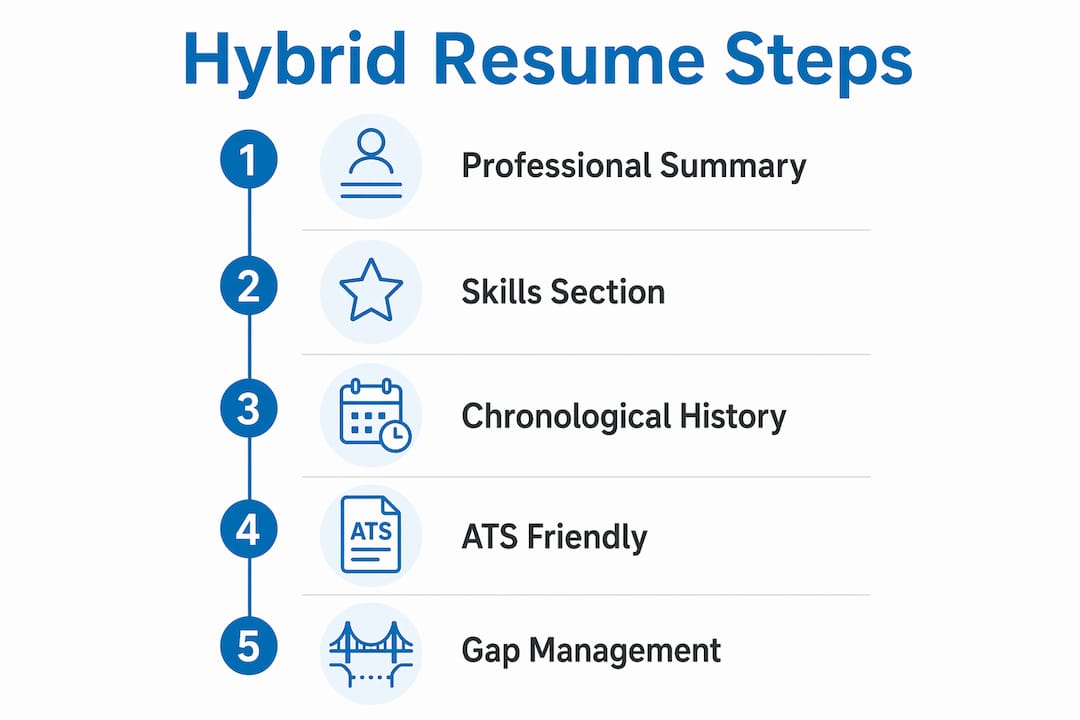
The hybrid format solves both problems. It opens with a professional summary, moves into a dedicated skills section, and then presents your work history in reverse chronological order. This layout fits comfortably within one to two pages, which matters because recruiters spend roughly 6–7 seconds on an initial resume scan.

| Section | Content | Purpose |
|---|---|---|
| Contact information | Name, phone, email, LinkedIn URL | Basic identification |
| Professional summary | 2–4 sentences on your value proposition | Hook the recruiter immediately |
| Skills | Grouped categories with bullet points | Pass ATS filters and signal competency |
| Work experience | Reverse-chronological job history with achievements | Prove your track record |
| Education | Degrees, institutions, graduation years | Meet baseline requirements |
| Certifications / extras | Licenses, awards, languages | Add supporting credibility |
Pro Tip: Group your skills by category, such as “Project Management,” “Data Analysis,” or “Client Relations.” Grouped skills are easier for ATS systems to parse and faster for recruiters to scan.
The skills section is the heart of the hybrid format. It should contain the exact keywords from the job posting, organized into two to four logical categories. Each category gets three to six bullet points. Keep each bullet to a single skill or tool, not a full sentence.
What are the advantages of a hybrid resume over other formats?
The hybrid format outperforms both the chronological and functional formats for most mid-career job seekers. It is ideal for mid-level professionals and career changers because it balances skill visibility with a credible work history. Neither of the single-format alternatives achieves both goals simultaneously.
Here is a clear breakdown of the pros and cons:
Advantages:
- Passes ATS filters more reliably because skills keywords appear in a dedicated, scannable section
- Preserves the career timeline employers expect, unlike a purely functional format
- De-emphasizes employment gaps by leading with skills before the reader reaches your dates
- Highlights transferable skills for career changers without hiding their history
- Works across industries, from technology to healthcare to finance
Disadvantages:
- Can run long if you do not edit tightly, which risks losing recruiter attention
- Conservative recruiters may prefer a pure chronological format, especially in traditional industries like law or banking
- Not ideal for entry-level candidates who lack a strong skills portfolio to lead with
Pro Tip: If you are applying to a highly traditional field, research the company culture before choosing the hybrid format. A law firm with a 40-year history may respond better to a clean chronological layout.
The gap-management benefit deserves special attention. The hybrid format does not hide gaps. It strategically shifts focus to skills first, so the recruiter forms a positive impression of your competency before they reach your dates. That sequence matters psychologically.
How to create a hybrid resume step by step
Building a strong hybrid resume follows a clear sequence. Skipping steps or reordering sections reduces both ATS scores and recruiter impact.
-
Write your contact information. Include your full name, phone number, professional email address, and your LinkedIn profile URL. Keep this block clean and at the very top.
-
Draft a professional summary. Write two to four sentences that state your job title, years of experience, and your top two or three value points. Tailor this summary to each job posting. Use the exact job title from the posting if it accurately describes you.
-
Build your skills section. Pull keywords directly from the job description. Incorporating job posting keywords naturally into skills and summary sections increases your chances of passing ATS filters. Group skills into two to four categories. Use bullet points, not paragraphs.
-
Write your work experience section. List jobs in reverse chronological order, starting with your most recent role. For each position, include your job title, company name, location, and dates of employment. Under each role, write three to five bullet points focused on measurable achievements.
-
Quantify your impact. Use action verbs and quantify impact in experience bullets for maximum effect. “Managed a team” is weak. “Led a 12-person team that reduced project delivery time by 20%” is strong. Numbers give recruiters a concrete sense of scale.
-
Add education and certifications. List your highest degree first. Include certifications that are directly relevant to the role. Skip certifications that are outdated or unrelated.
-
Tailor the entire document to the job posting. A generic hybrid resume is only marginally better than a generic chronological one. Tailoring your resume to a specific job description is the single highest-impact step you can take before submitting.
-
Format for readability. Clear headings, bullet points, and logical flow improve recruiter engagement. Use a standard font like Arial or Calibri at 10–12 points. Leave white space between sections. Avoid tables, text boxes, or graphics inside the document body, as these can break ATS parsing.
Pro Tip: Save your resume as a .docx file unless the posting specifically requests a PDF. Many ATS systems parse Word documents more accurately than PDFs.
The most common structural mistake is redundancy between the skills section and the experience section. Effective hybrid resumes use the skills section for high-level competencies and the experience section for specific outcomes. If your skills section says “Data Analysis” and your experience section also just says “performed data analysis,” you have wasted space. The experience bullet should say what you analyzed, how you analyzed it, and what changed as a result.
For role-specific examples, the developer resume guide and the HR manager resume guide both show how to apply this structure to specific industries.
Hybrid resume examples and best practices
A strong hybrid resume looks different from a weak one in very specific ways. The table below shows the most common contrast points.
| Element | Strong example | Weak example |
|---|---|---|
| Skills section | Grouped by category, 4–6 bullets each | Flat list of 20 unrelated skills |
| Experience bullet | “Increased sales pipeline by 35% in Q3 2025” | “Responsible for sales activities” |
| Professional summary | Tailored to the job title and top requirements | Generic two-sentence career overview |
| Keywords | Pulled directly from the job posting | Generic industry terms not in the posting |
| Length | One to two pages, tight editing | Three pages with repeated information |
Common mistakes job seekers make with the hybrid format:
- Repeating the same bullet points in both the skills section and the experience section
- Listing skills without grouping them, which reduces ATS readability
- Writing a professional summary that reads like an objective statement from 1995
- Using a creative or graphic-heavy template that breaks ATS parsing
Pro Tip: Run your finished resume through an ATS compatibility check before submitting. Even a well-structured hybrid resume can fail if the file format or fonts are not machine-readable.
Industry-specific tailoring matters more than most job seekers realize. A hybrid resume for a software engineer should group skills under headers like “Programming Languages,” “Frameworks,” and “DevOps Tools.” A hybrid resume for a marketing manager should group under “Campaign Management,” “Analytics Platforms,” and “Content Strategy.” The structure is the same. The vocabulary is entirely different.
Key Takeaways
The hybrid resume format is the most effective structure for mid-level professionals and career changers because it passes ATS filters and satisfies recruiter expectations in a single document.
| Point | Details |
|---|---|
| Hybrid resume definition | A combination of functional skills and reverse-chronological work history in one document. |
| ATS compatibility | A keyword-rich skills section placed early in the document increases ATS scoring. |
| Gap management | Leading with skills shifts recruiter focus to competency before employment dates appear. |
| Avoid redundancy | Use the skills section for categories, the experience section for measurable achievements. |
| Tailor every application | Match skills and summary keywords to each specific job posting for best results. |
Why the hybrid format changed how I read resumes
I have reviewed thousands of resumes across hiring cycles in marketing, operations, and technology. The single most consistent pattern I see is this: candidates with genuinely strong backgrounds get screened out because their resume format works against them, not because of their actual qualifications.
The chronological format punishes career changers and anyone with a gap. The functional format frustrates recruiters who cannot quickly verify a candidate’s timeline. The hybrid format is the only structure that respects both the machine and the human in the process.
What I find most job seekers get wrong is the skills section. They treat it as a keyword dump. A flat list of 25 skills with no grouping tells a recruiter nothing about how those skills connect. Grouped categories, by contrast, tell a story. “Data Analysis: SQL, Python, Tableau, Power BI” communicates depth and specialization in four words and four tools.
The other mistake I see constantly is a professional summary that could belong to anyone. “Results-driven professional with 10 years of experience seeking a challenging role” is noise. A strong summary names the exact role, the specific industry, and one concrete result. That is three sentences of real signal.
My honest advice: treat your hybrid resume as a living document. Update the skills section every time you finish a project or earn a certification. Retailor the summary and keywords every time you apply. A resume that worked six months ago may not match the language a new posting uses today. The format gives you the structure. You have to keep the content current.
— Johan
How Jobalign builds your hybrid resume automatically
Crafting a tailored hybrid resume for every application takes real time. Most job seekers either submit the same generic document repeatedly or spend hours manually adjusting keywords and summaries.
Jobalign solves this by syncing directly with your LinkedIn profile and generating a fully tailored, ATS-optimized resume for each job you apply to. Its technology extracts your relevant experience, matches it to the job posting’s keywords, and structures the output in a clean, machine-readable format. Jobalign reports an 87% success rate at passing ATS filters. You can generate a resume for every posting without complicated setup. Start with Jobalign’s LinkedIn resume generator and see how a properly structured hybrid resume performs against the roles you actually want.
FAQ
What is the difference between a hybrid and a combination resume?
A hybrid resume and a combination resume are the same format. Both terms describe a resume that leads with a skills section and follows with a reverse-chronological work history.
Who benefits most from a hybrid resume format?
Mid-level professionals, career changers, and candidates with employment gaps benefit most. The format highlights transferable skills before presenting the work timeline.
How long should a hybrid resume be?
A hybrid resume fits best on one to two pages. Two pages is acceptable for candidates with ten or more years of relevant experience.
Does the hybrid format work with ATS systems?
Yes, when formatted correctly. A keyword-rich skills section placed early in the document helps ATS systems score the resume accurately, provided the file uses a standard format without graphics or text boxes.
What is the biggest mistake to avoid in a hybrid resume?
Repeating the same information in both the skills section and the experience section. Use skills for high-level competency categories and experience bullets for specific, quantified achievements.