What Is an Optimized Job Application? 2026 Guide

An optimized job application is defined as a document precisely tailored to a single job description, matching the employer’s exact language, prioritized skills, and ATS-compatible formatting. Generic resumes fail at an alarming rate. Approximately 75% of resumes are rejected by Applicant Tracking Systems before a human ever reads them. That number alone explains why understanding what makes a job application effective is no longer optional. This guide breaks down how ATS systems work in 2026, what strategies actually move the needle, and how to build a repeatable system that gets you interviews.
What is an optimized job application, exactly?
An optimized job application is tailored to a single job description, matching prioritized skills, exact terminology, and ATS-friendly formatting such as single-column .docx files without tables. The industry term for this practice is ATS optimization, and it covers both the content and structure of your resume. Think of it as writing two documents in one: a resume that a machine can parse cleanly and a recruiter finds compelling.
The core requirement is specificity. A resume that works for every job works for none. You update the professional summary, reorder your skills section, and mirror the job posting’s language for every single application. That level of customization is what separates a 5% callback rate from a 30% one.

How do modern ATS systems evaluate job applications?
ATS platforms have changed significantly. The old playbook of stuffing your resume with keywords no longer works. Modern ATS platforms use natural language processing to assess career context and measurable achievements, not just keyword counts. Keyword stuffing actively lowers your relevance score. That is a critical shift most job seekers have not caught up with yet.
Here is what current ATS systems actually evaluate:
- Career progression: Does your experience show logical growth toward the target role?
- Achievement orientation: Do your bullets describe outcomes, or just responsibilities?
- Language precision: Does your terminology match the job description’s exact phrasing?
- Formatting integrity: Can the parser extract your data without errors?
- Contextual relevance: Does the overall document read as a fit for this specific role?
Formatting errors like tables, text boxes, and multiple columns reduce parsing accuracy and ATS scores significantly. Modern AI parsers penalize structural ambiguity far more severely than older systems did. A beautifully designed resume with a two-column layout may score zero in an ATS because the parser reads columns left-to-right across the page, scrambling your content.
Pro Tip: Open your resume in a plain text editor. If the content reads in a logical order, your formatting is ATS-safe. If it looks scrambled, fix the layout before applying.
What strategies make a job application optimized for ATS and recruiters?
Effective job application strategies combine content customization with formatting discipline. Neither alone is enough. The professional summary and work experience bullets are the highest ATS-weighted resume sections for keyword placement. Start there.
Follow these steps for every application:
- Read the job description three times. On the first pass, note the required skills. On the second, mark repeated phrases. On the third, identify the outcomes the employer cares about most.
- Rewrite your professional summary. Use the job title from the posting and two or three of its top requirements. Keep it to three sentences.
- Mirror exact terminology. If the posting says “cross-functional collaboration,” use that phrase. Do not substitute “teamwork.” ATS systems match strings, and NLP models weight exact matches higher.
- Include synonyms strategically. Add one or two natural variants of key terms. A posting for a “software engineer” may also scan for “developer” or “programmer.”
- Replace responsibility bullets with achievement bullets. “Managed a team” becomes “Led a team of 8 engineers to deliver a product two weeks ahead of schedule.” Quantified results score higher with both ATS and human reviewers.
- Save as .docx. PDF rendering varies by ATS vendor. A .docx file gives you the most consistent parsing results across platforms.
- Use a single-column layout. No tables, no text boxes, no graphics. Clean, linear structure is machine-readable structure.
Pro Tip: Copy the job description into a word frequency tool. The words that appear most often are your primary keyword targets. Place them in your summary and your top two work experience bullets.
You can also follow a detailed resume tailoring workflow to apply these steps consistently across every application without starting from scratch each time.
What misconceptions about automated job applications should you avoid?
The biggest myth in job searching right now is that AI can fully automate your application materials. AI works best when used to polish and augment authentic, detailed applications rather than replacing them with generic automation. AI-generated content without real proof behind it reads as hollow to experienced recruiters. They see hundreds of applications a week and recognize templated language immediately.
Watch out for these common traps:
- Mass applying with one resume. Sending 200 applications with the same document produces near-zero results. The conversion math does not work in your favor.
- Treating AI output as a finished product. Use AI to draft, then edit heavily with your own voice, specific achievements, and real context.
- Confusing keyword presence with keyword relevance. Dropping a skill into your resume once without context does not convince an ATS or a recruiter that you actually have it.
- Ignoring the human layer. ATS filters narrow the pool, but a human recruiter makes the final call. Your resume must work for both audiences.
Applying 10 targeted, human-backed applications yields more interview opportunities than hundreds of generic submissions. That finding reframes the entire job search. Quality and targeting beat volume every time.
How can you build a system to optimize applications and increase interviews?
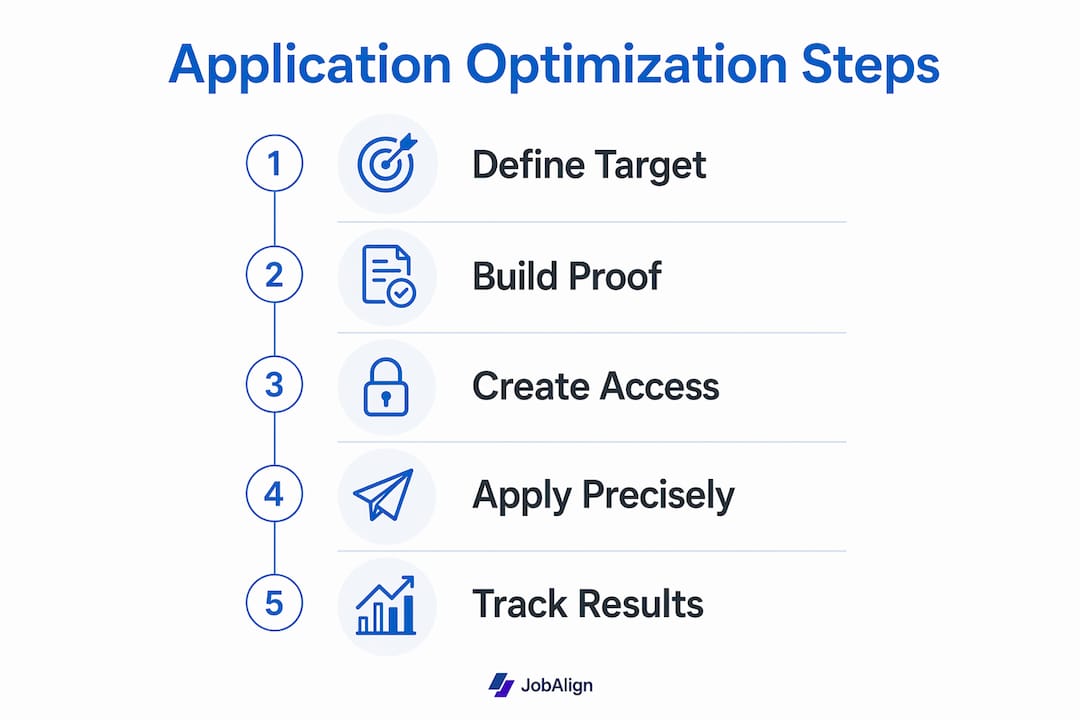
A system approach treats your job search like a project with measurable phases. Here is a framework that works:
Step 1: Define your target. Pick a specific role title and employer segment where your skills and the market’s demand overlap. Vague targets produce vague results.
Step 2: Build your proof layer. Create a master resume with every achievement, metric, and skill you have. This is your source document. Every tailored application pulls from it. Add a portfolio or reference letters where the role warrants them.
Step 3: Create warm access paths. Referral conversion rates near 40% vastly outperform cold applications, which convert at roughly 0.5%. That gap is enormous. Reach out to former colleagues, attend industry events, and connect with hiring managers on LinkedIn before applying. A referral turns your application from a cold document into a vouched submission.
Step 4: Apply selectively and precisely. For each role, pull the relevant proof from your master resume, tailor the summary and bullets, check formatting, and submit. Aim for quality over quantity. Ten well-targeted applications outperform a hundred generic ones.
Step 5: Track and learn. Build a simple spreadsheet with columns for company, role, date applied, ATS format used, and outcome. A weekly review focused on bottlenecks in your direction, proof, access, and application phases helps you identify what to fix. If you apply to 10 roles and get zero callbacks, the problem is likely your targeting or your resume content, not your effort level.
| Phase | Key Action | Success Indicator |
|---|---|---|
| Target | Define role and employer segment | Clear job title and 10+ target companies |
| Proof | Build master resume with quantified results | Every bullet has a metric or outcome |
| Access | Activate referrals and networking | At least one warm contact per application |
| Apply | Submit tailored, ATS-formatted resumes | Callback rate above 15% |
| Learn | Weekly review of application outcomes | Identified bottleneck per week |
Pro Tip: Use your LinkedIn profile as the foundation for your master resume. Jobalign syncs directly with LinkedIn to extract your experience and generate tailored, ATS-ready resumes for each role. It removes the manual rebuild work entirely.
For a deeper look at how to use AI tools within this system, the step-by-step AI resume guide covers the full workflow from LinkedIn profile to finished application.
Key Takeaways
An optimized job application combines precise language, ATS-safe formatting, and quantified proof to pass automated filters and earn attention from human recruiters.
| Point | Details |
|---|---|
| Tailor every application | Update your summary and skills section to match each job description’s exact language. |
| Format for machines first | Use single-column .docx files with no tables, text boxes, or graphics to avoid parsing errors. |
| Prioritize quality over volume | Ten targeted applications consistently outperform hundreds of generic submissions. |
| Use referrals aggressively | Referral conversion rates near 40% make warm access the highest-return activity in any job search. |
| Track outcomes weekly | A structured review of your application phases reveals bottlenecks and improves results over time. |
What I’ve learned after watching thousands of job seekers apply
Most job seekers treat their resume as a static document. They write it once, maybe update it every few years, and send the same version to every employer. That approach made sense in 2005. It does not work now.
What actually moves the needle is treating each application as a short consulting project. You research the employer, identify the three or four outcomes they care about most, and then build a document that speaks directly to those outcomes. That takes 30 to 45 minutes per application. Most people are not willing to do it. That unwillingness is your competitive advantage if you are.
The referral piece is the one most job seekers skip entirely. They spend hours perfecting their resume and zero time building the relationships that would make the resume almost irrelevant. A warm referral from a trusted employee changes the recruiter’s frame before they open your document. The resume then confirms what the referral already suggested.
My honest take: AI tools are genuinely useful for the drafting and formatting work. Where they fail is in generating the authentic, specific proof that recruiters find credible. Use AI to structure and polish. Use your own memory and records to supply the real achievements. The combination is hard to beat.
— Johan
Jobalign makes tailored, ATS-ready resumes faster
Building a tailored resume for every application is the right approach. The time cost is the real barrier. Jobalign removes that barrier by syncing with your LinkedIn profile and generating a customized, ATS-optimized resume for each job you apply to. Its proprietary technology places the right keywords in the right sections, applies clean machine-readable formatting, and produces a finished document in minutes. Jobalign reports an 87% ATS pass rate across its generated resumes. You can also choose from a library of ATS-optimized resume templates designed to pass modern parsers without sacrificing visual quality. Try the Jobalign LinkedIn resume generator and see how much faster your next application can be.
FAQ
What is an optimized job application?
An optimized job application is a resume and cover letter tailored to a single job description, using the employer’s exact terminology, ATS-safe formatting, and quantified achievement bullets to pass automated filters and appeal to human recruiters.
How do I know if my resume is ATS-friendly?
Paste your resume into a plain text editor. If the content reads in a clean, logical order without scrambled sections, your formatting is ATS-compatible. Avoid tables, text boxes, graphics, and multiple columns.
Does keyword stuffing still work in 2026?
No. Modern ATS platforms use natural language processing to evaluate career context and achievement orientation. Keyword stuffing lowers your relevance score rather than raising it.
How many jobs should I apply to each week?
Ten targeted, well-tailored applications consistently outperform hundreds of generic ones. Focus on roles where your skills closely match the requirements and where you can activate at least one referral or warm contact.
How much does a referral actually help?
Referral conversion rates near 40% compared to roughly 0.5% for cold applications. Activating even one referral per application dramatically increases your chances of reaching the interview stage.