8–15 Product Manager Resume Keywords That Win Interviews

Pick 8 to 15 role-matched keywords, pull them straight from real job descriptions, and prove every one of them inside a quantified experience bullet, not just a skills list. That single move (proof over labels) separates resumes that clear the applicant tracking system from resumes that die in a database.
TL;DR:
- Prioritize 8 to 15 core keywords that match the specific product management role, focusing on proof and measurable outcomes in your experience bullets.
- Place keywords strategically in the skills section, summary, and especially in experience bullets to maximize ATS relevance and human appeal.
- Tailor keywords by analyzing the job description and mirroring the exact phrasing, including acronyms and full terms on first use, to improve match accuracy.
- Avoid keyword stuffing, unverifiable claims, complex formatting, and senior vocabulary that misrepresents your scope, as these reduce your chances of passing ATS and recruiter screens.
- Use tools like Jobalign to automate resume tailoring by extracting real experience and aligning it with job descriptions for maximum ATS compatibility.
Table of Contents
- Product Manager Resume Keywords by Category and Seniority
- Where to Put Product Management Resume Keywords: Skills, Summary, and Bullets
- Tailoring Keywords to a Job Description Without Faking Experience
- Sample PM Resume Bullets That Pair Keywords With Real Outcomes
- The Keyword Mistakes That Quietly Kill Your Application
- How Jobalign Turns This Playbook Into an Actual Resume
- The Nuance Most PM Resume Advice Skips
- Ready to Put These Keywords to Work?
- Sources
Product Manager Resume Keywords by Category and Seniority
Before you touch your resume, know which keywords carry weight and which ones just take up space. Tiered sampling of PM job postings shows that a handful of core terms show up in nearly every listing regardless of seniority, while other terms only matter once you cross into senior or staff territory. According to keyword sampling from ATS Verification, baseline terms like product roadmap, stakeholder management, data-driven decision making, user research, and OKRs appear in roughly 90% or more of sampled PM job descriptions. That is your floor, not your ceiling.
Pro Tip: Don’t chase every keyword you can find. A resume packed with 40 buzzwords reads like noise. Pick the 8 to 15 that map directly to the job you want, then spend your energy proving them.
Here is how the core vocabulary breaks down by function. Treat this as a checklist to audit your current resume, not a script to copy word for word.
Strategy & vision
- Product strategy
- Product roadmap
- Vision and prioritization frameworks (RICE, MoSCoW)
- Competitive analysis
- Market sizing and positioning
Execution & delivery
- Agile / Scrum methodology
- Sprint planning
- Cross-functional collaboration
- Backlog management
- Release management
Analytics & experimentation
- A/B testing
- Data-driven decision making
- Cohort analysis
- KPI tracking and dashboards
- Statistical significance
User & discovery
- User research
- Customer discovery
- Jobs-to-be-done framework
- Usability testing
- Voice of customer (VOC) programs
Go-to-market & launch
- GTM strategy
- Product launch
- Cross-functional launch coordination
- Pricing strategy
- Sales enablement
Tools & platforms
- Jira, Confluence, Productboard, Amplitude, Mixpanel, Figma, SQL
AI and machine learning keywords This category didn’t exist on most PM resumes five years ago. It’s now close to mandatory for anyone touching a product with an AI layer. A 2026 skills guide from Uxcel found AI-related skills have become common in senior PM job postings, spanning technical, business, and design categories. If your product touches machine learning in any way, you want terms like:
- LLM integration
- Prompt engineering
- RAG (retrieval-augmented generation)
- Model evaluation metrics (precision, recall)
- Responsible AI / AI governance
- Human-in-the-loop design
Now, the tiering. Not every keyword belongs on every resume, and using senior vocabulary without the scope to back it up is one of the fastest ways to get flagged in a screening call.
| Level | Signal keywords | What they signal |
|---|---|---|
| APM / entry | Sprint planning, backlog grooming, user stories, wireframes, SQL basics | Execution competence, tool fluency |
| Mid-level | Roadmap ownership, A/B testing, GTM strategy, cross-functional leadership | Ownership of a feature area or product line |
| Senior | Product vision, multi-product strategy, revenue impact, executive communication | Influence beyond a single team |
| Staff / Principal | Org-level strategy, P&L accountability, platform architecture decisions, cross-portfolio prioritization | Company-wide or platform-wide scope |
A staff-level resume that still leans on “sprint planning” and “backlog grooming” as its main keywords undersells the candidate. A senior recruiter reading that resume assumes the applicant is still doing junior-level work.
Where to Put Product Management Resume Keywords: Skills, Summary, and Bullets
There are three places a keyword can live on your resume, and each one does a different job. Get this wrong and even a perfectly chosen keyword list won’t save you.
- The skills section indexes you. This is the fastest place for both an ATS and a human recruiter to scan and confirm you have the vocabulary for the role. Keep it to 5 to 7 categorized groups, not a wall of 30 unrelated terms.
- The summary gives context. Two or three sentences at the top of your resume that state your specialty, your scope, and your biggest outcome. This is where “growth-focused PM” or “technical PM with a backend background” earns its keep.
- The experience bullets carry the proof. This is the section that actually convinces a hiring manager, and it’s also where the highest-value keyword density lives, because it pairs the term with a number.
Here’s the transformation that matters most. A skills-only listing of “Product strategy” tells a recruiter nothing they can verify. Turn it into a bullet:
Before: Skills: Product strategy, roadmap planning After: Defined product strategy for a three-product portfolio, rebuilding the roadmap around user research findings that lifted trial-to-paid conversion 18% in six months.
The second version still contains the keyword “product strategy,” but now it’s evidence, not a claim. A PMResume analysis of PM resume structure recommends embedding keywords inside experience bullets rather than relying on the skills section alone, since that’s where both ATS relevance scoring and human judgment converge.
Formatting matters just as much as word choice here. An Wikipedia’s overview of applicant tracking systems explains that these systems parse resumes into structured fields, meaning a resume built on a clean, single-column layout with standard section headers (“Experience,” “Skills,” “Education”) gets parsed correctly far more often than a resume built on tables or multi-column templates. If you introduce an acronym, spell it out the first time: “OKRs (Objectives and Key Results)” catches searches for both the abbreviation and the full term.
Pro Tip: If you only have time to rewrite one section before applying, rewrite your three most recent bullets under your current role. That’s the section an ATS weights most heavily, and it’s the first thing a recruiter reads after your title.
Tailoring Keywords to a Job Description Without Faking Experience
Every strong PM resume starts the same way: with the actual job posting, not a generic keyword list. Here’s the workflow that works without turning into a guessing game.
- Paste the job description into a document and highlight every noun phrase that repeats. If “stakeholder management” or “cross-functional leadership” shows up two or three times, that’s a must-have, not a nice-to-have.
- Separate tools from outcomes. A JD that says “experience with Amplitude” is naming a tool. A JD that says “drove data-driven roadmap decisions” is naming an outcome. You need both types represented, but outcomes carry more weight with human readers.
- Match exact phrasing on the must-haves. If the JD says “product-led growth” and your resume says “growth strategy,” an ATS keyword match may miss it entirely. Mirror the exact wording where it’s true to your experience.
- Include acronym and full term together on first use. This single habit catches searches from both technical and non-technical reviewers.
- Run a final check before you submit. Confirm your top three bullets in your most recent role, your skills row, and your summary all reflect the JD’s top five repeated terms.
Understanding how different ATS platforms behave helps explain why this workflow matters. Greenhouse and Lever are common in PM hiring at startups and mid-size companies, while Workday shows up more often at large enterprises, and each has quirks in how it weighs recency and header formatting. A resume that gets parsed cleanly by one platform can lose fields on another if the formatting relies on tables, headers-in-images, or nested columns.
Common parsing traps worth avoiding entirely:
- Skills or contact info placed inside a text box or table cell
- Headers that use nonstandard labels (“My Journey” instead of “Experience”)
- Resumes saved as images or scanned PDFs
- Icons or graphics used in place of section titles
A tool like Jobalign can shortcut a lot of this manual JD comparison work by pulling the relevant terms directly from a posting and checking them against your existing resume content, which saves the highlight-and-count step above without asking you to invent experience you don’t have.
Sample PM Resume Bullets That Pair Keywords With Real Outcomes
Templates are useless until you see them filled in with the kind of specificity that actually reads as credible. Here’s what that looks like at four different levels.
Entry-level / APM bullets lean on named tools and clear execution:
- Managed sprint backlog in Jira for a 6-person engineering team, reducing average cycle time from 12 to 8 days.
- Built low-fidelity wireframes in Figma for three feature releases, incorporating feedback from 40+ user interviews.
- Wrote SQL queries to pull weekly engagement metrics, surfacing a drop-off point that informed a redesign of the onboarding flow.
Mid-level bullets show ownership of a roadmap and a business result:
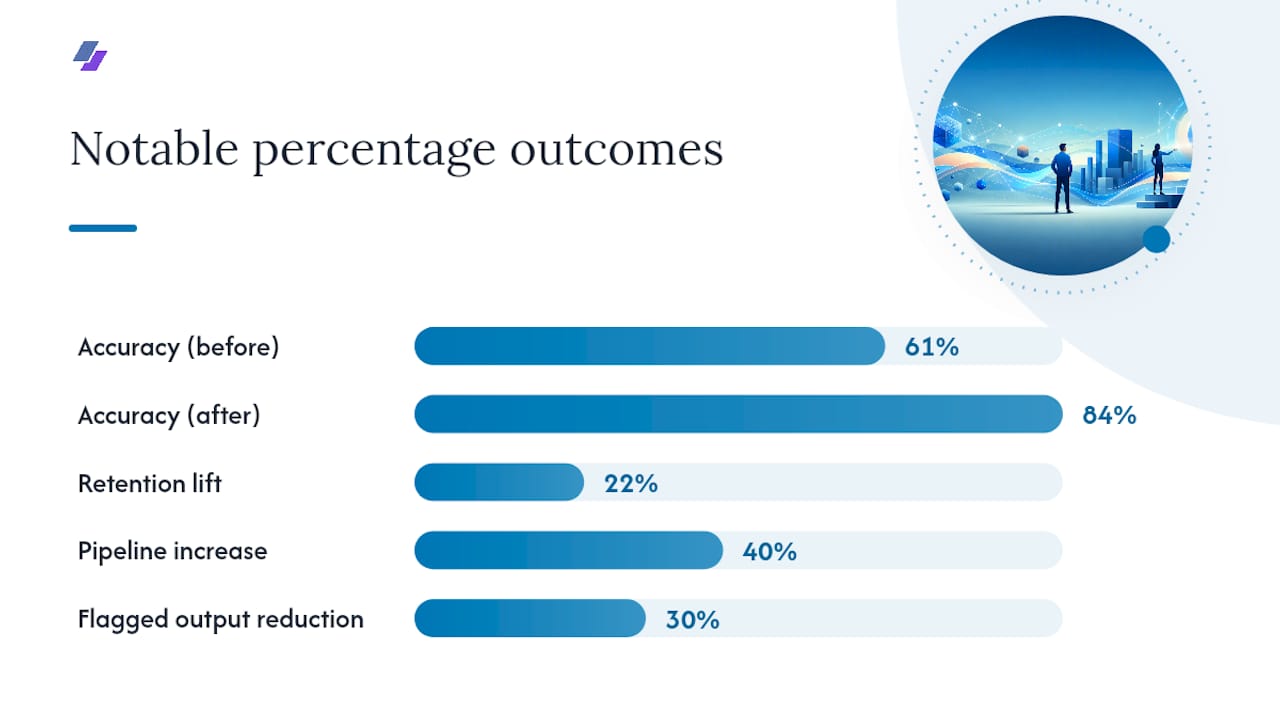
- Owned the product roadmap for the referral feature, prioritizing based on cohort analysis that showed a 22% lift in 30-day retention.
- Ran A/B tests across pricing page variants, identifying a layout change that increased conversion 9% and added $400K in annual recurring revenue.
- Led cross-functional collaboration between design, engineering, and sales to launch a self-serve onboarding flow, cutting time-to-value from 14 days to 3.
Senior-level bullets shift toward portfolio scope and executive visibility:
- Defined multi-product strategy across a $30M portfolio, presenting quarterly roadmap reviews directly to the executive team.
- Built the business case and pricing strategy for a new product line, achieving P&L accountability within the first two quarters post-launch.
- Directed GTM strategy for a platform-wide launch spanning four product teams, coordinating sales enablement materials that supported a 40% increase in qualified pipeline.
AI PM bullets need to show both the technical vocabulary and a measurement discipline:
- Designed prompt engineering guidelines for an internal LLM-powered support tool, improving first-response accuracy from 61% to 84%.
- Partnered with ML engineering to define model evaluation metrics (precision, recall) for a recommendation feature, catching a data drift issue before launch.
- Established a human-in-the-loop review process for AI-generated content, reducing flagged output by 30% while maintaining response speed.
Notice the pattern across every level: keyword, metric, mechanism. The keyword names the skill, the metric proves it happened, and the mechanism (how you did it) shows judgment. Drop any one of the three and the bullet gets weaker.
The Keyword Mistakes That Quietly Kill Your Application
Most PM resumes don’t fail because they lack keywords. They fail because of how those keywords get used.
- Keyword stuffing. Cramming your skills section with every term you’ve ever heard in a standup doesn’t fool an ATS the way it used to, and it reads as padding to a recruiter. Analysis from ATS Verification notes that keyword density above roughly 1.5% starts triggering negative signals rather than positive ones.
- Unverifiable claims. Listing “machine learning” or “data science” without a bullet that shows what you actually did invites a follow-up question you can’t answer well in an interview.
- Two-column and image-heavy templates. These consistently cause field mapping errors, dropping your work history or skills entirely from what the ATS reads.
- Senior vocabulary without senior scope. Writing “org-wide strategy” when your actual scope was one feature team is the fastest way to get filtered out in a screening call, not fast-tracked.
Pro Tip: Limit your skills row to 5 to 7 categorized groups (not individual tools), pick 3 to 4 tools you can speak to in real depth during an interview, and quantify every claim you can. Depth beats a long list every time.
How Jobalign Turns This Playbook Into an Actual Resume
Everything above works. It also takes time most job seekers don’t have when they’re applying to a dozen roles a week. Jobalign was built around that exact bottleneck: it syncs directly with your LinkedIn profile, extracts your real experience and skills, then compares them against a specific job description to identify the keywords worth adding.

The platform generates a tailored resume per posting, each one built on ATS-compatible templates and matched to the job you’re targeting, without you manually rewriting bullets for every application. That matters because roughly 75% of resumes get rejected by ATS filters before a human ever opens them, often over formatting or missing keyword matches that have nothing to do with a candidate’s actual qualifications. Jobalign reports an 87% ATS pass rate for resumes generated through its keyword matching process. This reflects the same principle covered in the sections above: match the JD’s language, place it in proof-based bullets, and keep the formatting clean.
The Nuance Most PM Resume Advice Skips
Most keyword guides treat vocabulary as static, as if “sprint planning” and “multi-team strategy” belong in the same tier. They don’t. Vocabulary should shift as your actual scope shifts, and I’ve seen plenty of strong mid-level PMs undersell themselves by still leading with execution language (“backlog grooming,” “sprint ceremonies”) when their real work has moved into strategy and stakeholder alignment. The fix isn’t adding more keywords. It’s swapping the ones you have for ones that match your current altitude.
The reverse mistake is just as common and more damaging: reaching for senior terms like “P&L ownership” or “org-wide strategy” without the scope to back them up in an interview. A recruiter who catches that gap once stops trusting the rest of the resume.
Whatever level you’re at, the next move is the same: run your updated resume through an ATS check before you submit it, and confirm the keywords you added are ones you can actually defend out loud.
— Johan
Ready to Put These Keywords to Work?
Reading a keyword list is one thing. Matching it to your actual LinkedIn history, job by job, is where most people lose an evening. Jobalign automates that step: it pulls your real experience straight from LinkedIn, compares it against the job description you’re applying to, and generates a tailored, ATS-optimized resume built on the keyword and placement rules covered above, without inventing a single skill you didn’t already have.
Nothing in that process fabricates experience. Jobalign tailors language around what’s already on your LinkedIn profile, so the resume that comes out the other side stays factual while still speaking the JD’s language.
If you want to see where your current resume stands, run it through the free LinkedIn resume generator and compare the keyword matches against your target job posting. It takes about two minutes, and it’s the fastest way to find out whether your resume is actually saying what you think it’s saying.
Sources
For readers who want to go deeper on any of the specifics covered above, these are the primary sources worth bookmarking:
- ATS Keywords for Product Managers (2026) — ATS Verification
- PM Resume: PM resume keywords for ATS (2026) | PMResume
- Top product manager skills for 2026 | Uxcel
- Applicant tracking system — Wikipedia