Resume Personalization: How to Land More Interviews

Resume personalization is defined as the intentional adaptation of your resume to highlight the qualifications most relevant to a specific job posting. The goal is twofold: pass the Applicant Tracking System (ATS) filter and hold a recruiter’s attention long enough to earn an interview. Approximately 75% of resumes are rejected by ATS before a human ever reads them. That number alone explains why a generic, one-size-fits-all resume fails most job seekers. Career strategist Robin Ryan describes the process as “connecting the dots” for hiring managers by reframing relevant achievements rather than fabricating new ones.
What is resume personalization and why does it matter?
Resume personalization, also called resume tailoring, is the practice of aligning resume content with the specific skills, qualifications, and language of a job description. It is not a full rewrite for every application. It is a targeted edit of the sections that carry the most weight with both ATS software and human reviewers.
Recruiters apply a “7-second scan” rule when reviewing resumes. They decide within seconds whether to keep reading or move on. That means your most relevant qualifications must appear at the very top of your document, not buried in a role from five years ago.

The importance of resume customization goes beyond keyword matching. A tailored resume signals to a hiring manager that you understand the role and have taken the time to show fit. Generic resumes, by contrast, read as low effort and get passed over even when the candidate is qualified.
Which parts of your resume to personalize for maximum impact
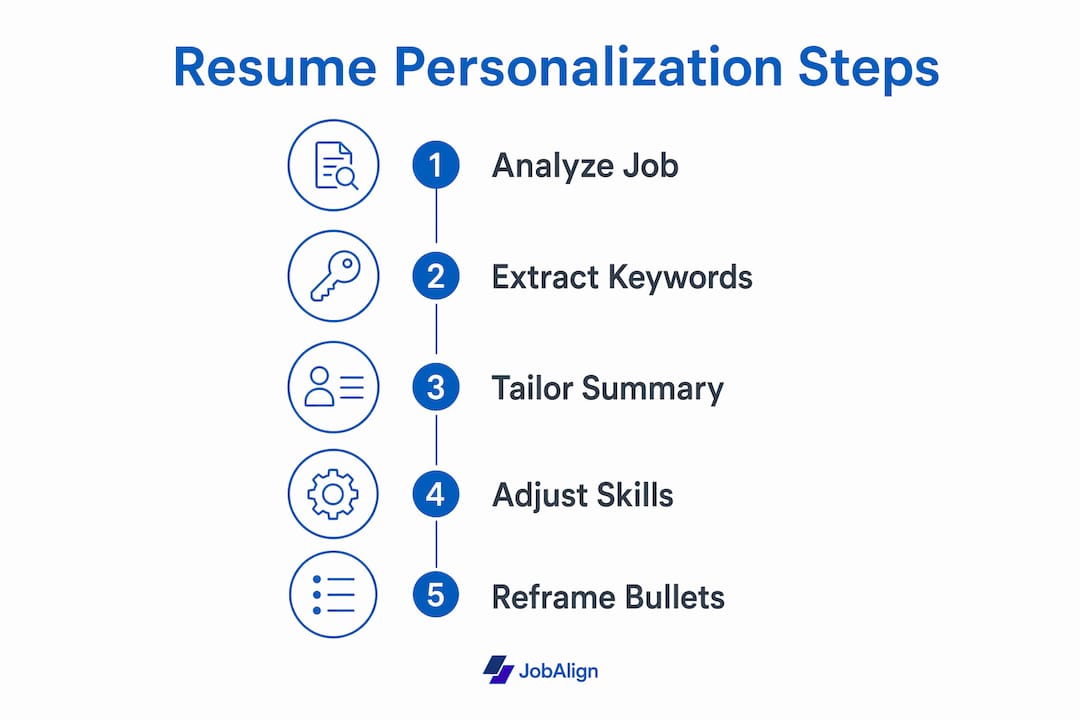
Not every section needs a rewrite. Focus personalization on the top 20% of your resume to capture 80% of the ATS and recruiter decision impact. That top 20% includes three specific areas.
- Professional summary: This is the first thing a recruiter reads. Rewrite it for each application to mirror the job title and top two or three requirements from the posting. A summary for a “Senior Data Analyst” role should use that exact phrase and reference the core skills listed in the job description.
- Skills section order: ATS systems score resumes partly by keyword frequency and placement. Move the skills that match the job description to the top of your skills list. If the posting prioritizes Python and SQL, those go first.
- Top two or three bullet points in your most recent role: These carry the most weight. Rewrite them to reflect the language and priorities of the job posting, using quantified results wherever possible.
Everything else, your education, older roles, and certifications, can stay consistent across applications. This preserves your core professional brand while making the high-impact sections feel purpose-built for each role.
Pro Tip: Copy the job description into a plain text document and highlight every hard skill, soft skill, and qualification. Then check your resume against that list before submitting. Any gap in the top 20% of your resume is a gap worth closing.
How to analyze job descriptions and extract the right keywords
Keyword extraction is the foundation of effective resume tailoring. Parse job descriptions into lists of hard skills, soft skills, required qualifications, and preferred qualifications before touching your resume. This separates must-haves from nice-to-haves and tells you exactly where to focus your edits.
A practical method for manual extraction works like this:
- Read the job description twice. First for overall understanding, then for specific language.
- Highlight every technical skill, tool, certification, and degree requirement.
- Note repeated words or phrases. Repetition signals priority to both ATS and hiring managers.
- Separate requirements labeled “required” or “must have” from those labeled “preferred” or “a plus.”
- List the top five to seven keywords and check each one against your current resume.
The table below maps common job description elements to the resume sections where they belong.
| Job description element | Resume section to update |
|---|---|
| Required technical skills | Skills section, top bullet points |
| Job title and seniority level | Professional summary |
| Soft skills (e.g., “cross-functional collaboration”) | Summary and relevant bullet points |
| Industry-specific tools or platforms | Skills section |
| Preferred qualifications | Summary or secondary bullet points |
One mistake to avoid is keyword stuffing. Dropping every keyword from the posting into your resume without context reads as unnatural to recruiters and can trigger ATS spam filters. Each keyword should appear in a sentence that demonstrates how you used that skill, not just as a standalone term in a list.
Pro Tip: Use a resume personalization checklist to verify keyword coverage before each submission. A checklist takes two minutes and prevents the most common omissions.
How to rewrite resume bullets and summaries without misrepresenting your experience
The most effective resume bullets are specific, metric-led, and written in the employer’s own language. Replace generic verbs like “leveraged” or “spearheaded” with concrete impact statements that mirror the job description’s terminology. This improves both ATS recognition and recruiter engagement.
Here is a before-and-after example. Suppose a job description calls for “reducing customer churn through data analysis.”
- Before: “Spearheaded initiatives to improve customer retention using various analytical tools.”
- After: “Reduced customer churn by 18% by building a predictive model in Python that flagged at-risk accounts 30 days before cancellation.”
The second version uses the job description’s language (“customer churn,” “data analysis”), includes a specific metric, and names the tool. It passes ATS keyword checks and gives a recruiter a concrete reason to keep reading.
Personalization means reframing, not fabricating. Every metric and achievement you include must be real. If you do not have a number, describe the scope or outcome in specific terms. “Managed a team of six engineers” is more credible than “led a large team.”
Pro Tip: Read your rewritten bullets out loud. If a sentence sounds robotic or unnatural, a recruiter will feel the same way. Smooth, direct language reads better and scans faster.
How to scale resume personalization across multiple applications
Resume personalization at scale requires a system, not just effort. The foundation is a master resume document that contains every bullet point, achievement, and skill you have ever used. Think of it as a library you pull from, not a document you submit.
A four-step workflow makes scaling practical:
- Extract job description intel. Paste the job posting into a document and identify the top five to seven keywords and the two or three most critical requirements.
- Pull from your master resume. Select the bullets and summary language that best match those requirements. Rewrite the top two or three bullets to mirror the job description’s language and metrics.
- Verify ATS match. Use an AI-powered resume tool to check keyword alignment before submitting. Most tools score your resume against the job description and flag gaps.
- Submit while the application is fresh. Early applicants receive more recruiter attention. Completing steps one through three within 30 minutes keeps your pipeline moving.
AI-driven tailoring workflows that follow this sequence can boost recruiter response rates significantly by removing the guesswork from keyword alignment. The key is using AI to handle the mechanical matching while you retain editorial control over tone, accuracy, and authenticity.
For IT professionals specifically, AI-written job-specific resumes follow similar principles but require extra attention to technical stack keywords, which vary sharply between employers even for the same job title.
Common resume personalization mistakes and how to avoid them
Most personalization errors fall into one of two categories: doing too much or doing too little. Both hurt your results.
- Rewriting every bullet point. This wastes time and often dilutes your strongest achievements. Focus edits on the top 20% of your resume.
- Using a generic summary. A summary that reads “results-driven professional with 10 years of experience” tells a recruiter nothing specific. Neglecting summary tailoring is one of the most common and costly mistakes.
- Overstuffing keywords. Packing every keyword from the job description into your resume harms readability and can flag your resume as spam in some ATS systems.
- Fabricating metrics. Invented numbers destroy credibility the moment a recruiter asks about them in an interview. Use real data, even if the numbers are modest.
- Ignoring the 7-second scan. If your most relevant qualification appears in the third paragraph of your summary or halfway down the page, a recruiter will miss it.
Pro Tip: Limit your personalization edits to the summary, skills order, and top three bullets. That scope takes 15–20 minutes per application and covers the sections that drive the most impact.
Key takeaways
Resume personalization works because it aligns your strongest, most relevant qualifications with the exact language and priorities of each job description, satisfying both ATS filters and human reviewers in the first seconds of review.
| Point | Details |
|---|---|
| Personalize the top 20% | Focus edits on your summary, skills order, and top three bullets for maximum ATS and recruiter impact. |
| Extract keywords first | Parse the job description for hard skills, soft skills, and required qualifications before editing your resume. |
| Use metric-led bullets | Replace generic verbs with specific, quantified impact statements that mirror the job description’s language. |
| Build a master resume | Maintain a library of all your bullets and achievements to pull from quickly for each application. |
| Avoid keyword stuffing | Include keywords in context, not as standalone terms, to satisfy both ATS scoring and recruiter readability. |
The part of resume tailoring most job seekers skip
I have reviewed hundreds of resumes over the years, and the most consistent pattern I see is this: job seekers spend 90% of their effort on the bottom half of their resume and almost none on the top. They polish their education section, list every certification they have ever earned, and add a skills section that reads like a software catalog. Then they write a two-line summary that says nothing specific and wonder why they are not getting callbacks.
The 7-second scan rule is real. A recruiter reviewing 200 resumes in a week is not reading your third bullet point in a role from 2019. They are reading your summary and your most recent title. If those two elements do not immediately signal fit, the rest of your resume does not matter.
What I find works best is treating your summary as a custom cover letter in three sentences. State your title, your most relevant achievement, and the specific value you bring to this role. That approach takes more thought than copying a template, but it is the difference between a resume that gets a second look and one that gets archived.
The other thing I want to say plainly: AI tools are genuinely useful here, but they are not a substitute for judgment. Use them to handle keyword matching and formatting. Keep the editorial decisions, especially around which achievements to highlight and how to frame your experience, in your own hands. Authenticity is not a soft concept. Recruiters notice when a resume sounds like it was written by a machine, and it costs you the interview.
— Johan
How JobAlign handles resume tailoring for you
JobAlign is built specifically for job seekers who want tailored, ATS-ready resumes without spending an hour on each application. The platform syncs directly with your LinkedIn profile, extracts your relevant experience and skills, and generates a custom resume for each job you apply to. Its proprietary technology matches your qualifications to the job description’s keywords and formats everything in a machine-readable style that passes ATS filters. JobAlign reports an 87% ATS pass rate across its generated resumes. If you are applying to multiple roles and want to maintain quality without burning out, JobAlign’s per-posting resume generation removes the bottleneck entirely.
FAQ
What is resume personalization in simple terms?
Resume personalization is the process of editing your resume to match the specific language, skills, and requirements of a job posting. The goal is to pass ATS filters and show recruiters your fit within seconds.
How much of my resume should I change for each application?
Focus changes on the top 20% of your resume: your summary, skills order, and the first two or three bullet points in your most recent role. The rest can stay consistent across applications.
Does resume personalization mean I have to lie about my experience?
No. Personalization means reframing and emphasizing real achievements that are most relevant to the role. Every metric and claim must be accurate, as fabricated details will surface in interviews.
How long should resume personalization take per application?
A focused edit of the summary, skills section, and top three bullets takes 15–20 minutes per application when you work from a master resume document.
What is resume personalization at scale?
Resume personalization at scale means using a master resume library and AI-powered tools to tailor multiple applications efficiently, maintaining keyword alignment and quality without rewriting from scratch each time.