Resume Workflow for Job Seekers: 2026 Guide

A resume workflow for job seekers is a structured, repeatable system for creating, tailoring, tracking, and submitting resumes to maximize interview opportunities. Most job seekers treat each application as a one-off task. That approach wastes time and produces generic resumes that fail to pass Applicant Tracking Systems. Approximately 75% of resumes are rejected by ATS before a human ever reads them. A proper job application workflow fixes that by turning a chaotic process into a reliable system with predictable results.
What is a resume workflow for job seekers?
A resume workflow is the industry term for a repeatable, stage-by-stage process that covers every step from identifying a target role to following up after submission. Think of it as your personal assembly line. Each stage feeds the next, and the whole system improves over time as you gather data on what works.
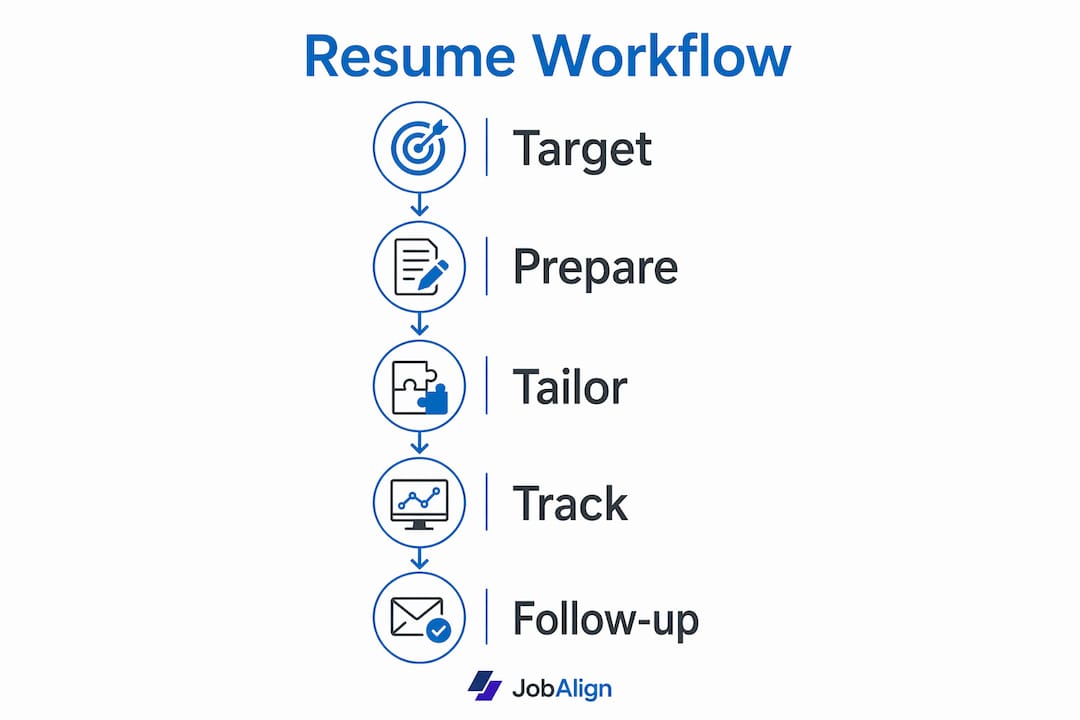
A successful workflow involves five stages: Targeting, Preparation, Tailoring, Tracking, and Follow-up. These stages create a loop that reduces burnout and improves results with every cycle. Treating them as isolated tasks is the single biggest mistake job seekers make.
Here is what each stage does:
- Targeting. Identify roles that match your skills, experience level, and career goals. Apply to roles where you meet at least 70% of the listed requirements.
- Preparation. Build a modular resume asset library. This includes a complete master CV, a bullet bank of achievements, and a skills inventory you can pull from quickly.
- Tailoring. Customize your resume for each specific job posting using keywords from the job description and quantified achievements.
- Tracking. Log every application with the company name, role, date applied, current stage, and planned next action.
- Follow-up. Send a brief, professional message to the hiring manager or recruiter 5–7 business days after submitting.
Pro Tip: Build your modular asset library before you apply to a single job. Tailoring time drops to 10–15 minutes per application when your bullet bank is ready.
How to tailor your resume effectively to each job

Tailoring is the highest-leverage step in the entire resume creation process. Recruiters spend an average of 11 seconds reviewing a resume, and over 60% reject it before reading it fully. Your resume needs to pass a machine first and impress a human second.
The tailoring process follows four steps:
- Extract keywords. Read the job description carefully. Pull out job titles, required skills, tools, and phrases that appear more than once. These are the terms the ATS is scanning for.
- Rewrite your summary. Your professional summary should mirror the language of the job posting. If the role says “cross-functional collaboration,” your summary should use that exact phrase.
- Update your skills section. Add the specific tools and technologies listed in the posting. Remove skills that are irrelevant to this role.
- Revise your experience bullets. Use the pattern: [Action verb] + [what you did] + [scale] + [result]. “Managed a team” becomes “Led a 6-person engineering team that reduced deployment time by 40%.”
The goal is to hit an ATS match score above 75% before you submit. Resumes that clear this threshold generate 5–10x higher recruiter response rates than generic versions. That gap is not a small edge. It is the difference between getting calls and getting silence.
Here is a quick reference for the three resume formats and when to use each:
| Format | Best for | Key strength |
|---|---|---|
| Chronological | Consistent work history | Shows career progression clearly |
| Functional | Career changers or employment gaps | Highlights transferable skills |
| Combination | Diverse backgrounds | Balances skills and experience |
Choosing the right resume format matters before you tailor. A chronological format works for most job seekers with steady experience. A functional format suits career changers who need to lead with skills rather than job titles.
Pro Tip: Paste the job description and your resume into an ATS simulation tool. Any score below 75% means you need more keyword alignment before submitting.
How to track applications and follow up professionally
Tracking every application is the step most job seekers skip. That is a costly mistake. Logging applications with role, company, date, stage, and next steps gives you data to identify where your pipeline breaks down.
A simple spreadsheet works well. Use these columns:
- Company name and role title
- Date applied and application method (company site, job board, referral)
- Current stage (applied, phone screen, interview, offer, rejected)
- Follow-up date and notes from any recruiter conversations
This structure lets you see patterns fast. If you apply to 30 roles and get zero phone screens, the problem is your resume or targeting. If you get phone screens but no interviews, the issue is your pitch or experience match. Tracking turns guesswork into a diagnostic tool.
The average job search lasts around 108 days. That is a long time to manage applications from memory. A structured job search pipeline keeps you organized and prevents strong applications from going cold.
Follow-up timing matters. Send your first follow-up 5–7 business days after submitting. Keep it short: one sentence referencing the role, one sentence expressing continued interest, and a polite close. Do not follow up more than twice for the same role. Persistence signals interest. Repeated messages signal desperation.
Pro Tip: Set a calendar reminder on the day you apply. That way, your follow-up date is already scheduled before you forget about it.
How AI tools enhance the resume workflow in 2026
AI has changed what is possible in a resume workflow. Tasks that used to take an hour now take minutes. The key is knowing which tools cover which parts of the process.
Here is how the tool categories break down:
| Tool category | What it covers | What it misses |
|---|---|---|
| Keyword extractors | Pulls terms from job descriptions | Does not rewrite your resume |
| Resume rewriters | Updates bullets and summaries | Does not score ATS match |
| ATS scoring tools | Grades keyword alignment | Does not submit applications |
| Integrated platforms | Covers all stages end to end | Fewer options available |
Standalone tools only cover parts of the workflow. Integrated platforms that combine keyword extraction, resume rewriting, ATS scoring, and submission save hours per week and improve results across the board. Using three separate apps for three separate steps creates friction and increases the chance of errors.
JobAlign is built specifically for this problem. It syncs with your LinkedIn profile, extracts relevant experience and skills, and generates a tailored resume for each job posting. JobAlign reports an 87% ATS pass rate for resumes produced through its platform. You can learn more about AI-powered resume optimization to see how the process works in practice.
The workflow automation guide from JobsAI also covers how digital tools handle the resume workflow stages for tech industry job seekers, which is useful if you are applying in a technical field.
Pro Tip: Use an integrated platform for tailoring and ATS scoring. Reserve your manual effort for the targeting and follow-up stages, where human judgment still matters most.
Key Takeaways
A resume workflow for job seekers is the single most effective way to increase interview rates while reducing the time and stress of applying.
| Point | Details |
|---|---|
| Five-stage workflow | Target, Prepare, Tailor, Track, and Follow up as a connected loop, not isolated tasks. |
| ATS match score | Aim for 75%+ keyword alignment before submitting to generate significantly higher recruiter response rates. |
| Modular asset library | Build a bullet bank and master CV once to cut tailoring time to 10–15 minutes per application. |
| Application tracking | Log every application with stage and follow-up date to identify pipeline bottlenecks early. |
| Integrated AI tools | Use platforms that combine tailoring, ATS scoring, and submission to avoid gaps between standalone tools. |
Why most job seekers are one system away from better results
Here is what I have seen repeatedly: job seekers who struggle are not less qualified than those who succeed. They are less organized. The candidate who applies to 15 well-targeted, tailored roles almost always outperforms the one who blasts 100 generic applications. Volume without structure is just noise.
The mindset shift that changes everything is treating your job search as a system rather than a series of tasks. That one reframe reduces burnout dramatically. When you have a workflow, a bad week does not derail you. You check your tracking sheet, identify where things stalled, and adjust. That is a skill most people never develop because no one teaches it.
My honest recommendation: invest two hours upfront building your modular asset library. Write 20 strong achievement bullets. Draft three versions of your professional summary for different role types. That investment pays back every single application after it. The job seekers who skip this step spend 90 minutes on every application. The ones who do it spend 15 minutes.
Stay critical of AI tools. They are genuinely useful for keyword extraction and first-draft tailoring. But they do not know your career story the way you do. Review every AI-generated bullet before it goes on your resume. The goal is speed plus accuracy, not speed alone.
— Johan
JobAlign and your resume workflow
JobAlign handles the most time-consuming parts of the resume workflow automatically. It connects directly to your LinkedIn profile, pulls your relevant experience, and builds a tailored, ATS-ready resume for each job you apply to. No manual reformatting. No starting from scratch. JobAlign’s platform reports an 87% ATS pass rate, which means your resume reaches human reviewers far more often. You can browse resume examples by job type to see what a well-structured, keyword-aligned resume looks like before you build your own. Check the pricing page to find the plan that fits your search volume.
FAQ
What is a resume workflow for job seekers?
A resume workflow is a structured, repeatable process covering five stages: Targeting, Preparation, Tailoring, Tracking, and Follow-up. It turns job searching into a system that improves with each application cycle.
How long does it take to tailor a resume for each job?
Tailoring takes 10–15 minutes per application when you have a modular asset library built in advance. Without one, the same task can take 60–90 minutes.
What ATS score should my resume reach before I submit?
Aim for an ATS match score above 75%. Resumes that hit this threshold generate 5–10x higher recruiter response rates than generic versions.
What resume format works best for most job seekers?
The chronological format works best for job seekers with a consistent work history. Career changers benefit more from a functional or combination format that leads with transferable skills.
How soon should I follow up after submitting a resume?
Send a brief, professional follow-up 5–7 business days after submitting. Following up once or twice is appropriate. More than that reduces your chances.