The Role of Soft Skills in Resumes: 2026 Guide

Soft skills are defined as the interpersonal, cognitive, and emotional competencies that shape how you work with others, adapt to change, and solve problems. The role of soft skills in resumes has never been more decisive: 92% of job candidates claim excellent soft skills, yet only 15% provide any evidence to back that claim. That gap is your competitive advantage. This guide shows you exactly how to move from vague claims to concrete, measurable proof that hiring managers and Applicant Tracking Systems both reward.
Which soft skills do employers value most in 2026?
Employers rank soft skills above many technical qualifications because hard skills can be trained on the job. Soft skills predict how well a candidate will integrate into a team, handle pressure, and grow with the company. Candidates with strong interpersonal skills integrate faster and show higher engagement from day one.
The most in-demand soft skills for 2026 reflect the rise of AI in the workplace:
- Analytical thinking: The ability to interpret data, weigh options, and make sound decisions that machines cannot replicate alone.
- Resilience and adaptability: Employers want people who recover quickly from setbacks and adjust when priorities shift.
- Communication: Clear written and verbal communication remains critical across every industry, from finance to engineering.
- Teamwork and collaboration: The ability to work across functions and time zones matters more as remote work persists.
- Emotional intelligence: Reading a room, managing conflict, and building trust are skills no algorithm can replace.
Analytical thinking, resilience, flexibility, and agility top the list of sought-after competencies as AI integration rises across industries. That finding matters because it signals a deliberate shift: employers are not replacing human workers with AI. They are looking for people who can direct, refine, and collaborate alongside AI tools. Soft skills like communication, adaptability, and emotional intelligence are now considered critical even in STEM fields, where technical credentials once dominated hiring decisions.
Why do most candidates fail to show soft skills on their resumes?

The most common mistake is listing soft skills as adjectives. Phrases like “great communicator,” “team player,” or “highly adaptable” appear on thousands of resumes every day. Recruiters see them so often that they carry almost no weight. Recruiters want proof embedded as measurable outcomes in the experience section, not a standalone skills list.
Here is where most job seekers go wrong:
- Isolating soft skills in a separate section: A bullet point that reads “Skills: Communication, Leadership, Teamwork” tells a recruiter nothing about how you actually used those skills.
- Using adjectives instead of verbs: “Excellent problem-solver” is a claim. “Resolved a recurring supply chain bottleneck that cut delivery delays by 30%” is evidence.
- Ignoring context: Soft skills only make sense when tied to a specific situation. Without context, they read as filler.
- Copying generic lists: Pasting the same soft skills onto every resume signals that you have not read the job description carefully.
Pro Tip: Before you write a single bullet point, highlight every soft skill mentioned in the job posting. Those exact words should appear in your resume, tied to real examples from your work history.
The fix is not complicated, but it does require deliberate effort. Soft skills predict cultural fit and future performance more reliably than technical credentials alone. Hiring managers know this, which is why they look past the skills section and read your experience bullets for behavioral evidence.
How to highlight soft skills with examples and metrics
The most effective method for showing soft skills on a resume is the CAR framework: Context, Action, Result. Using the CAR framework moves your bullet points from vague claims to structured, credible evidence that hiring managers trust.
Here is a step-by-step process to apply it:
- Identify the soft skill the employer needs. Read the job description carefully. If it mentions “cross-functional collaboration,” that is your target.
- Set the context. Describe the situation briefly. “Led a team of six across three departments during a product launch” gives the reader a frame of reference.
- Describe your action. Focus on what you did, not what the team did. “Facilitated weekly alignment meetings and created a shared project tracker” is specific and active.
- State the result. Quantify wherever possible. “Delivered the launch two weeks ahead of schedule with zero budget overrun” closes the loop with proof.
- Tailor each bullet to the job. A bullet written for a project management role should emphasize different soft skills than one written for a customer success role.
- Add third-party validation when available. A LinkedIn recommendation that mentions your communication skills, or a performance review quote, adds credibility beyond self-reporting.
Pro Tip: Link your soft skills to AI tool usage for 2026 relevance. A bullet like “Used AI-generated reports to brief stakeholders, applying judgment to filter noise and prioritize key findings” shows both technical literacy and analytical thinking in one line.
Connecting soft skills to AI tool usage is one of the fastest ways to stand out right now. Employers do not just want to know you can use AI. They want to know you can apply human judgment to make AI outputs useful. You can find resume examples by industry that show exactly how to structure these kinds of bullets across different roles.
Soft skills vs. hard skills: what is the difference and which matters more?
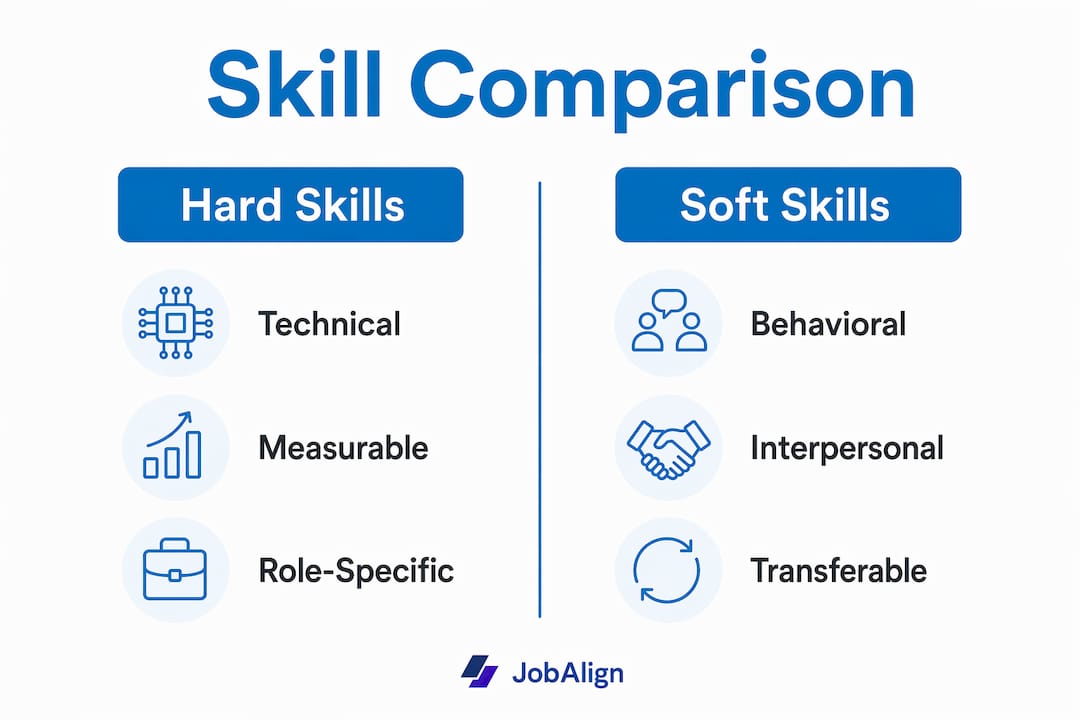
Hard skills are teachable, measurable technical abilities. Soft skills are behavioral and interpersonal competencies that shape how you apply those technical abilities. Both matter, but they serve different purposes on a resume.
| Category | Hard Skills | Soft Skills |
|---|---|---|
| Definition | Technical, role-specific knowledge | Interpersonal and cognitive behaviors |
| Examples | Python, financial modeling, data analysis | Communication, adaptability, resilience |
| How to learn | Courses, certifications, practice | Experience, feedback, reflection |
| Durability | Can become obsolete as technology changes | Transferable across roles and industries |
| How to show on a resume | Certifications, tools list, project outputs | CAR-structured bullet points with metrics |
| Why employers care | Confirms you can do the job | Predicts how you will perform and fit |
Soft skills remain durable and transferable across roles and industries, which makes them a long-term career asset. A Python certification may become less relevant in five years. Your ability to communicate clearly and adapt under pressure will not. That durability is why employers increasingly treat soft skills as the deciding factor when two candidates have similar technical backgrounds.
The practical takeaway: do not treat soft skills as secondary to hard skills on your resume. Treat them as the evidence that explains how you achieved your technical results. A developer who stands out with a resume does not just list programming languages. They show how their communication and problem-solving skills drove project outcomes.
Key Takeaways
Soft skills win interviews when they are backed by specific, measurable evidence rather than listed as adjectives in a standalone skills section.
| Point | Details |
|---|---|
| Evidence beats claims | 92% of candidates claim soft skills, but only 15% prove them. Be in that 15%. |
| Use the CAR framework | Structure every soft skill bullet as Context, Action, Result to show real impact. |
| Tailor to the job description | Match your soft skill examples to the exact language used in each posting. |
| Connect soft skills to AI use | Show how your judgment and collaboration enhanced AI-driven tasks for 2026 relevance. |
| Soft skills outlast hard skills | Interpersonal competencies transfer across roles and do not become obsolete as technology changes. |
What I have learned watching candidates get this wrong for years
Most job seekers treat soft skills as a checkbox. They add “strong communicator” to a skills section, assume it is covered, and move on. That approach has never worked, and in 2026 it is actively hurting candidates.
What I have seen work consistently is the opposite: job seekers who treat every experience bullet as an opportunity to demonstrate a behavioral competency. They do not announce that they are adaptable. They write about the time a project scope changed overnight and they reorganized the team’s priorities by morning. That is the difference between a resume that gets read and one that gets skipped.
The other thing most candidates miss is the growth angle. Soft skills are not fixed traits. They are learnable, improvable competencies. Candidates who show they have actively developed a skill, through a difficult project, a leadership course, or a stretch assignment, signal self-awareness and ambition. Hiring managers notice that.
My honest advice: audit your last three jobs and write down one situation per role where a soft skill made a measurable difference. Those three stories are the foundation of a resume that actually reflects your value. Do not wait until you are applying to start building that evidence. Start now, and keep adding to it as your career grows.
— Johan
How Jobalign helps you put soft skills to work on your resume
Knowing what to write is half the battle. Actually tailoring your resume for each application, with the right keywords and the right evidence, is where most job seekers lose time. Jobalign’s LinkedIn Resume Generator syncs with your LinkedIn profile and builds a customized, ATS-optimized resume for each job you apply to. It pulls your relevant experience and maps it to the job description, so your soft skill examples land in the right context every time. Jobalign reports an 87% success rate at passing ATS filters. That means your carefully crafted soft skill bullets actually get read by a human recruiter instead of disappearing into a screening system.
FAQ
What are soft skills on a resume?
Soft skills on a resume are interpersonal, cognitive, and emotional competencies such as communication, adaptability, and analytical thinking. They show employers how you work, not just what you know.
Do employers actually value soft skills over hard skills?
Employers value both, but soft skills predict cultural fit and performance in ways that hard skills alone cannot. When two candidates have similar technical backgrounds, soft skills are often the deciding factor.
How do I show soft skills on a resume without just listing them?
Use the CAR framework: describe the Context, your Action, and the measurable Result. This turns a vague claim like “strong leader” into a specific, credible bullet point.
Which soft skills matter most for job applications in 2026?
Analytical thinking, resilience, adaptability, and communication top the list. Employers specifically want candidates who can apply these skills alongside AI tools, not just independently.
Can soft skills be learned or are they fixed traits?
Soft skills are learnable and improvable with practice and feedback. Approaching them with a growth mindset is one of the strongest signals you can send to a hiring manager.