Why Graduates Need Tailored Applications to Get Hired

Tailored job applications are personalized submissions that align your resume and cover letter exactly with the skills, experiences, and keywords specified in each job posting. This is the core reason why graduates need tailored applications: 98% of Fortune 500 companies use Applicant Tracking Systems (ATS) to filter candidates before a human ever reads a single word. Generic resumes get rejected automatically. A tailored application, by contrast, mirrors the job description’s language, passes ATS keyword filters, and signals to recruiters that you are serious about that specific role. The industry term for this practice is “application customization,” and for graduates entering a competitive market, it is not optional.
Why graduates need tailored applications: the ATS reality
Applicant Tracking Systems act as automated gatekeepers. They scan your resume for keywords pulled directly from the job description, score your match, and filter out anyone below a threshold. 99.7% of recruiters apply automated filters, which means a generic resume rarely reaches a human reviewer at all.
Graduates often assume ATS systems penalize them for limited experience. That assumption is wrong. ATS does not judge the quality of your experience. It scans for the presence of specific keywords. A graduate who mirrors the job description’s exact language will outscore an experienced candidate who submits a generic resume every time.

The most common mistake is treating your resume as a static document. Each job posting has a different keyword priority. A marketing coordinator role at one company might list “social media analytics” first, while another lists “content calendar management.” Placing the highest-priority keywords at the top of your skills section and bullet points directly improves your ATS scoring.
Pro Tip: Copy the job description into a word frequency tool. The words that appear most often are your primary keywords. Use them verbatim in your resume, not paraphrased.
Graduates’ biggest challenge is translating academic experience into ATS-compatible keywords and structure. A class project on “consumer behavior analysis” becomes “market research and data analysis” when the job description uses that phrase. The translation is not dishonest. It is required.
What tailoring strategies actually work for graduates?
Tailoring is not just swapping out a few words. It requires restructuring your entire document around each job posting’s priorities.
-
Place education above work experience. Graduates should list education first on entry-level resumes because ATS systems weight education more heavily for early-career roles. Include your GPA if it is above 3.5, relevant coursework, and academic honors.
-
Format internships and projects as professional experience. ATS reads structure, not labels. A capstone project formatted with a job title, organization name, date range, and bullet points gets parsed the same way a full-time role does. Formatting projects like work entries boosts your ATS score and recruiter readability simultaneously.
-
Mirror the job description hierarchy. Matching the order of your bullet points to the job description’s priority order is a nuanced tactic that improves ATS scoring beyond simple keyword inclusion. If the posting lists “project management” before “data analysis,” your bullet points should follow that same sequence.
-
Write a tailored cover letter for every application. A strong tailored cover letter demonstrates genuine company interest and compensates for limited resume experience. Name a specific product, initiative, or company value. One concrete sentence about why you want that company specifically is worth more than three paragraphs of generic enthusiasm.
-
Rewrite your summary statement for each role. Your professional summary is the first text a recruiter reads after the ATS passes your resume. It should echo the job title and top two or three required skills from the posting.
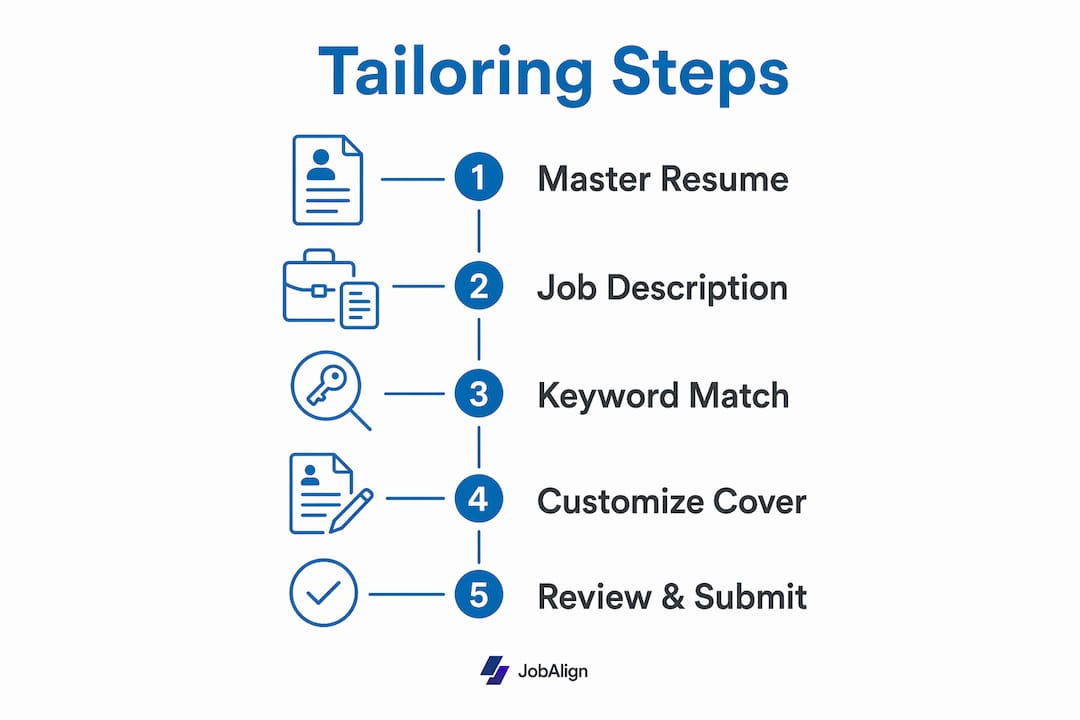
Pro Tip: Keep a master resume with every experience, project, and skill you have ever listed. For each application, copy from the master and cut down to what matches the posting. This saves time and keeps your tailoring accurate.
Recruiters instantly identify generic applications. Tailoring signals intent and seriousness. That signal matters more at the entry level, where most candidates have similar academic credentials. Your tailoring is often the only differentiator.
How many tailored applications should graduates submit each week?
Quality beats quantity, but quality alone is not enough. The average graduate job search takes three to six months. Submitting 10–15 thoughtful, tailored applications weekly, paired with active networking, is the most effective pace.
The “spray-and-pray” approach, where you send the same resume to 50 companies in a weekend, produces poor results. Mass submitting generic resumes is statistically less effective than a focused volume of customized submissions. The math is simple: a 5% response rate on 50 generic applications equals 2.5 callbacks. A 20% response rate on 15 tailored applications equals 3 callbacks, with far less wasted effort.
Networking amplifies every tailored application you send. Networking fills 50%–80% of roles before they are ever posted publicly. When you combine a tailored application with an internal referral, your chances of reaching the interview stage increase sharply. Treat networking not as a separate activity but as the pipeline that makes your tailored applications land in front of the right people.
| Application approach | Weekly volume | Expected callback rate | Time to first offer |
|---|---|---|---|
| Generic, mass submissions | 40–60 | Low | Unpredictable |
| Tailored, focused submissions | 10–15 | Higher | 3–6 months average |
| Tailored + active networking | 10–15 | Highest | Shorter than average |
Two-thirds of successful job searches are completed within 50 targeted, tailored applications. That number puts the 10–15 per week pace in perspective. You do not need hundreds of applications. You need the right ones, done well. For graduates entering tech roles, understanding how hiring teams evaluate candidates can sharpen your targeting further.
What mistakes do graduates most often make when tailoring applications?
Most tailoring errors fall into five categories. Avoiding them is as important as executing the tactics above.
-
Putting work experience before education. For entry-level roles, this misaligns with ATS weighting. Education belongs at the top until you have two or more years of full-time professional experience.
-
Using generic language instead of job description vocabulary. Writing “strong communicator” when the posting says “cross-functional stakeholder communication” is a missed keyword match. Copy the exact phrase.
-
Submitting a generic cover letter or skipping it entirely. A cover letter addressed “To Whom It May Concern” with no company-specific content tells the recruiter you did not research the role. Recruiters value candidates who show preparedness and respect for the hiring process. A generic cover letter does the opposite.
-
Unclear date formatting on internships and projects. ATS filters sometimes miscalculate experience when dates are ambiguous, assigning a “0 years experience” penalty. Use a consistent format: “June 2024 – August 2024” on every entry.
-
Ignoring ATS formatting rules. Tables, graphics, headers, and footers often break ATS parsing. Use a clean, single-column layout with standard section headings like “Education,” “Experience,” and “Skills.” Review a dedicated ATS resume guide before you submit your first application.
Each of these mistakes is fixable in under 30 minutes per application. The graduates who avoid them consistently outperform those who do not, regardless of GPA or school prestige.
Key Takeaways
Tailored applications are the single most effective tool graduates have for passing ATS filters and earning recruiter attention in a competitive entry-level market.
| Point | Details |
|---|---|
| ATS filters are unavoidable | 98% of Fortune 500 companies use ATS, so keyword matching is required to reach a human reviewer. |
| Education belongs first | Place your education section above work experience to align with ATS weighting for entry-level roles. |
| Mirror job description language | Use the exact keywords and hierarchy from each posting to maximize your ATS score. |
| Quality over volume | Submit 10–15 tailored applications weekly rather than mass-sending generic resumes. |
| Networking multiplies results | Combining tailored applications with active networking shortens the average 3–6 month job search. |
The part of tailoring no one talks about
Graduate job searching feels like a numbers game, but the graduates who treat it that way almost always take longer to land a role. I have reviewed hundreds of entry-level applications over the years, and the pattern is consistent: the candidates who get callbacks fastest are not the ones with the most impressive credentials. They are the ones whose resumes read like they were written specifically for that job.
What surprises most graduates is how little tailoring actually takes once you build a system. The first tailored application takes 90 minutes. By the tenth, you are down to 25 minutes. The investment front-loads the work, and the payoff compounds. A generic resume sent to 40 companies produces the same result as silence. A tailored resume sent to 12 companies produces conversations.
The other thing worth saying plainly: technology has removed the excuse. Tools that sync with your LinkedIn profile and generate customized resume versions for each posting exist specifically to solve the time problem. There is no longer a trade-off between quality and speed. The graduates who use these tools effectively are not cutting corners. They are working at the pace the market now requires.
My honest advice: stop thinking about your resume as a document about you. Think of it as a response to a specific question the employer is asking. Every tailored application is your answer to that question. The more precisely you answer it, the more often you get called back.
— Johan
How Jobalign helps graduates create tailored resumes faster
Jobalign is built for exactly the situation graduates face: strong experience to present, limited time to customize, and ATS filters standing between you and the recruiter. The platform syncs directly with your LinkedIn profile, extracts your relevant experiences and skills, and generates a tailored resume for each job aligned with the specific posting’s keywords and structure. Jobalign reports an 87% ATS pass rate for resumes created through its system. You get a resume per posting, no complicated setup, and a document that mirrors the job description hierarchy automatically. For graduates submitting 10–15 applications per week, that time saving is significant.
FAQ
Why do graduates need tailored applications instead of one strong resume?
A single resume cannot match the keyword requirements of multiple different job postings. ATS systems filter by exact keyword matches, so each application needs its own version aligned to that specific role.
How long does it take to tailor a resume for each job?
The first tailored resume takes longer to build, but subsequent versions typically take 20–30 minutes once you have a strong master resume to work from.
Does tailoring a resume mean lying about your experience?
Tailoring means translating your real experience into the language the employer uses. Describing a class project as “market research” when the job posting uses that exact phrase is accurate, not dishonest.
Where should graduates place their education on a resume?
Graduates should place education above work experience because ATS systems weight education more heavily for entry-level roles. This changes once you have two or more years of full-time experience.
How many tailored applications should a graduate send per week?
Industry benchmarks point to 10–15 tailored applications weekly as the most effective pace, combined with active networking to fill roles that are never publicly posted.