5 Nurse Resume Keyword Buckets to Beat ATS, Copyable Lists

The nurse resume keywords that matter most fall into five buckets: your title and license (RN, BSN), your certifications (BLS, ACLS, CCRN), your specialty language (telemetry, med-surg, ICU), your EHR platforms (Epic, Cerner), and quantified outcomes tied to patient care. Put them in your summary, skills section, and the first line of your last two jobs. Copy the lists below, then tailor every set to the exact job posting in front of you.
TL;DR:
- ATS systems prioritize exact matches for titles, licensure, certifications, EHR platforms, and specialty unit terms; mismatches can prevent your application from advancing.
- Keywords should be placed in your professional headline, summary, certifications, skills section, and the opening bullets of your most recent roles for maximum visibility.
- Use truthful, specific language that ties each keyword to a measurable scope or outcome, avoiding claims of experience you do not possess.
- Incorporate both universal and specialty-specific keywords relevant to your experience to improve chances of being shortlisted for targeted roles.
- Automating resume customization with tools like Jobalign can save time and ensure accurate, ATS-optimized keyword placement across multiple applications.
Table of Contents
- What Are Nurse Resume Keywords and Why Do ATS Systems Care?
- Quick Copy-Paste: Top Universal Nursing Keywords
- Why Keyword Categories Matter to ATS and Hiring Managers
- Where to Place Keywords for Maximum ATS and Recruiter Visibility
- Specialty-Specific Keyword Banks for Every Nursing Unit
- Sample Resume Summaries and Experience Bullets
- ATS-Safe Dos and Don’ts for Nursing Resumes
- What the Research Says About ATS Behavior and Nursing Credentials
- Why Truthful, Iterative Keyword Use Beats a One-Size-Resume
- Let Jobalign Handle the Keyword Matching for You
- Sources
- FAQ
What Are Nurse Resume Keywords and Why Do ATS Systems Care?
Nurse resume keywords are the exact clinical terms, credentials, and tools a job posting names, and an applicant tracking system (ATS) scans your resume for those same terms before a recruiter ever opens the file.
The logic is mechanical, not mysterious. An ATS parses your document into fields, matches those fields against the job requisition’s language, and scores the overlap. If a posting says “telemetry” and your resume says “cardiac monitoring,” you may lose credit for a skill you actually have. The U.S. Bureau of Labor Statistics defines core registered nurse duties as assessing patient conditions, administering care, maintaining records, and educating patients and families. Those four duties are the backbone of almost every keyword category on this page, because they’re the language employers write requisitions around.
Recruiters read differently than parsers do, but they still scan fast. Once a resume clears the ATS, a hiring manager typically spends seconds, not minutes, deciding whether to keep reading. That means the same keywords doing the work of getting you past the filter also need to read naturally to a human, tied to something specific you actually did.
Quick Copy-Paste: Top Universal Nursing Keywords
Start here if you’re building a resume from scratch. These terms show up across the vast majority of RN postings, regardless of specialty, and they belong somewhere on every nursing resume, provided they’re true for your background.
Clinical skills: patient assessment, medication administration, IV therapy, wound care, patient education, care coordination, vital signs monitoring, discharge planning, infection control.
Certifications and licensure: Registered Nurse (RN), Basic Life Support (BLS), Advanced Cardiovascular Life Support (ACLS), Pediatric Advanced Life Support (PALS), Critical Care Registered Nurse (CCRN), Compact/multistate license.
EHR and technology: Epic, Cerner, Meditech, barcode medication administration (BCMA), electronic health record (EHR) documentation.
Power verbs for your bullets: managed, administered, implemented, coordinated, reduced, monitored, educated, led, trained, streamlined patient flow.
A word of caution before you paste any of this in: only claim what’s true. If you’ve never charted in Cerner, don’t list it because a posting mentions it. A specific rule from resume guidance aimed at nursing candidates is worth following here: spell out full terms once, like “Basic Life Support (BLS),” then use the abbreviation for the rest of the document. That single move satisfies both the parser, which may be scanning for the acronym, and the recruiter, who wants confirmation you know what it stands for.
Why Keyword Categories Matter to ATS and Hiring Managers
Parsers don’t treat every word on your resume equally. They weight certain fields heavily: your job title, your license type, your named certifications, the specific tools you’ve used, and the patient population you’ve served. Get those fields wrong or vague, and the rest of your resume struggles to compensate.
Exact specialty labels carry outsized value for a specific reason. A posting that says “Med-Surg/Telemetry” is often matched by the ATS against that literal phrase, not a paraphrase like “general nursing floor.” Industry analysis of ATS behavior in nursing hiring finds that parsers prioritize exact specialty language, credentials, and EHR names over synonyms or descriptions, which is why “ICU” beats “critical care unit” when the job ad itself says ICU.
The category breakdown looks like this:
- Title and licensure: RN, BSN, ADN, compact license state
- Specialty and unit: ICU, ED, L&D, OR, Med-Surg, Oncology
- Certifications: BLS, ACLS, PALS, CCRN, OCN, CEN
- Tools and systems: Epic, Cerner, Pyxis, BCMA
- Procedures and patient population: central line care, ventilator management, geriatric care, pediatric care
Multiple hiring platforms including iCIMS, Workday, and Taleo filter on these exact fields before a human recruiter sees the resume, which is why a mismatch here can end an application before it starts.
Where to Place Keywords for Maximum ATS and Recruiter Visibility
Placement matters as much as word choice. A keyword buried in your job description from four positions ago carries less weight, in both parser scoring and human attention, than the same term sitting in your summary or your most recent bullet.
Follow this priority order:
- Professional title/headline directly under your name. Match the posting’s title where honest (“Registered Nurse, ICU” beats a vague “Healthcare Professional”).
- Summary section, three to four lines that front-load your specialty, top certifications, and years of experience.
- Certifications/licensure block, listed clearly and kept current.
- Skills section, a scannable list mixing clinical, technical, and soft skills.
- First one to three bullets of your two most recent roles, where your strongest keyword matches and outcomes should live.
Formatting discipline protects everything above it. Avoid tables, text boxes, columns, and graphics, since many parsers can’t read them reliably. Stick to standard section headings (“Experience,” “Skills,” “Certifications”) instead of creative labels, and save your final file as a plain-text-friendly PDF rather than a heavily designed template.
Here’s a model summary line: “Registered Nurse (RN) with 4 years of Med-Surg/Telemetry experience, BLS and ACLS certified, skilled in Epic documentation and patient education for a 6:1 patient ratio unit.” And a model first bullet: “Managed care for up to 6 Med-Surg patients per shift, administering medications via Epic BCMA and reducing average discharge delays by coordinating with case management.”
Pro Tip: Copy your finished resume text into a plain-text editor or an ATS preview tool before submitting. If your certifications or specialty terms disappear or get jumbled, your formatting is fighting the parser, and it’s worth fixing before you hit send.
Specialty-Specific Keyword Banks for Every Nursing Unit
Universal keywords get you in the door. Specialty terms get you shortlisted, because they tell the parser and the recruiter you’ve done the specific work the unit needs.
- ICU: hemodynamic monitoring, ventilator management, titrating vasopressors, arterial lines, central lines, CCRN, sepsis protocols.
- Med-Surg/Telemetry: cardiac monitoring, post-op care, high patient-ratio management, medication reconciliation, PCT supervision.
- Emergency Department (ED): triage, trauma response, CEN certification, rapid assessment, de-escalation, mass casualty protocols.
- Operating Room (OR): sterile technique, circulating/scrub duties, CNOR certification, surgical counts, positioning.
- Labor and Delivery (L&D): fetal monitoring, postpartum care, RNC-OB certification, high-risk delivery support, lactation support.
- Pediatrics: family-centered care, PALS certification, growth and development assessment, pediatric medication dosing.
- Home Health: care plan management, patient/family education, wound vac management, chronic disease management, documentation compliance.
- Oncology: chemotherapy administration, OCN certification, symptom management, palliative care coordination.
- APRN/NP: differential diagnosis, prescriptive authority, chronic disease management, evidence-based practice, patient panel management.
Pick only the bank that matches your real background, and don’t borrow terms from a specialty you haven’t worked in just because the list looks stronger. Whatever you choose, attach context: a patient ratio, a device name, or a population size. “Managed ventilator care” reads generically. “Managed ventilator care for 4 ICU patients with a 24 percent reduction in average vent days” reads like proof.
Sample Resume Summaries and Experience Bullets
Seeing keywords in context matters more than reading them in a list. Here’s how the same categories translate into real resume language across three career stages.
New grad RN: “Newly licensed Registered Nurse (RN), BSN, with clinical rotations in Med-Surg and ICU settings. BLS and ACLS certified. Proficient in Epic documentation, patient education, and care coordination for high-acuity patients.”
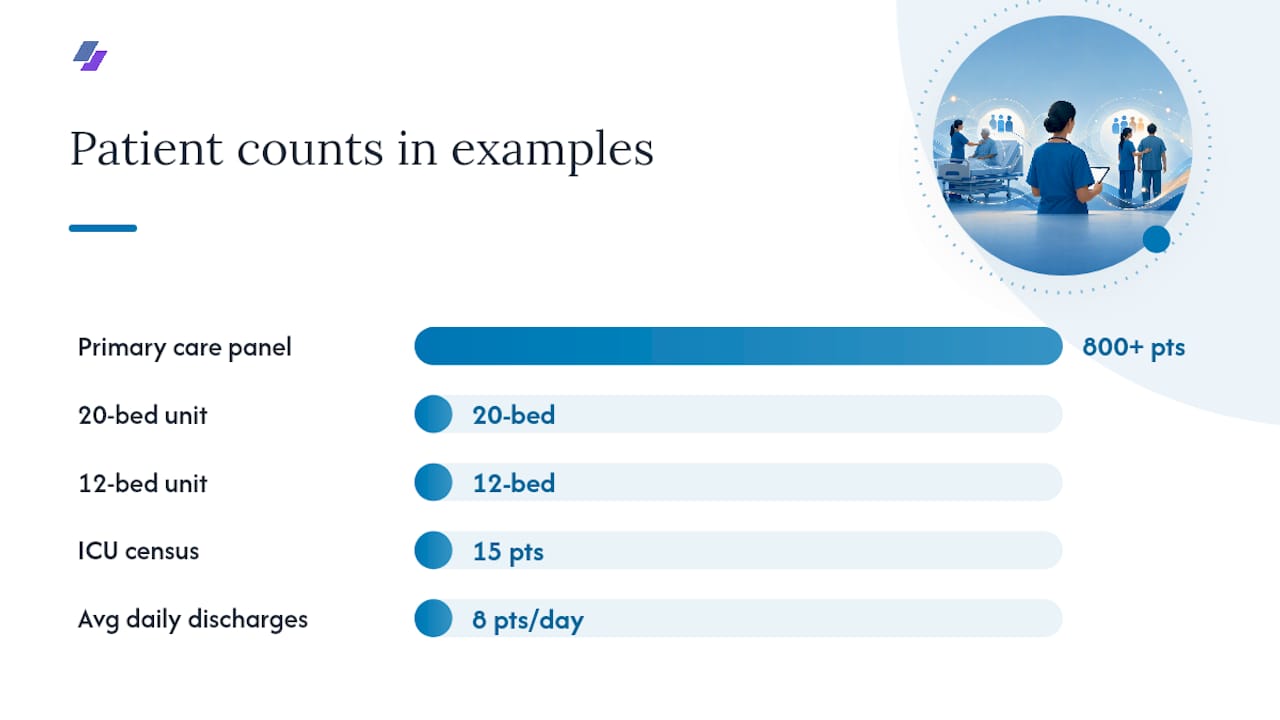
Experienced RN: “Registered Nurse with 6 years of ICU experience managing ventilator care, hemodynamic monitoring, and sepsis protocols for a 12-bed unit. CCRN certified, proficient in Cerner and Pyxis, with a track record of reducing central line infections through protocol adherence.”
APRN/NP: “Family Nurse Practitioner with 5 years of primary care experience, managing chronic disease panels of 800+ patients. Skilled in differential diagnosis, prescriptive authority, and evidence-based treatment planning, with Epic and telehealth platform proficiency.”
Bullets should follow the same logic: skill plus context plus number.
A few more examples worth adapting:
- Implemented a fall-prevention protocol across a 20-bed unit, reducing incidents by 18 percent in six months.
- Coordinated discharge planning for an average of 8 patients daily, improving on-time discharges by 22 percent.
- Trained 6 new graduate nurses on Epic charting and BCMA workflows during unit onboarding.
- Led daily interdisciplinary rounds for a 15-patient ICU census, aligning care plans across nursing, respiratory, and case management.
Turn a plain duty into an achievement bullet by asking three questions: What did I do, how many patients or units were involved, and what changed because of it?
ATS-Safe Dos and Don’ts for Nursing Resumes
Getting keywords onto the page is only half the job. Getting them there without triggering red flags is the other half.
Do:
- Match the posting’s exact language for titles, certifications, and specialty units.
- Test your parsed resume output before submitting.
- Tie every keyword to a specific ratio, outcome, or scope.
Don’t:
- List a certification you don’t hold or that has lapsed.
- Claim EHR experience with a system you’ve never charted in.
- Stuff keywords into a skills list with zero supporting context elsewhere in the resume.
Recruiters and credentialing teams verify licenses and certifications during screening, so a claim that doesn’t hold up gets caught, often after you’ve already invested time in the process. Avoid graphics, text boxes, and multi-column layouts too, since they tend to scramble parsed text even when they look polished on screen.
Pro Tip: If a posting lists a certification as “preferred” rather than “required” and you don’t have it, don’t fake it. Instead, use your summary to name the closest certification you do hold and note that you’re pursuing the preferred one.
What the Research Says About ATS Behavior and Nursing Credentials
The keyword categories in this guide aren’t guesswork. The BLS’s own description of registered nurse responsibilities, assessing patients, administering care, maintaining documentation, is the same language most job requisitions echo, which is why those terms carry weight in ATS scoring.
For advanced practice nurses, the ANCC’s role delineation study for Family Nurse Practitioners names assessment, diagnosis, planning, implementation, and evaluation as core competency domains, giving APRNs a credible framework for specialty keyword choices.
Industry analysis of hiring platforms confirms parsers weight exact specialty language, named credentials, and EHR platforms above paraphrased skills. Jobalign builds its resume generation around this same principle, syncing directly with a candidate’s LinkedIn profile to extract and tailor keywords automatically for each posting.
Why Truthful, Iterative Keyword Use Beats a One-Size-Resume
The biggest mistake I see isn’t under-optimizing, it’s writing one keyword-stuffed resume and reusing it everywhere. ATS scoring rewards precision to each posting, not volume. A resume tailored honestly to ten different units will outperform one generic version blasted at fifty.
Test your parsed output. Adjust language per posting. Never claim a credential you don’t hold. That discipline, more than any single keyword, is what holds up under a recruiter’s second look.
— Johan
Let Jobalign Handle the Keyword Matching for You
Manually rewriting your resume for every posting is exactly the kind of repetitive work that eats an evening you don’t have. Jobalign syncs directly with your LinkedIn profile, pulls your real experience and skills, and generates a tailored, ATS-optimized resume for each job you apply to, matching the categories covered in this guide (title, certifications, specialty terms, EHR names) automatically instead of by hand.
If you’re applying to a handful of similar roles, tailoring manually with the templates above works fine. If you’re applying broadly across units or facilities, an automated match saves real time. Start with a free LinkedIn resume to see your first ATS-optimized draft, or check the Solo, Starter, and Pro plans for unlimited tailored resumes as you apply to more positions.
Sources
FAQ
What Are Good Keywords for a Nursing Resume?
The strongest nursing resume keywords are your license and title (RN, BSN), certifications (BLS, ACLS, CCRN), specialty terms (ICU, Med-Surg, telemetry), and EHR platforms (Epic, Cerner). Place them in your summary, skills section, and the first bullets of your most recent roles.
What Are the 5 P’s of a Resume?
Definitions of the “5 P’s” vary by source, but a common version covers Personal (your title and contact info), Profile (a summary), Proficiency (skills and certifications), Positions (work history), and Proof (measurable results). For nursing resumes, the proof piece, ratios, outcomes, and specific procedures, tends to matter most to both ATS scoring and recruiters.
What Are Good Action Words for a Nurse Resume?
Strong action verbs for nursing bullets include managed, administered, implemented, coordinated, monitored, educated, led, and trained. Pair each verb with a number or scope, such as a patient ratio or a percentage improvement, to turn a duty into an achievement.
What Are the Key Skills to Include on a Nursing Resume?
Key skills include patient assessment, medication administration, IV therapy, wound care, EHR documentation (Epic or Cerner), and certifications like BLS and ACLS. The BLS also confirms care planning and patient education as core duties worth listing.
Does Jobalign Help With Nurse-Specific Resume Keywords?
Yes. Jobalign syncs with your LinkedIn profile and analyzes each job posting to pull matching clinical, certification, and EHR keywords into your resume automatically. Pricing details for unlimited tailored resumes are listed on Jobalign’s pricing page.