Resume Targeting Explained: Your 2026 Guide to More Interviews

A targeted resume is a resume customized for one specific job opening to show exactly how your skills and experience match what that employer needs. This is not just a nice-to-have tweak. ATS-optimized resumes have been shown to achieve notably higher callback rates compared to generic ones, a significant lift attributed to clarity-focused targeting. If you have been sending the same resume to every posting and wondering why the phone stays quiet, resume targeting is the answer.
Here is what targeting actually does. It aligns your language with the employer’s language, surfaces the skills they specifically asked for, and gives both the applicant tracking system (ATS) and the human recruiter an immediate, obvious reason to keep reading. A generic resume forces the reader to connect the dots. A targeted one connects them for you.

What is resume targeting and why does it matter so much?
Resume targeting means rewriting or adjusting your resume so it speaks directly to one job, one company, and one set of requirements. The U.S. Department of Labor defines a targeted resume as one that “focuses on a specific organization or job opening and highlights the skills and experiences you have gained, relevant to that position.” That definition is simple, but the execution is where most job seekers fall short.
Why does it matter so much in 2026? Because the hiring funnel has two gatekeepers before a human even reads your name: the ATS and the recruiter’s seven-second scan. A generic resume often fails both. A targeted one is built to pass both.
- Relevance to ATS: Modern ATS platforms use natural language processing to score your resume against the job description. A resume that mirrors the posting’s language scores higher.
- Relevance to recruiters: Recruiters scan for an obvious job target, obvious skills, and obvious results. Targeting makes all three immediately visible.
- Demonstrated fit: Tailoring your resume shows you actually read the posting, which signals genuine interest and saves the recruiter’s time.
- Higher callback rates: The 178% callback lift from targeted resumes is the clearest evidence that customization pays off.
How to create a targeted resume step by step
The process is methodical, not mysterious. Follow these steps and you will have a targeted resume ready for any application.
-
Scan 10–20 job descriptions for your target title. Pull active postings from LinkedIn, Indeed, and company career pages. Highlight the skills, tools, tasks, and certifications that appear repeatedly. This pattern tells you what the market actually wants, not what you assume it wants.
-
Separate must-haves from nice-to-haves. Requirements that appear in every posting are must-haves. Build your resume around those first. Nice-to-haves appear in some postings; add them only if you genuinely have them.
-
Build a role-version resume, not a per-job rewrite. Building 2–4 role-specific versions instead of rewriting from scratch for every application saves hours without sacrificing targeting quality. Each version covers a distinct job title with its own headline, skills section, and top bullets.
-
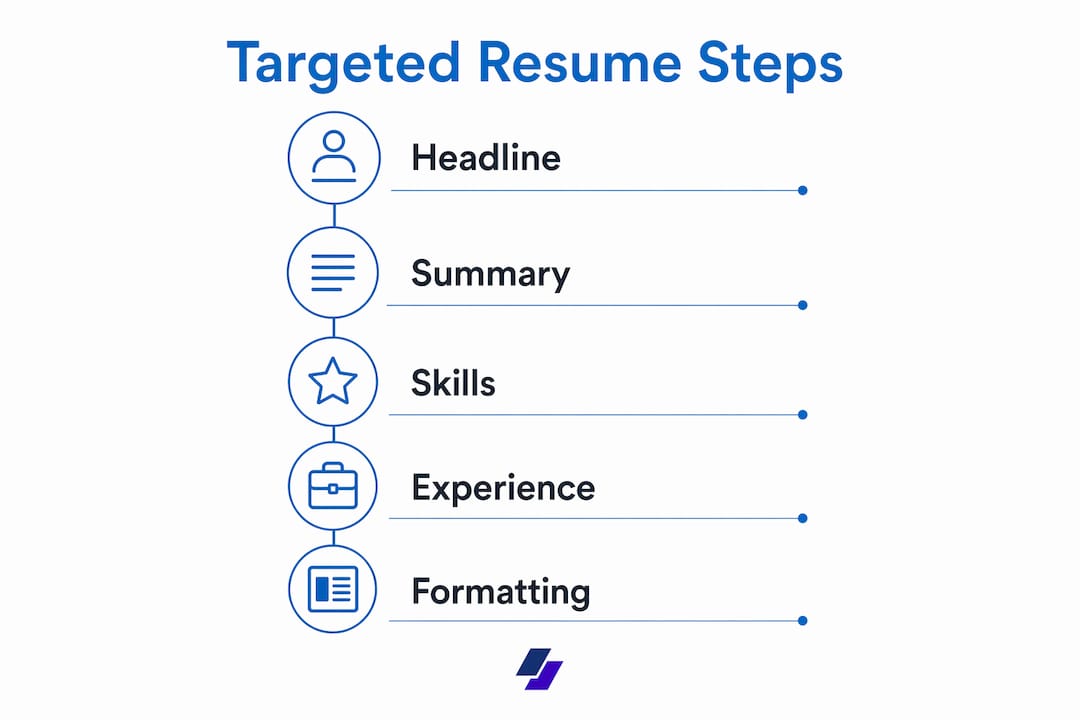
Customize the headline to match the exact job title. Candidates whose resume job title matches the target role are 10.6x more likely to get an interview. Put the target title on the second line under your name, every time.
-
Rewrite your professional summary for this role. Two to three sentences that name the role, your most relevant skills, and one quantified result. Mirror the job description’s language, not your preferred synonyms.
-
Update your skills section to reflect the posting’s priorities. Group skills by category (technical, business, tools). Limit each group to 6–8 specific items. Drop skills that are irrelevant to this role.
-
Rewrite experience bullets using the What + How + Why formula.
- What: the skill, task, or qualification
- How: the tools, methods, or approach you used
- Why: the business outcome or measurable result
Weak: “Worked with data analysis.” Strong: “Built SQL queries to analyze customer retention trends, helping the team identify churn drivers and improve renewal planning.” Same work, completely different signal.
-
Include both acronyms and full terms for technical skills. Write “Natural Language Processing (NLP)” not just “NLP.” Including both versions captures taxonomy-based matching and keyword scanning simultaneously.
-
Apply a 5-minute targeting edit on top of your role-version. For high-priority roles, update the headline to match the exact posting title, surface 2–3 bullets that address the top must-haves, and reorder the skills section. Do not spend 45 minutes on every low-fit application.
-
Proofread for alignment, not just typos. Read the job description one more time, then read your resume. Every required qualification should have a clear echo somewhere in your document. If it does not, add it or address it.
What are the core components of a well-targeted resume?
Every targeted resume shares the same structural skeleton. Get these sections right and the ATS has a clear map to follow.
Header and contact information. Place your name, phone, email, LinkedIn URL, and city or region in the document body, not in a header or footer. ATS parsers often skip headers entirely.
Target-role headline. One line, directly below your name. Use the exact job title from the posting. This single placement drives the 10.6x interview multiplier cited above.
Professional summary. Three to four sentences. State your target role, your two or three most relevant skills, and one specific quantified achievement. This section carries heavy ATS weight as a signal of overall role alignment.
Skills section. Group by category: hard skills, tools, methodologies, certifications. Aim for 8–12 specific, relevant items. A wall of 30 generic skills reads as noise to both ATS and recruiters.
Work experience with achievement bullets. Each bullet answers What + How + Why. Achievement-based bullets prove competency rather than just listing it, which is exactly what ATS 2.0 semantic scoring rewards.
Section headings that carry keywords. “Project Management Experience” as a heading surfaces in recruiter keyword searches. Most job seekers miss this placement entirely.
Formatting that ATS can parse. Single-column resumes without graphics, tables, or text boxes parse most accurately. Multi-column or graphic-heavy templates cause parsing errors that scramble your content before a human ever sees it. Save as .docx unless the posting specifies otherwise.
Common mistakes that kill a targeted resume’s effectiveness
Knowing what to do is half the battle. Knowing what to avoid is the other half.
Keyword stuffing. Repeating “project management” six times in your skills section used to boost match scores. Today, ATS 2.0 platforms actively penalize unnatural repetition as a manipulation signal, the same way Google penalizes websites for the same behavior. One mention in context beats three in isolation.
Hidden text. Some job seekers paste white-font keywords at the bottom of a resume. This does not work. ATS systems strip formatting and expose the text, and the near-universal recruiter response is immediate disqualification.
Generic skills lists without context. A “Core Competencies” block full of buzzwords registers as “low intent” to semantic systems. Skills that are not proven anywhere else in the resume are treated as unverified claims.
Ignoring ATS semantic updates. The system is no longer asking “does this resume contain the phrase ‘project management’?” It is asking “does this resume show evidence this person can actually manage projects?” Tactics built for 2018 ATS tools actively hurt you in 2026.
Over-customizing every single application. Spending two hours on every job posting is unsustainable and unnecessary. The role-version strategy (2–4 versions plus a 5-minute targeting edit) solves this problem without sacrificing quality.
Skipping proofreading for alignment. Typos matter, but misalignment matters more. A resume that is grammatically perfect but does not address the job’s top requirements will still get filtered out.
Pro Tip: Build your role-version resumes once during a focused session, then store them in a clearly labeled folder. When a new posting lands, pull the closest version, run your 5-minute targeting edit, and apply. You will cut your per-application time dramatically while keeping every submission genuinely tailored.
How ATS technology and the 7-second recruiter rule shape your results
Understanding how the system actually works changes how you write every bullet point.
Modern ATS platforms use Natural Language Processing (NLP) and semantic analysis to evaluate resumes. They are not asking whether a keyword appears; they are assessing whether your experience bullets demonstrate genuine competency. ATS 2.0 semantic matching evaluates context, career trajectory, and skill clusters, not just raw text matches.
The concept of “semantic proximity” is the key insight here. A candidate who genuinely knows strategic financial management will naturally use related language: P&L, budget allocation, resource planning, cost reduction, ROI. Those supporting concepts form a rich semantic cluster the algorithm recognizes as authentic. A candidate who typed “strategic financial management” once in a skills section gives the algorithm nothing to work with.
What recruiters look for in the first seven seconds:
- An obvious job target: Is the headline immediately clear about what role this person wants?
- Relevant skills: Can they spot the must-have skills within the top third of the page?
- Measurable results: Do the first few bullets show real outcomes, not just responsibilities?
- Clean formatting: Can they read it without squinting at a cluttered two-column layout?
Matching your resume job title to the target role greatly increases the likelihood of obtaining an interview, demonstrating the importance of that first line. Front-load your most relevant content. The keyword that matches the role’s must-haves should appear in the top third of the resume, not buried below older roles and education.
Pro Tip: Read each bullet point out loud and ask: “Does this sentence prove I have the skill, or just claim I have it?” ATS 2.0 rewards proof. Anyone can write “experienced in data analysis.” Not everyone can write a specific result that only comes from actually doing the work.
What does a targeted resume actually look like in practice?
Seeing the difference between generic and targeted makes the concept click faster than any definition.
Headline comparison:
| Generic | Targeted |
|---|---|
| Marketing Professional | Senior Content Marketing Manager |
| Data Analyst with 5 Years Experience | Data Analyst, SQL & Tableau |
| Project Manager | Agile Project Manager, PMP |
Summary comparison:
Generic: “Experienced professional with strong communication and leadership skills seeking a challenging role.”
Targeted: “Senior Content Marketing Manager with 6 years driving B2B demand generation. Skilled in HubSpot, SEO strategy, and editorial planning. Grew organic traffic 340% over 18 months through a structured content program.”
Bullet point transformation using What + How + Why:
- Generic: “Responsible for managing social media accounts.”
- Targeted: “Grew organic LinkedIn following by 340% over 18 months by building a structured content and engagement calendar, increasing qualified inbound leads by 22%.”
Skills section comparison:
Generic: “Communication, leadership, teamwork, Microsoft Office, problem-solving, detail-oriented.”
Targeted (grouped by category):
- Tools: HubSpot, Salesforce, Google Analytics, SEMrush
- Skills: Content strategy, SEO, demand generation, A/B testing
- Certifications: HubSpot Content Marketing, Google Analytics 4
Cover letter alignment. Your cover letter should mirror the same targeting logic as your resume. Use the exact job title in the opening paragraph, reference two or three of the posting’s must-have requirements by name, and connect them to a specific achievement from your experience. The U.S. Department of Labor recommends keeping cover letters to 250–400 words and structuring them around your qualifications for the specific role, a key achievement, and a clear call to action. A targeted cover letter that echoes your resume’s language reinforces the same semantic clusters the ATS already scored positively.
For role-version differences, a data professional might maintain four versions: one emphasizing SQL and dashboarding for Data Analyst roles, one focused on stakeholder management for Business Analyst roles, one built around A/B testing for Product Analyst roles, and one highlighting team leadership for Analytics Manager roles. Each version shares the same core experience but surfaces different priorities depending on what the posting demands.
How do you measure whether your targeted resume is actually working?
Targeting is a strategy, and like any strategy, you need feedback to know if it is working.
Track your application-to-callback ratio. Keep a simple spreadsheet: job title, company, date applied, resume version used, and whether you received a response. After 15–20 applications, patterns emerge. If one role-version consistently generates callbacks and another does not, the underperforming version needs a revision.
Monitor your ATS score before you apply. Several online tools let you paste a job description and your resume to generate a match score. Aim for 70–80% alignment on key terms from the required qualifications section. You are not trying to hit 100%; you are trying to demonstrate that you speak the same professional language as the role.
Watch your response timing. Applications submitted within the first 24 hours of a posting going live tend to receive more careful review. If you are consistently applying late in the posting cycle, your role-version strategy should include a monitoring step so you can move fast when the right role appears.
Assess the quality of your callbacks. Getting called for roles that are a strong fit is more valuable than getting called for anything. If your callbacks are for roles that do not match your target, your headline or summary may be sending mixed signals. Tighten the targeting on those sections.
Iterate on your bullets. If a specific bullet consistently appears in your targeted versions but never seems to generate traction, rewrite it. Apply the What + How + Why test: does it prove the skill, or just name it? A well-structured ATS resume is never truly finished; it improves with each round of feedback.
JobAlign takes the manual work out of resume targeting
Targeting every resume by hand is the right approach. It is also genuinely time-consuming, especially when you are applying to multiple roles across different job titles. JobAlign gives you the targeting results without the hours of manual editing.
JobAlign syncs directly with your LinkedIn profile, extracts your relevant experience and skills, and generates a fully tailored, ATS-optimized resume for each specific job posting automatically. No complicated setup. No starting from a blank page every time. The platform’s technology handles keyword alignment, role-specific language, and ATS-compliant formatting so your resume passes the filters that reject roughly 75% of applications before a human ever reads them. JobAlign reports an 87% ATS pass rate for resumes generated through the platform.
If you are ready to stop rebuilding your resume from scratch for every application, start generating targeted resumes with JobAlign today.
Key Takeaways
A targeted resume, customized to match a specific job posting’s language and requirements, achieves an 11.7% callback rate compared to 4.2% for generic resumes—a 178% lift, making tailoring your resume the single highest-return action in your job search.
| Point | Details |
|---|---|
| Callback rate advantage | Targeted resumes achieve an 11.7% callback rate vs. 4.2% for generic ones, a 178% lift. |
| Headline match multiplier | Matching your resume job title to the target role makes you 10.6x more likely to get an interview. |
| Role-version strategy | Build 2–4 role-specific versions plus a 5-minute targeting edit instead of rewriting from scratch each time. |
| ATS 2.0 semantic scoring | Embed keywords in achievement-based bullets with context; isolated keyword lists score lower under semantic matching. |
| JobAlign automates targeting | JobAlign syncs with LinkedIn and generates ATS-optimized, tailored resumes for each application automatically. |