Resume Trends 2026: 10–15 Minute Tailoring for Busy Professionals

The resume that gets interviews in 2026 proves measurable, job-specific skills inside an ATS-friendly structure. That combination, skills-first evidence plus quantified achievements plus semantic context that an AI screener can actually parse, beats generic keyword stuffing and flashy design every time. Before you touch a template, check your layout is single-column, quantify at least two bullets, and tailor your top five skills to the job description in front of you.
TL;DR:
- Contextually relevant achievements with measurable outcomes, rather than keyword stuffing, are favored by AI screening systems in 2026.
- Skills-based resumes outperform traditional formats for career changers, those with gaps, or job titles that underrepresent actual experience.
- Strict ATS formatting rules recommend single-column layouts, standard headings, and plain text files; creative designs can hurt deliverability.
- Validating consistency across LinkedIn, portfolios, and online signals enhances credibility and increases callback rates.
- Human-in-the-loop strategies for AI-assisted resume drafting improve personalization, accuracy, and success in high-volume applications.
Table of Contents
- Top Resume Trends 2026 Is Built Around
- What’s Out: Resume Habits Costing You Interviews in 2026
- Resume Formats and ATS-Safe Layout: The Exact Rules
- How to Tailor a Resume in 10 to 15 Minutes for High-Volume Applications
- Using AI Safely: What the Data Says About Human-in-the-Loop Resumes
- Aligning Your Resume With LinkedIn, Portfolios, and Online Signals
- Design and Visual Trends: What’s In and What’s Overdone
- Bias Reduction and Inclusive Language in Resume Writing
- Video Resumes and Other Emerging Digital Formats
- Storytelling in Resume Content: Where Narrative Actually Helps
- How Remote and Hybrid Work Are Reshaping Resume Content
- An Editor’s First-Person Playbook for Modernizing a Resume
- Sources
Top Resume Trends 2026 Is Built Around
Forget the idea that resume trends 2026 means chasing a new visual style every few months. The real shift is structural: screening software got smarter, and recruiters got more skeptical of anything that looks templated. Here’s what’s actually moving the needle.
Semantic ATS screening rewards context, not keyword count. Most Fortune 500 companies now run AI-powered applicant tracking systems that read for meaning, not just exact phrase matches. A system built to recognize “led cross-functional team” as relevant to “team leadership” even without a perfect keyword hit, according to DailyGenius’s 2026 job search trends report. That means stuffing a skills section with disconnected buzzwords does less work than one strong sentence showing you actually did the thing.
Skills-first formats are winning more head-to-head comparisons than they used to. Employers are leaning harder into skills-based hiring, and NACE reports growing adoption of skills-based evaluation across recruiting teams. If you’re changing industries, returning after a gap, or your job titles undersell what you actually do, a skills-forward layout near the top of the page outperforms a strict chronological list.
AI-assisted drafting works, but only as a first pass. Use a tool to generate a rough draft or restructure a messy bullet, then rewrite it in your own voice with your own numbers. Skipping that second step is the single most common way modern resumes get flagged.
If you truly can’t quantify something, describe the scope instead (team size, client count, project scale).
ATS-friendly formatting rules are stricter than most people assume. Single-column layouts, standard section headings (“Experience,” “Skills,” “Education”), and a clean PDF or .docx export still beat every creative alternative. Career resources like MeritAmerica’s 2026 ATS checklist converge on the same short list of rules, and they haven’t changed much because parsing engines still choke on the same things: text boxes, tables, graphics, and multi-column layouts.
Personal branding signals now carry real weight. A LinkedIn profile that matches your resume, a portfolio link, or a short project writeup all function as evidence a recruiter can check in under a minute. Workers who show concrete AI-related projects, not just a list of tools, can see meaningfully higher callback rates and even a wage premium, per DailyGenius’s analysis of 2026 hiring data.
Keyword strategy has shifted from matching to mirroring. Don’t just copy terms from the job posting. Mirror the context around them. If the listing says “manages stakeholder relationships across product and engineering,” don’t just write “stakeholder management.” Show the cross-functional evidence.
A quick gut check on where you stand: does your top third of the page prove you can do the specific job in the posting, using numbers a recruiter can verify? If not, that’s your priority fix before anything cosmetic.
Executive recruiters are raising the bar even further. Industry expert Donna Svei argues that 2026 resumes need to answer leadership-level questions directly, showing you can operationalize AI tools and connect your work to business ROI, not just describe your day-to-day, according to Fast Company’s 2026 resume playbook. That standard is trickling down from senior roles into mid-career hiring fast.
For role-specific examples of how this plays out in practice, our breakdown of software engineer resume keywords and bullet rewrites walks through real before-and-after language.
What’s Out: Resume Habits Costing You Interviews in 2026
Some habits that felt safe a few years ago are now actively working against you. Here’s what to drop.
- Generic objective statements. “Seeking a challenging role where I can grow” tells a recruiter nothing and wastes prime real estate. Replace it with a two-line summary naming your target role and your strongest quantified win.
- Complex, multi-column templates. They look sharp on screen and break silently in ATS parsing, sometimes scrambling your work history into unreadable order. Stick to single-column layouts with standard headings.
- Buzzwords with no backing. “Results-driven,” “dynamic self-starter,” and similar phrases read as filler unless every one is followed by a number or a specific outcome.
- Personal details that add legal or bias risk. Age, marital status, headshots, and full home addresses belong nowhere on a 2026 resume. Most hiring teams no longer expect them, and some flag them as red flags for outdated advice.
- “References available upon request.” Recruiters know this already. The line just eats space you could use for another achievement bullet.
- Fully unedited AI output. A resume that reads like it was generated and never touched again tends to sound generic and occasionally contradicts itself across sections, which is one of the fastest ways to lose credibility with a human reviewer.
One data point worth sitting with: Monster’s State of Resumes 2026 report found that 77% of job seekers worry their resume gets filtered before a human ever sees it. That anxiety is largely solvable with formatting discipline, not more content.
Resume Formats and ATS-Safe Layout: The Exact Rules
Picking a format isn’t about personal preference. It’s about matching your career story to what a screener and a recruiter can both parse fast.
When to use each format:
- Reverse-chronological works best when your last two or three jobs map directly onto the role you’re applying for, with no major gaps or pivots.
- Skills-first works best for career changers, people re-entering the workforce after a gap, or anyone whose job titles undersell their actual capabilities.
- Hybrid (a skills summary up top, followed by reverse-chronological detail) works for most mid-career professionals and is becoming the default recommendation across career-advice guides in 2026.
Layout rules that matter more than they get credit for:
- Use a standard font (Calibri, Arial, or Georgia) at 10.5 to 12 points; anything decorative risks garbling on parse.
- Keep margins between 0.5 and 1 inch; going smaller to cram in content usually backfires visually and structurally.
- Use consistent date formatting throughout (“Jan 2023 to Present,” not a mix of formats).
- Save as a .docx or a text-based PDF, never an image-based PDF or a design-tool export that flattens text into graphics.
- Label sections with standard headings (“Experience,” “Skills,” “Education,” “Certifications”) since semantic ATS models are trained to expect them.
A sample top-of-resume structure by experience level:
| Experience level | What goes in the top third |
|---|---|
| Early career | Name, contact info, 2 line summary, education, then 5 relevant skills |
| Mid-career | Name, contact info, 3 line summary tied to target role, 6 skills, then experience |
| Senior/executive | Name, contact info, ROI-focused summary, leadership skills grid, then experience with business impact bullets |
A quick ATS QA checklist before you submit anything:
- Copy and paste your resume into a plain text file. If the formatting collapses into a mess, an ATS will likely have the same problem.
- Confirm your skills section includes both the exact terms and the natural phrasing used in the job posting.
- Check that dates, job titles, and company names are plain text, not embedded in graphics or tables.
For a deeper breakdown of exact keyword placement by section, see our guide on where to place ATS resume keywords.
Pro Tip: Open your resume in a free browser-based ATS scanner before submitting to any role that asks you to upload a document rather than fill out a form. If your name or job titles don’t show up correctly in the parsed text, fix the file before you send another application.
How to Tailor a Resume in 10 to 15 Minutes for High-Volume Applications
Job seekers are customizing resumes faster than ever, but often shallower: Monster’s 2026 data shows 68% of applicants spend under 30 minutes tailoring each resume, while 49% are still submitting resumes longer than one page. The fix isn’t spending more time. It’s spending it on the right three moves.
- Skim the job description for 60 seconds and pull 3 to 5 priority skills and verbs. Look specifically at the first two bullets under “Responsibilities” and the top of “Requirements.” That’s usually where the real priorities live, not buried further down.
- Rewrite your top two experience bullets to mirror that language and add measurable context. Don’t copy phrases verbatim. Restate them using your own numbers and outcomes.
- Update your summary and skills section to reflect the job’s main context. If the posting emphasizes remote collaboration, your summary should say so explicitly, not just imply it.
- Save with a clean, ATS-safe filename (FirstName_LastName_Resume.pdf, not “Resume_final_v3_edit.pdf”) and run a quick parsing check before you submit.
What to let AI handle, and what to always do yourself: let a tool speed up formatting, restructure a bullet, or suggest phrasing you’re stuck on. Never let it invent numbers, job titles, or dates you didn’t provide, and never submit a draft you haven’t personally read start to finish.
Pro Tip: Keep a master resume with every accomplishment you’ve ever quantified. Tailoring becomes a copy-and-trim exercise instead of a rewrite from scratch, which is how you get the process down to 10 minutes without sacrificing quality.
Using AI Safely: What the Data Says About Human-in-the-Loop Resumes
AI-only resumes are getting rejected at a rate that should give every job seeker pause. A 2026 industry synthesis found that 53% of hiring managers said they’d rejected a candidate they suspected of using AI to write their entire application, according to DailyGenius’s job search trends analysis. The tell is usually generic phrasing, inconsistent voice between the summary and the experience section, or achievements that sound impressive but lack any specific number.
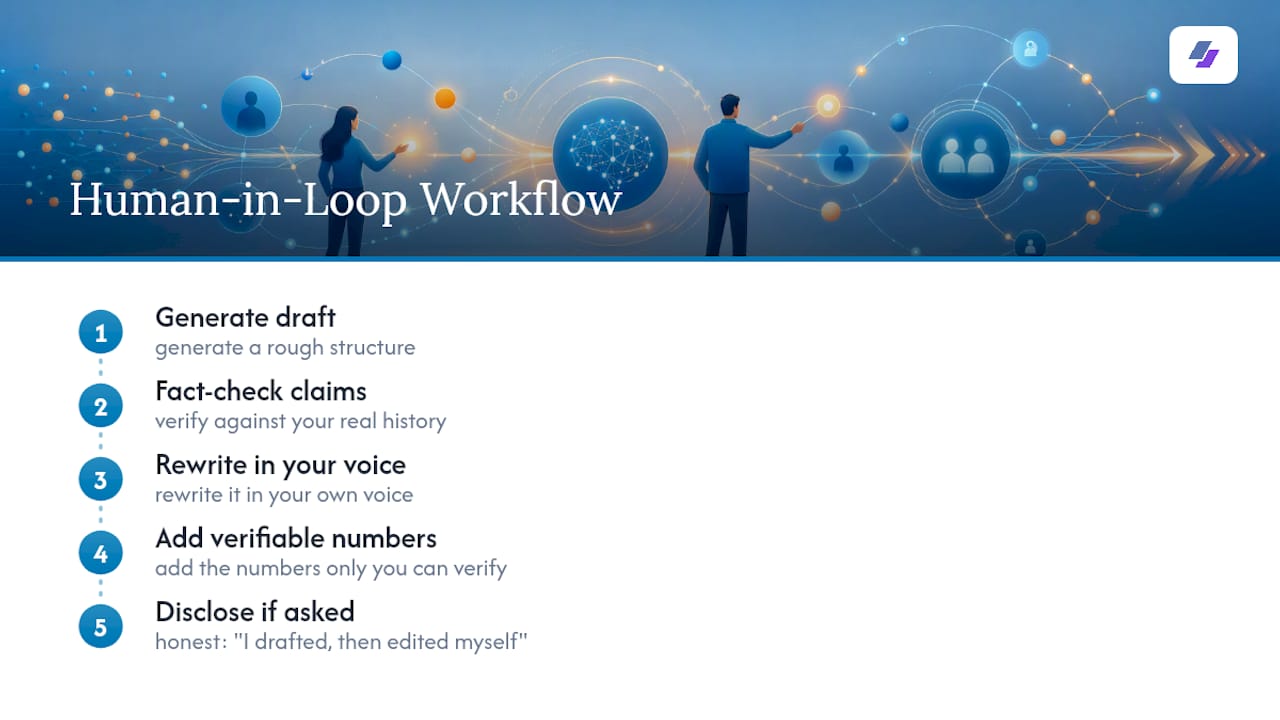
The safest workflow treats AI as a drafting assistant, not a ghostwriter: generate a rough structure, fact-check every claim against your real history, rewrite it in your own voice, then add the numbers only you can verify.
If a recruiter asks whether you used AI tools to build your resume, the honest answer, “I used it to draft and organize, then edited everything myself,” holds up fine. What doesn’t hold up is submitting content you can’t personally explain or back up in an interview.
This is where the human-in-the-loop model actually earns its reputation. Some resume tools sync directly with your LinkedIn profile, extract your real experience and skills, and build a tailored, ATS-optimized resume around job-specific keywords, but the achievements, numbers, and voice still come from you. It’s a starting draft that respects the same fact-check-and-personalize workflow the data supports, not a shortcut around it. For a fuller walkthrough of that process, see our step-by-step guide to optimizing a resume with AI.
Aligning Your Resume With LinkedIn, Portfolios, and Online Signals
A resume that makes claims a recruiter can’t verify in thirty seconds invites skepticism. Every number, title, and date you list should match what shows up when someone searches your name.
Run through this before you submit anything:
- Confirm your LinkedIn headline and current title match what’s on your resume, not an old role you forgot to update.
- Make sure project dates on LinkedIn line up with the dates on your resume; a six-month discrepancy is an easy red flag.
- Link a portfolio or work samples only when they’re current and directly relevant to the role, and label the link clearly (“Portfolio: [name],” not a bare URL).
- If you include a video resume or demo reel link, keep it under two minutes and make sure it doesn’t contradict anything in your written experience section.
- Avoid inflating a title or scope on your resume that your LinkedIn profile doesn’t support. Recruiters cross-reference both more often than most applicants assume.
Consistency across your resume and an optimized LinkedIn profile does more for your credibility than any single achievement bullet.
Design and Visual Trends: What’s In and What’s Overdone
Minimalism won, and it’s not close. The resumes performing best in 2026 use a single accent color (usually a muted navy, deep green, or charcoal) reserved for headers and section dividers, not body text. Bright colors, decorative icons, and graphic skill bars are fading fast, mostly because they parse poorly and read as dated to recruiters who’ve seen a thousand versions of the same template.
Typography matters more than color. Clean sans-serif fonts (Calibri, Lato, Arial) dominate for digital-first resumes, while a classic serif like Georgia still works for more traditional industries (law, finance, academia). Whatever you choose, keep it to one font family with maybe a bold or italic variation for emphasis. Mixing three fonts on one page reads as unpolished, not creative.
White space is doing more work than most job seekers realize. Dense, cramped pages that try to fit everything in one page at 9-point font are actively working against you.
The one exception to minimalism: a small, well-placed skills grid or a horizontal rule separating sections can improve scannability without triggering ATS problems, as long as it’s simple text and lines, not embedded graphics.
Bias Reduction and Inclusive Language in Resume Writing
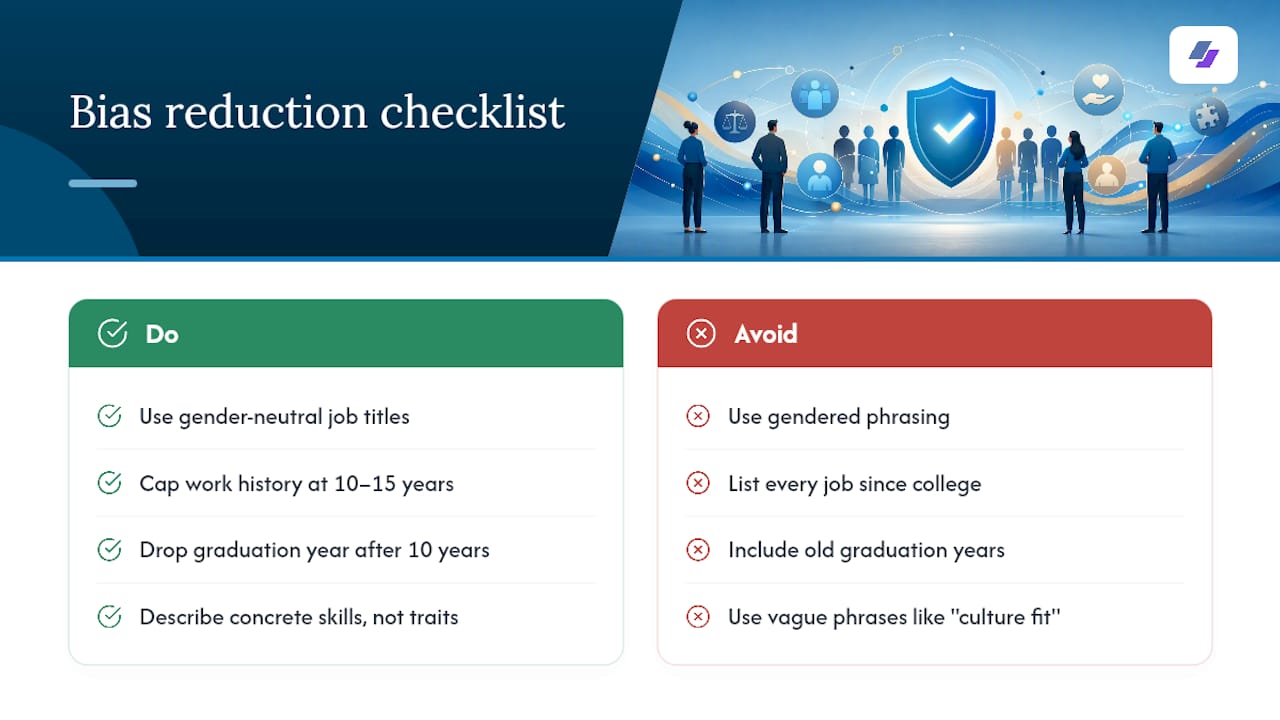
Resume language is getting a closer look in 2026, and some of it comes down to habits nobody questioned five years ago. Gendered phrasing (“salesman,” “he/she will report to”) has largely disappeared in favor of neutral terms (“sales representative,” “this role reports to”). It’s a small fix that removes an unnecessary assumption from the page.
Age-signaling details are the bigger issue. Graduation years older than 15 to 20 years, an “Objective” written like a 1990s template, or listing every job back to your first internship all invite unconscious bias around age, whether or not that’s the intent. The fix is straightforward: cap your work history at 10 to 15 years unless something older is directly relevant, and drop graduation years if you’re more than a decade out of school.
Inclusive language also means being specific rather than coded. “Culture fit” as a phrase has become a flag for bias in hiring conversations broadly, and the same caution applies to how you describe yourself. Instead of “works well with a young, energetic team,” describe the actual skill: “collaborates across cross-functional teams” or “mentors junior staff.” Specificity protects you and reads as more professional either way.
Video Resumes and Other Emerging Digital Formats
Video resumes moved from novelty to niche-but-real in 2026, particularly in creative, sales, and client-facing roles where communication style is part of the job. A 60 to 90 second video, hosted on LinkedIn or a personal site and linked (never embedded as a file attachment), can work as a supplement to a written resume, not a replacement for one.
The format only helps when it’s used with intent. A generic “hi, I’m excited about this opportunity” video adds nothing an ATS or recruiter needs. A short video that walks through one specific project and its outcome, in your own words, gives a hiring manager something a written bullet can’t fully capture: how you actually communicate under low pressure.
Interactive portfolio links and lightweight personal sites are more common too, especially in design, product, and technical roles. The rule stays the same as everything else in this list: link it, label it clearly, and make sure it’s current. A portfolio site with a broken link or a two-year-old project as the top example undercuts the resume more than having no portfolio at all.
Storytelling in Resume Content: Where Narrative Actually Helps
A resume isn’t a personal essay, but the strongest ones in 2026 still use a light narrative thread instead of a flat list of disconnected duties. The technique that works best is framing each role around a problem, an action, and a measurable result, essentially a compressed story arc in one or two lines.
Compare “Managed customer support team” with “Inherited a support team with a 48-hour average response time; restructured ticket triage and cut it to 6 hours within one quarter.” The second version tells a story: there was a problem, you acted, something changed. That structure sticks in a recruiter’s memory in a way a duty list never does, and it gives you something concrete to expand on in an interview.
The summary section is where this matters most. Instead of a list of adjectives, write one or two sentences that frame your career arc: where you started, what you’re known for now, and what you’re aiming at next. Keep it grounded in facts, not aspiration. A summary that reads like a movie trailer instead of a factual arc undercuts your credibility fast.
How Remote and Hybrid Work Are Reshaping Resume Content
Remote and hybrid roles are no longer a footnote on a resume. They’re often the main filter a recruiter uses before reading further. If you’ve worked remotely, say so explicitly, and back it with evidence rather than the label alone: “Managed a fully remote team across four time zones, maintaining 95% on-time project delivery” does more work than “comfortable with remote work” ever will.
Flexibility and asynchronous collaboration skills deserve their own line if they’re genuinely part of your work history. Tools you used to coordinate across time zones, how you handled communication without daily in-person check-ins, and any measurable outcome from that setup (retention, delivery speed, team growth) all count as real evidence, not filler.
One nuance worth flagging: don’t overstate remote experience you don’t actually have just because a posting mentions hybrid flexibility. If your remote work was limited to a few months during a broader in-office role, describe it accurately. Recruiters screening for genuine remote-readiness ask about this directly in interviews, and an inflated claim falls apart fast under a follow-up question.
An Editor’s First-Person Playbook for Modernizing a Resume
My routine for updating any resume comes down to three passes, done in order, never combined. First pass: strip everything that doesn’t answer “what changed because I did this.” Second pass: rebuild the top third of the page around the specific role I’m targeting, not a generic version of my career. Third pass: read it out loud. If a sentence sounds like something I’d never actually say to a colleague, I rewrite it.
Here’s a real pattern I see constantly and fix the same way every time. Before: “Responsible for social media strategy and content creation.” After: “Grew organic Instagram following from 4,200 to 19,000 in eight months by shifting posting cadence and content mix based on engagement data.” Same person, same job. One version proves something happened.
Before you send anything out, run it through both filters that matter: does an ATS parse it cleanly, and does a human reading it for six seconds walk away knowing exactly what you’re good at? If either answer is no, you’re not done yet.
— Johan
Sources
- 12 Job Search Trends You Need to Know in 2026
- Your 2026 resume playbook: what wins resume tips 2026 (Fast Company)
Ready to put these trends into practice without rebuilding your resume from scratch every time you apply? Browse ATS-ready resume examples by role or see how Jobalign’s pricing plans support tailored resumes, one for every job posting, synced straight from your LinkedIn profile.