The Role of Client Work in Resume Building

Client work is defined as any professional project completed for an external paying client, and its role in resume building is to prove real-world accountability, business impact, and professional reliability that classroom or internal projects simply cannot match. Approximately 75% of resumes are rejected by ATS before a human ever reads them. That means your content must work harder than ever. Freelance experience, consulting engagements, and contract projects all fall under this category. When framed correctly, they signal to employers that you have managed real stakes, real deadlines, and real consequences.
How does client work demonstrate real-world problem solving?
Client projects develop skills that no academic assignment can replicate. When you work for a paying client, you face competing stakeholder priorities, shifting requirements, and the pressure of a real business outcome on the line. That combination forces you to grow faster than any classroom setting.
Maggie Proper, a designer, describes how client work changed her entire approach by teaching her to treat the brief as a conversation rather than a fixed instruction. That shift, from passive executor to active problem solver, is exactly what employers want to see on a resume. It signals maturity and professional judgment.

Client projects also build communication skills that internal roles rarely demand at the same level. You learn to ask clarifying questions, simplify technical explanations for non-technical clients, and manage expectations across the full project lifecycle. Forsk Coding School notes that real client projects teach professionals to handle genuine problems, communicate effectively, and deliver quality work on time.
The accountability factor is equally significant. When a client pays you, there is no safety net of a supervisor absorbing the consequences of a missed deadline. Hiring experts recognize that client work signals reliability and the ability to meet business needs with minimal supervision. That is a trust signal most internal project experience cannot provide.
- Stakeholder management: You balance the needs of clients, end users, and sometimes third-party vendors simultaneously.
- Deadline ownership: You set and meet timelines without a manager enforcing them for you.
- Communication under pressure: You deliver difficult updates, flag problems early, and maintain client confidence throughout.
- Adaptability: Real client briefs change. You learn to adjust scope without losing quality.
Pro Tip: When you list client work on your resume, note whether the engagement was repeat business. A client who hired you more than once is a stronger credibility signal than ten one-off projects.
Why should you frame client work with outcomes, not deliverables?
The single biggest mistake job seekers make with client work is listing what they built instead of what the client gained. Deliverables are outputs. Outcomes are results. Employers hire for results.
Jason Early advises rewriting resume entries to emphasize the outcomes clients achieved rather than the project outputs you produced. The difference in reader impact is significant. A bullet that reads “Designed a new onboarding flow” tells a recruiter what you did. A bullet that reads “Redesigned onboarding flow, reducing client churn by 18% in the first quarter” tells them what it was worth.
Outcome-focused language also performs better in ATS scoring. Keywords tied to business results, such as “revenue,” “retention,” “cost reduction,” and “time saved,” appear in more job descriptions than task-based verbs alone. Pairing deliverable language with outcome language gives your resume both the keyword match and the human impact.
| Deliverable-focused bullet | Outcome-focused bullet |
|---|---|
| Built a reporting dashboard for a retail client | Built a reporting dashboard that cut weekly reporting time by 6 hours for a retail client |
| Wrote social media content for a startup | Wrote social media content that grew the client’s Instagram following by 40% in 90 days |
| Managed a website migration project | Managed a website migration with zero downtime, preserving $50K in monthly e-commerce revenue |
| Designed a brand identity package | Designed a brand identity that the client used to secure a Series A funding round |
Long-term client engagements create an even stronger resume narrative than multiple short projects. Repeat work for the same client shows sustained trust and compounded value, which is harder to fake and more impressive to a hiring manager than a long list of one-off gigs.
Pro Tip: If you cannot find a hard number for an outcome, use a qualitative result. “Improved client confidence in the product roadmap” is still stronger than “Attended weekly client calls.”
How should you handle client names and confidentiality on a resume?
Presenting client work on a resume requires judgment. Not every client name belongs in your professional experience section, and getting this wrong can cost you more than it gains.
The general consensus among consulting professionals is to name a client only when three conditions are met: the client is publicly known, the relationship is not confidential, and naming them adds genuine credibility. A Fortune 500 brand name on your resume carries weight. A small local business name typically does not, and naming it without permission creates unnecessary risk.
When you cannot name the client, describe the project by industry and scale instead. “E-commerce client with $5M in annual revenue” communicates context without breaching confidentiality. “Regional healthcare provider” tells a recruiter enough to understand the environment you worked in.
Resume structure matters as much as the content itself. Client work belongs in your professional experience section, not a separate “freelance” catch-all at the bottom. List it with a clear role title, the engagement period, and a brief project description followed by outcome-focused bullets.
- Named client: Use when the client is a recognized brand and you have explicit or implied permission.
- Generic client description: Use when confidentiality applies or the client name adds no value. Example: “B2B SaaS startup, Series B.”
- Client type: Use when the industry context matters more than the specific company. Example: “Financial services client.”
- Project-based listing: Use when you completed multiple short engagements. Group them under a consulting or freelance header with individual project bullets beneath.
For job seekers who want to stand out with a resume, structuring client work clearly within the professional experience section is one of the fastest ways to increase recruiter attention.
Practical steps to leverage client work in job applications
Translating client experience into job application success requires more than copying your project list onto a resume. You need to tailor, contextualize, and present that experience in a way that speaks directly to each employer’s needs.
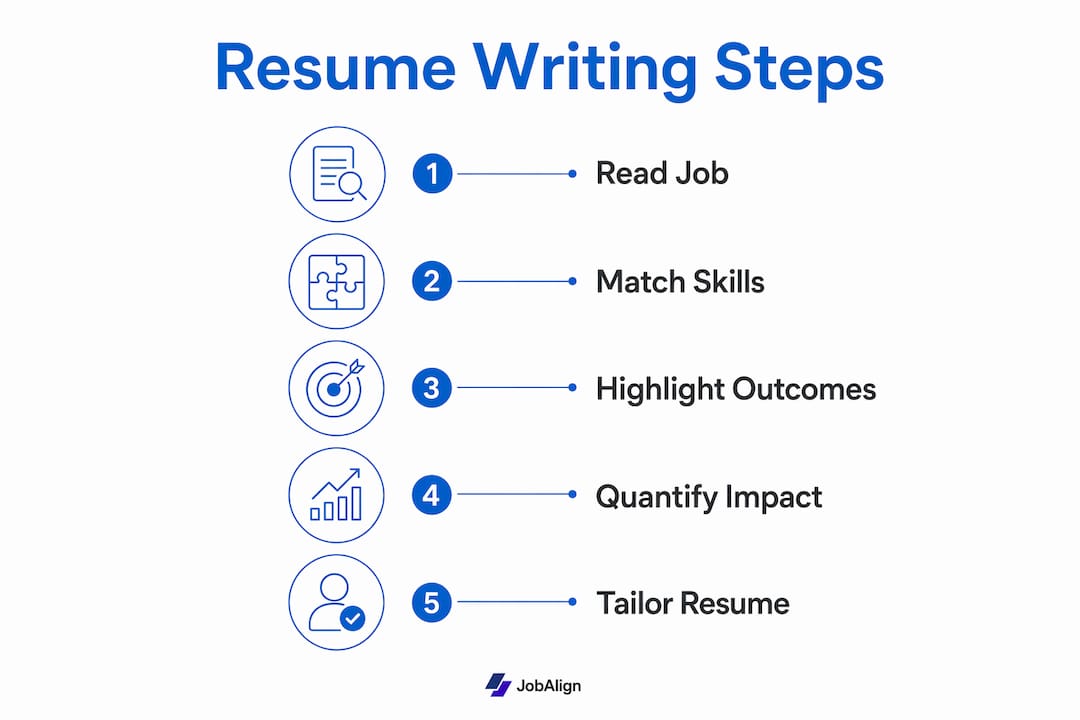
Start by reading the job description carefully and identifying the skills and outcomes the employer values most. Then map your client projects to those priorities. If the role emphasizes cross-functional collaboration, lead with the client project where you managed the most stakeholders. If it emphasizes speed to market, lead with the engagement where you delivered fastest.
Ben Matthews recommends regular status updates, early problem flagging, and structured final handovers as baseline practices for professional client management. These same behaviors translate directly into resume language. “Maintained weekly status reports for a six-month engagement” shows process discipline. “Flagged a scope risk three weeks before deadline, preventing a budget overrun” shows judgment.
In interviews, use client work stories to answer behavioral questions. The STAR format (Situation, Task, Action, Result) maps naturally onto client project narratives. Your client was the situation. Their problem was the task. Your solution was the action. Their business outcome was the result.
- Tailor every application: Match your strongest client project to the top priority in each job description.
- Use testimonials: A short client quote in your portfolio or LinkedIn profile adds third-party credibility that a resume alone cannot provide. Learn more about using client testimonials to reinforce your resume.
- Highlight repeat engagements: Note when a client extended or renewed your contract. It signals trust and performance.
- Quantify wherever possible: Time saved, revenue generated, error rates reduced. Numbers make outcomes concrete.
- Link to a portfolio: If your work is visual or documented, include a URL. Recruiters who click through are already more engaged.
For project managers specifically, client project experience is a core differentiator. A project manager resume that shows client-facing delivery is consistently stronger than one that lists only internal initiatives.
Key Takeaways
Client work builds the kind of resume credibility that internal projects and academic experience cannot replicate, because it proves real accountability, real outcomes, and real professional relationships.
| Point | Details |
|---|---|
| Outcomes over deliverables | Write resume bullets that show what the client gained, not just what you built. |
| Accountability as a signal | Client work proves you can meet deadlines and manage expectations without supervision. |
| Confidentiality judgment | Name clients only when they are publicly known and naming them adds genuine value. |
| Repeat engagements matter | Long-term client relationships show sustained trust and are stronger than many one-off projects. |
| Tailor to each job | Map your strongest client project to the top priority in each job description before applying. |
What client work really taught me about resume storytelling
Most job seekers treat client work as a footnote. They list it at the bottom under “freelance” and move on. That is the wrong instinct entirely.
The professionals I have seen land the most competitive roles are the ones who put client work at the center of their resume narrative. Not because it sounds impressive, but because it is the most honest proof of professional capability available. You cannot fake a client relationship. You either delivered or you did not.
What I find most underrated is the value of long-term client relationships on a resume. A single client who hired you three times over two years tells a hiring manager more than a dozen one-off projects ever could. It says: this person solves problems well enough that a real business kept coming back. That is the kind of signal no certification or degree can replicate.
The other thing most articles miss is the emotional maturity that client work develops. Managing a client who changes the brief mid-project, or who is unhappy with a first draft, teaches you how to stay professional under pressure. That skill shows up in interviews, in how you answer difficult questions, and in how you carry yourself. Employers sense it even when they cannot name it.
Frame your client work as client-centered solutions, not personal achievements. The shift is subtle but powerful. “I built a new reporting system” is about you. “I built a reporting system that gave the client real-time visibility into their sales pipeline” is about them. Employers hire people who think about impact, not just output.
— Johan
Jobalign makes your client work count in every application
Translating client project experience into a tailored, ATS-ready resume for every job you apply to is time-consuming when done manually. Jobalign automates that process by syncing with your LinkedIn profile and extracting the most relevant experiences for each specific job description. The platform’s proprietary technology ensures your outcome-focused client work language is paired with the right keywords for each role, giving your resume an 87% ATS pass rate. You get a tailored resume per posting without complicated setup. If you are ready to put your client experience to work in every application, the Jobalign LinkedIn Resume Generator is the fastest way to get there.
FAQ
What counts as client work on a resume?
Client work includes any paid project completed for an external client, such as freelance contracts, consulting engagements, or agency work. It belongs in your professional experience section with a clear role title and outcome-focused bullets.
Should I name my clients on my resume?
Name a client only if they are publicly known, the relationship is not confidential, and the name adds real credibility. Otherwise, describe the client by industry and scale, such as “B2B SaaS startup” or “regional healthcare provider.”
How do I write resume bullets for client projects?
Lead with the business outcome the client achieved, not the task you completed. Replace “Built a dashboard” with “Built a dashboard that reduced weekly reporting time by 6 hours” to show measurable impact.
Is freelance experience as valuable as full-time employment on a resume?
Freelance client work is often more credible than internal roles for demonstrating accountability, because client projects signal the ability to meet business needs independently without a manager absorbing the risk.
How do I handle client work that I cannot discuss in detail?
Describe the project by industry, scope, and outcome without naming the client or revealing proprietary details. “Delivered a data migration project for a financial services firm, completed two weeks ahead of schedule” communicates value without breaching confidentiality.