What Is a Career Objective Statement? Examples & Templates

A career objective statement is a one- to two-sentence line at the top of your resume that names the role you want, the skill or credential you bring, and the value you’ll deliver. Here’s the fill-in-the-blank version you can copy right now:
“[Job title] with [key skill or credential] seeking to [action verb + goal] at [company or industry], bringing [specific value or result].”
A quick example: “Detail-oriented marketing coordinator with three years of social media management experience seeking to grow brand engagement at a consumer tech company, bringing demonstrated success in significantly increasing follower growth.”
That’s the whole concept in one sentence. Everything below explains when to use it, how to write one that actually earns a second look from a hiring manager, and how to tailor it so it survives an Applicant Tracking System (ATS) scan.
Before you fill in your own version, it helps to know:
- It sits directly under your name and contact information, not buried mid-resume.
- It’s short by design. One to two sentences, never a paragraph.
- It works best when it answers “why should this employer keep reading?” instead of “what do I want out of this job?”
Key Takeaways
A career objective statement is a one to two sentence line at the top of your resume that names your target role, your top qualification, and the value you’ll deliver to that specific employer.
| Point | Details |
|---|---|
| Definition | An objective states your target role, key skill, and value in one to two sentences below your contact info. |
| Use it strategically | Objectives work best for entry-level, career-change, relocation, or nonlinear-experience applicants. |
| Tailor every time | Pull 3 to 5 keywords from each job posting and fold in 1 or 2 naturally to improve ATS visibility. |
| Avoid generic phrasing | Replace “seeking a challenging role” with a specific title, skill, and measurable value. |
| Speed up tailoring | JobAlign generates a keyword-matched, ATS-optimized objective and resume from your LinkedIn profile for each application. |
Table of Contents
- What Is a Career Objective Statement, Exactly?
- When Should You Use a Career Objective vs a Summary?
- What Is a Career Statement, and How Is It Different From a Career Objective?
- Career Statement vs Objective vs Summary vs Mission vs Vision
- Why Does a Career Objective Matter to Hiring Managers?
- How Do You Write an Effective Career Objective?
- Career Objective Examples for Every Situation
- What Mistakes Make a Career Objective Fall Flat?
- Where Should the Objective Go on Your Resume?
- How Do You Tailor an Objective to Beat ATS Filters?
- Quick Templates and a Proofreading Checklist
- Treat Every Objective Like a Live Experiment
- Let JobAlign Write Your Objective for You
- Frequently Asked Questions
- Sources
What Is a Career Objective Statement, Exactly?
A career objective is a brief, targeted statement of your professional goal paired with the qualification that makes you a fit for it. CareerAddict defines it as a short section presenting your goals and relevant skills, training, or experience, and it typically sits right below your contact details. That placement matters: it’s the first thing a recruiter reads after your name, which is exactly why it needs to work harder than any other line on the page.
People often confuse an objective with a resume summary or a personal statement, but the three serve different jobs. A resume summary recaps your career highlights and works best for candidates with a solid track record to showcase. A personal statement, more common on graduate school applications or portfolios, tells a longer story about who you are and why you’re pursuing a path. A career objective does neither. It states a specific goal and a specific qualification, and it does it fast.
- Career objective: one to two sentences, forward-looking, states the role and the value you bring.
- Resume summary: three to four sentences, backward-looking, recaps achievements and years of experience.
- Personal statement: longer narrative, used mainly for academic or creative applications, not typical resumes.
A resume objective is a short, targeted line at the top of your resume that summarizes your career goals and the qualifications you bring to a role. Think of it as the answer to “what are you aiming for, and why are you qualified to get there?”
When Should You Use a Career Objective vs a Summary?
Not every resume needs an objective, and knowing when to skip it is just as useful as knowing how to write one. Objectives shine when your resume needs upfront context that your work history alone doesn’t provide.
You’ll get the most value from an objective if you’re an entry-level applicant with limited work history, a job seeker pivoting into a new field or industry, someone relocating and needing to explain why you’re applying out of state, or a candidate with a varied or nonlinear career path that benefits from a clear statement of direction. The Muse notes that objectives are especially useful for career changers and entry-level applicants because a hiring manager can’t infer intent from the work history alone.
A professional summary usually serves you better if you have several years of relevant experience in the same field, a track record of measurable achievements worth highlighting immediately, or a resume that already makes your career direction obvious from your most recent title. And if neither fits, some resumes are fine skipping both and jumping straight into experience, particularly for senior roles where the work history speaks for itself.
- Use an objective: entry-level, career change, relocation, gaps or nonlinear history.
- Use a summary: established career, strong recent results, clear trajectory.
- Use neither: senior-level resumes where title and experience make intent obvious.
What Is a Career Statement, and How Is It Different From a Career Objective?
A career statement, also called a career goal statement, is a short declaration of your professional direction: where your career is headed and what you bring to it. Its length depends on where it’s asked for, since a resume, an application form and a development plan each expect a different size.
“Career objective” is the resume version, covered in full under What Is a Career Objective Statement, Exactly?. That leaves the ambiguity of the wider term, which is worth pinning down before you write one:
- On a resume, “career statement” and “career objective” describe the same one- to two-sentence block under your contact details.
- No standards body owns the term. If a recruiter, a career center, or an application form asks for a “career statement,” check the word count they expect before assuming which one they mean.
- Length is the tell. A field capped near 40 words wants the objective version. A field that allows a full paragraph wants the vision or mission version.
Career Statement vs Objective vs Summary vs Mission vs Vision
Five terms get used for a statement of career direction, and only two of them are resume sections. Here is the whole set side by side.
| Term | What it is | Where it lives | Typical length | When to use it |
|---|---|---|---|---|
| Career statement | Umbrella term for a short statement of career direction. | Wherever someone asks for your career goals: a resume, an application form, a development plan. | Varies with where it’s asked for, from one sentence to a short paragraph. | When someone asks for one by that name. Clarify the length they expect. |
| Career objective | The resume section naming target role, top qualification, and value. | Directly under your name and contact block. | One to two sentences. | When the resume needs to state intent your job titles do not show. |
| Professional summary | A recap of what you have already done and delivered. | Same spot on the resume, instead of an objective. | Three to four sentences. | Established track record in the field you’re applying to. |
| Personal mission statement | A values-and-purpose line about how you work (not the academic personal statement). | LinkedIn About section, personal site, coaching worksheet. | One to three sentences. | Personal branding and networking profiles, rarely on a resume. |
| Career vision | A private, longer-range picture of where you want to be. | Career plan, development review, your own notes. | A short paragraph. | Planning your next three to five years, not applying to a job. |
The same five in one line each, with the numbers that decide the format:
- Career statement: the umbrella term, with no fixed length; match the format and word count the reader asked for. On a resume it takes the form of a career objective.
- Career objective: one to two sentences naming your target role, your top qualification, and the value you’ll deliver, forward-looking and written for one specific posting.
- Professional summary: three to four sentences recapping results you have already delivered. It replaces the objective rather than joining it.
- Personal mission statement: one to three sentences on the purpose behind your work and the way you do it. It reads well on a profile and badly on a resume, where employers want a role and a result.
- Career vision statement: long-range, three to five years out, a short paragraph, written for yourself and not for a recruiter. Treat it as the source material your objectives get cut down from.
One example of each, with the fill-in-the-blank version underneath:
- Career statement (asked for by name): “Supply chain analyst building a career around sustainable sourcing, seeking a procurement role, bringing supplier-emissions analysis that cuts both carbon and landed cost.” Template: “[Field] analyst building a career around [focus], seeking a [target role], bringing [skill or analysis] that [employer outcome].”
- Career objective (one specific posting): “Bilingual account manager with four years in SaaS renewals, seeking to reduce churn for a mid-market customer success team.” Template: “[Title] with [X years] in [specialty], seeking to [employer outcome] for a [company type] team.”
- Professional summary (established track record): “Financial analyst with seven years in manufacturing FP&A. Built the rolling forecast model now used across four business units. Cut the monthly close from eight days to five.” Template: “[Title] with [X years] in [specialty]. Built [system or process] now used across [scope]. Cut [metric] from [before] to [after].”
- Personal mission statement (LinkedIn About or personal site): “I use plain writing and patient teaching to make complex health information usable by the people who need it most.” Template: “I use [method] and [method] to make [subject] usable by [audience].”
- Career vision statement (your own planning notes): “Within five years, lead a data team at a climate technology company, with direct responsibility for how our models inform policy decisions.” Template: “Within [X years], [target role] at a [industry] company, with direct responsibility for [scope].”
Work down this list and stop at the first line that describes you:
- Applying to a specific job? That call is already settled under When Should You Use a Career Objective vs a Summary?: an objective for entry-level, career-change or relocation cases, a summary for an established track record, and neither when your most recent title already makes your direction obvious.
- A form or a recruiter asked for a “career statement”? Write the objective version, one to two sentences, unless they specified a longer word count.
- Filling in a LinkedIn About section or a personal site? A personal mission statement fits there, and you can follow it with your objective.
- Planning your next move rather than applying? Write a career vision first, then cut objectives out of it per application.
- Still unsure which of the five you were asked for? Write the one- to two-sentence version; it’s the shortest and the easiest to retailor.
One practical note: whichever you pick, it sits in the same top block as the rest of your resume (see Where Should the Objective Go on Your Resume?). If you’d rather not rewrite that top block for every posting, JobAlign generates a tailored, ATS-first resume for each posting from your synced LinkedIn profile.
Why Does a Career Objective Matter to Hiring Managers?
The top third of your resume gets scanned first, and it decides whether the rest gets read at all. Treat that space as your 30-second elevator pitch. Hiring managers and ATS software both process resumes from the top down, so a vague or missing objective wastes the most valuable real estate on the page.
Clarity does two things at once. It tells a human reader instantly whether you’re a plausible fit, and it gives an ATS a clean block of role-relevant language to match against the job posting. A generic line like “seeking a challenging position where I can grow” fails both tests. It says nothing about the role, the company, or what you offer, and it gives an ATS nothing to latch onto.
- A focused objective signals fit within seconds, before a recruiter reads a single bullet point.
- Vague objectives get skimmed past because they contain no scannable signal.
- ATS software weighs the top section of a resume heavily when matching job-specific terms.
Pro Tip: Write your objective from the employer’s side of the desk. Swap “I’m looking for a role that lets me grow” for “I bring three years of X to help your team achieve Y.” One version is about you; the other is about them, and only one gets remembered.
How Do You Write an Effective Career Objective?
Every strong objective follows the same underlying structure: target role plus top qualification plus the value or goal you’re driving toward. Recruiter-facing guides describe this same formula: name the role or field, highlight one strong skill or credential, then state the value you’ll bring. Here’s how to build it step by step.
- Name the target role and what the employer needs. Look at the job title and the top requirement listed in the posting.
- Add your strongest matching skill or credential. Pick the one qualification most likely to matter to this specific employer, not a laundry list.
- Close with a measurable goal or outcome. A number, a result, or a clear direction beats a vague aspiration every time.
- Trim to one or two sentences. Guidance from U.S. News Careers recommends keeping objectives tailored and concise rather than padded with filler.
- Swap in a keyword from the job description. Replace a generic term with the exact phrase the employer used, where it fits naturally.
A few wording habits separate a sharp objective from a forgettable one: use active verbs (“drive,” “manage,” “build”) instead of passive ones (“responsible for”), cap length at roughly 25 to 40 words, and mirror the job title’s exact phrasing when your background genuinely matches it.
Here’s a before-and-after to show the difference in practice:
- Before: “Looking for a job in customer service where I can use my skills and grow professionally.”
- After: “Customer service representative with two years of retail experience seeking to reduce response times at a fast-growing e-commerce company, bringing a high customer satisfaction rating.”
Pro Tip: Draft three versions in five minutes flat. Write the role-and-skill line first, then try two different closing goals. Read both aloud. The one that sounds like you’d say it in an interview is the one to keep.
Career Objective Examples for Every Situation
Adapting a template to your exact situation is faster than writing from scratch. Here are objectives grouped by the scenarios where they perform best, each with a fill-in-the-blank version underneath.
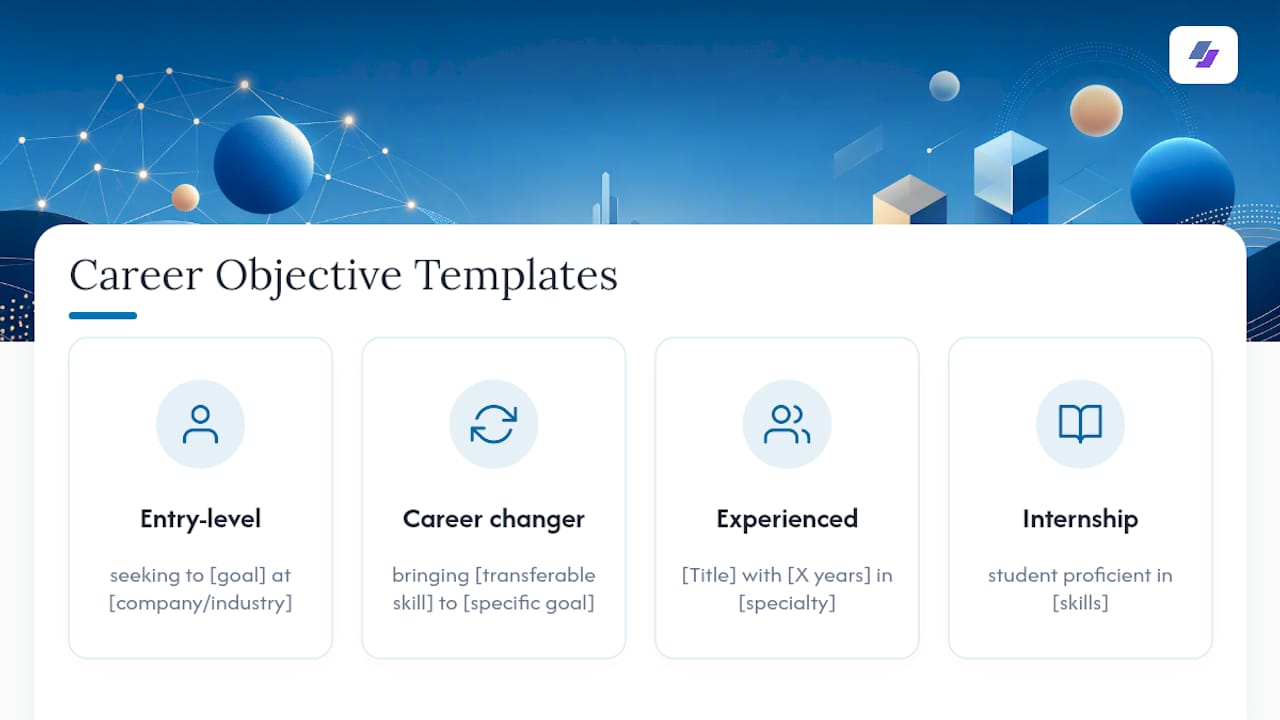
Entry-level graduate: “Recent marketing graduate with hands-on internship experience in content creation, seeking to support a growing brand team by producing data-driven social campaigns.” Template: “Recent [degree] graduate with [internship/project experience] seeking to [goal] at [company/industry].”
Career changer: “Former high school teacher transitioning into corporate training, bringing 6 years of curriculum design and public speaking experience to help onboard new hires faster.” Template: “Former [previous role] transitioning into [new field], bringing [transferable skill] to [specific goal].”
Experienced professional (relocation or pivot within field): “Operations manager with 8 years overseeing warehouse logistics, relocating to Denver and seeking to streamline fulfillment processes for a mid-size distribution company.” Template: “[Title] with [X years] in [specialty], relocating to [location] and seeking to [goal] at [company type].”
Internship or first job seeker: “Computer science student proficient in Python and SQL, seeking a summer internship to contribute to data analysis projects at a health tech startup.” Template: “[Field] student proficient in [skills], seeking [internship/role type] to [goal] at [company type].”
Nonlinear or varied background: “Versatile professional with experience across retail management and freelance graphic design, seeking to bring a hybrid creative and operational skill set to a growing agency’s project management team.”
Once you’ve picked the closest match, swap in the exact job title, company type, and one metric or skill pulled straight from the posting. That last step is what turns a generic template into an objective that reads like you wrote it for that specific job.
What Mistakes Make a Career Objective Fall Flat?
Most weak objectives fail for one of four reasons: they’re too generic, too long, focused on what you want instead of what you offer, or stuffed with buzzwords no evidence backs up. Career guidance from CareerAddict specifically flags the “what I want” framing as a common error, recommending applicants shift the focus toward what they offer the employer instead.
Here’s how the fix looks in practice:
- Too generic: “Seeking a position where I can use my skills.” → Fixed: “Seeking a data analyst role where I can apply three years of SQL and Tableau experience to improve reporting accuracy.”
- Too long: A four-sentence paragraph explaining your entire career history. → Fixed: One sentence naming role, skill, and goal.
- Employer-focused wording missing: “I want to grow my career in sales.” → Fixed: “Bringing a proven cold-calling framework to help grow your sales pipeline effectively.”
- Buzzwords without proof: “Passionate, driven professional seeking new challenges.” → Fixed: “Project coordinator who delivered 12 client projects on time and under budget in the past year.”
Run your draft through this quick self-audit before you finalize it:
- Does it name a specific role or field, not just “a position”?
- Does it include one concrete skill, credential, or result?
- Is it under 40 words?
- Does it focus on what you offer rather than what you want?
- Does it include at least one term pulled from the actual job posting?
Where Should the Objective Go on Your Resume?
Placement is non-negotiable: the objective goes in the top third of the page, directly beneath your name and contact information, before your work experience or education sections. That’s the section every reader’s eye hits first, human or automated, so burying it lower defeats the purpose entirely.
Formatting matters almost as much as placement. Keep it to one or two lines, avoid a bullet point format (write it as a flowing sentence, not a fragmented list), and skip first-person pronouns like “I” or “my,” since resumes conventionally drop them for a cleaner, faster read. Use a standard font that matches the rest of your resume; this isn’t the place to experiment with styling.
- Place it beneath your name and contact block, above your experience section.
- Keep it to one or two sentences, no bullet formatting.
- Drop first-person pronouns for a cleaner, more professional read.
- If submitting a plain-text version for an older ATS, avoid special characters, symbols, or unusual spacing that could scramble on parsing.
- For PDF submissions, confirm the text is selectable (not an image) so ATS software can actually read it.
How Do You Tailor an Objective to Beat ATS Filters?
Tailoring your objective with the job description’s own language is one of the most reliable ways to improve how an ATS scores your resume against a posting. Guidance on tailoring your resume confirms that integrating job-specific keywords helps a resume clear initial ATS filters and signals fit to the humans who read it afterward. Since a large percentage of resumes get rejected by ATS software before a person ever sees them, the objective line is not the place to phone it in.
Here’s a simple three-step workflow to tailor an objective for any posting in a few minutes:
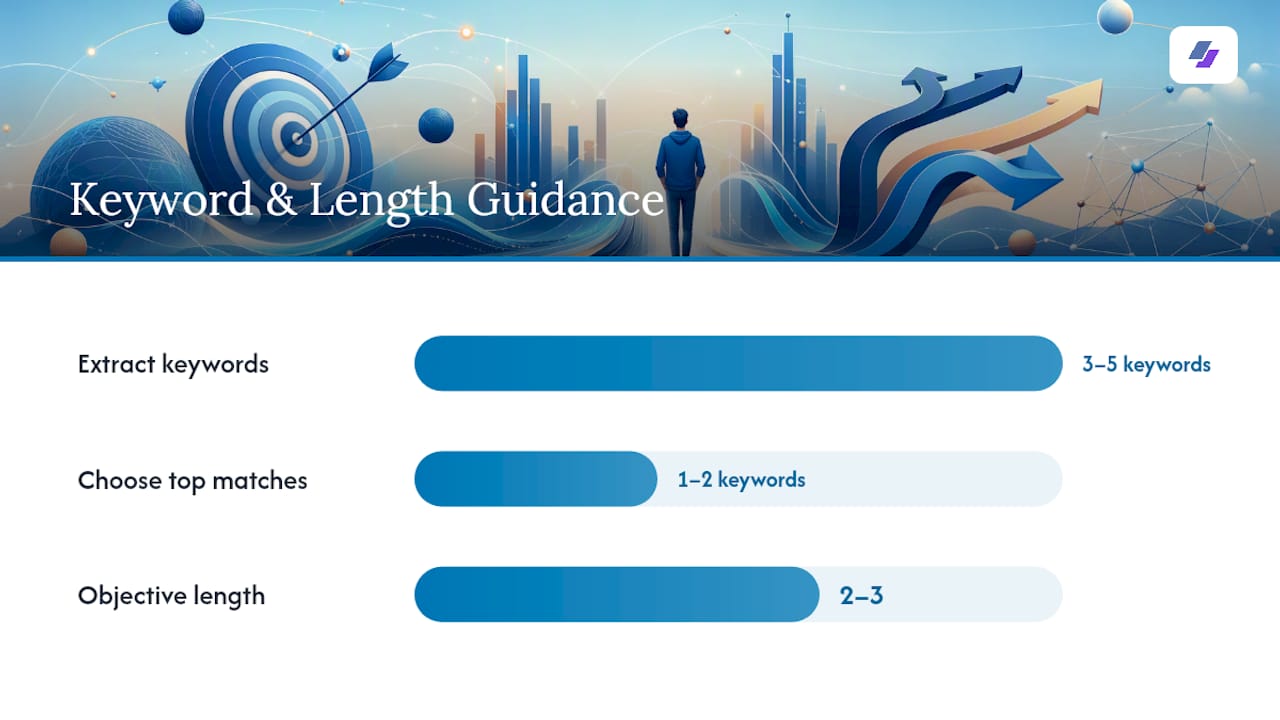
- Extract 3 to 5 keywords from the job description. Look for the exact job title, required skills, and any repeated terms (tools, certifications, methodologies).
- Choose the 1 or 2 strongest matches to your background. Don’t try to cram all five into one sentence. Pick what’s true and most relevant.
- Fold them into your objective naturally. Use the exact job title if it matches yours closely, but paraphrase soft skills into natural language rather than forcing an awkward keyword string.
Use the job posting’s exact title wording when your role genuinely aligns (“Senior Data Analyst” instead of “data professional”), but keep skill descriptions in natural, readable language. Indeed’s guidance recommends borrowing language directly from the posting while keeping the whole objective to two or three sentences, since scannability still matters even with keywords included.
The time-saving move here: build one core objective for your target role, then swap only the keyword and company reference for each application. Tools built for ATS resume keywords can speed up the extraction step if you’re applying to multiple similar roles in a week.
Pro Tip: Paste the job description and your draft objective into a free ATS keyword scanner before you submit. If your top 3 extracted keywords don’t appear anywhere in your objective or resume, you’re leaving an easy win on the table.
Quick Templates and a Proofreading Checklist
Save these templates somewhere you can grab them fast. Swapping brackets takes less time than starting from a blank line every application.
- Entry-level: “[Degree/field] graduate with [skill/experience] seeking to [goal] at [company/industry].”
- Career pivot: “Former [previous role] transitioning into [new field], bringing [transferable skill] to [specific outcome].”
- Experienced professional: “[Title] with [X years] of experience in [specialty], seeking to [goal] for [company type].”
- Internship/student: “[Field] student with [coursework/project experience] seeking [internship type] to [goal].”
- Creative/portfolio roles: “[Title] with a portfolio in [specialty], seeking to [goal] for a [company type] focused on [value].”
Before you paste your final version onto your resume, run it through this checklist:
- Is it one to two sentences, no longer?
- Does it name the specific role or field, not a vague “position”?
- Does it include at least one keyword lifted from this specific job posting?
- Does it focus on the value you bring rather than what you want from the job?
- Have you dropped first-person pronouns and passive phrasing?
- Does it read naturally out loud, not like a keyword list stitched together?
Keep a running document with three or four base versions (one per career track you’re targeting) so you’re editing instead of drafting from zero each time you apply.
Treat Every Objective Like a Live Experiment
Most job seekers write one objective and reuse it forever, which is a mistake. Treat your career objective the same way a marketer treats ad copy: draft a few variations, track which ones get responses, and refine from there. If you’re applying to fifteen jobs in the same field, you have fifteen small experiments running simultaneously. Pay attention to which phrasing gets you further.
The 30-second elevator pitch framing isn’t just a nice metaphor. It’s a genuinely useful constraint. If you can’t say your objective out loud in the time it takes to introduce yourself at a networking event, it’s too long or too vague, and both problems have the same fix: cut it down to the role, the skill, and the goal, and nothing else. The applicants who treat this line as an afterthought are competing against the ones who treat it as their opening argument.
Let JobAlign Write Your Objective for You
Manually tailoring an objective and matching keywords for every single application eats time you’d rather spend actually applying. JobAlign syncs directly with your LinkedIn profile, pulls your real experience and skills, and generates a tailored, ATS-optimized resume, objective included, for each job description you paste in. Instead of rewriting your top line fifteen times for fifteen postings, you get a fresh, keyword-matched version generated in under a minute, with a documented 87% ATS pass rate built on real keyword extraction from the actual job posting.
If you’ve been copy-pasting the same generic objective into every application, that’s likely costing you interviews before a human ever opens your resume. Try the free LinkedIn resume builder to generate your first tailored, ATS-ready resume and see the difference a matched objective makes.
Frequently Asked Questions
What is a career objective statement in simple terms?
It’s a one- to two-sentence line at the top of your resume that states the role you’re targeting, your strongest relevant skill, and the value you bring to that employer.
Is a career objective the same as a career goal statement?
They’re closely related. A goal statement is the broader concept of stating professional direction, while a career objective is the specific resume section that expresses that goal in a concise, employer-facing format.
Do I need both an objective and a summary?
No. Pick one based on your situation: an objective for entry-level, career-change, or relocation cases, and a summary if you already have a strong, relevant track record to highlight.
How long should a career objective be?
One to two sentences, generally under 40 words. Longer than that, and it stops getting read in full.
Should I customize my objective for every job application?
Yes. Swapping in the job title and one or two keywords from each posting takes a few minutes and meaningfully improves how well your resume matches ATS scoring criteria.
Sources
- Tailoring your resume
- What Is a Career Objective? Definition and Examples | CareerAddict
- How to Write a Career Objective for Your Resume | The Muse
- How to Write an Objective for a Resume | On Careers
- What Is a Career Objective? Definition and Examples | Indeed