Resume Optimization in 2026: Your Complete ATS Guide

Resume optimization is the process of tailoring your resume’s structure, content, and keywords to match a specific job description and the requirements of Applicant Tracking Systems (ATS). It’s not just polishing your writing. It’s making sure your resume speaks the same language as the software and the recruiter reading it afterward.
Here’s what resume optimization actually involves:
- Keyword alignment: Matching the exact language from the job posting throughout your resume
- ATS-friendly formatting: Using layouts and file types that automated systems can read without errors
- Targeted content: Highlighting the experience and skills most relevant to each role
- Quantified achievements: Replacing vague descriptions with measurable results
- Consistent structure: Using standard section headers and clean typography
Roughly 75% of candidates are filtered out before a human ever sees their application. Getting the fundamentals right is the difference between landing interviews and wondering why no one calls back.
How does an ATS actually filter your resume?
An ATS is software that stores, sorts, and scores job applications based on how well they match a job description. Think of it as a keyword scoring grid: the system parses your resume, extracts text, and ranks you against other candidates based on how closely your language mirrors the posting.
Nearly 98% of Fortune 500 companies use ATS platforms like Greenhouse, Lever, iCIMS, Workday, BambooHR, Taleo, and Jobvite. That means if you’re applying to a large employer, your resume almost certainly passes through one of these systems before a recruiter ever opens it.
Here’s what most ATS software actually does:
- Parses your document into structured fields (name, job titles, dates, skills)
- Scores keyword matches based on frequency and context within your bullets
- Filters by knockout questions such as required certifications or minimum years of experience
- Ranks candidates so recruiters see the highest-scoring applications first
Good news: 92% of ATS systems do not configure content-based auto-rejection rules. The real gatekeeping happens when a recruiter skims the top results. Your job is to rank high enough to get that skim, then be clear enough to earn the callback.
Key stat: ATS-optimized resumes achieve an 11.7% callback rate compared to 4.2% for generic resumes, a 178% improvement in effectiveness.
What keyword strategy actually moves the needle?
Keywords are the backbone of any resume tailoring effort. The most reliable source for them is the job description itself. Read it carefully, identify the skills, tools, and qualifications repeated most often, and mirror that exact language in your resume.
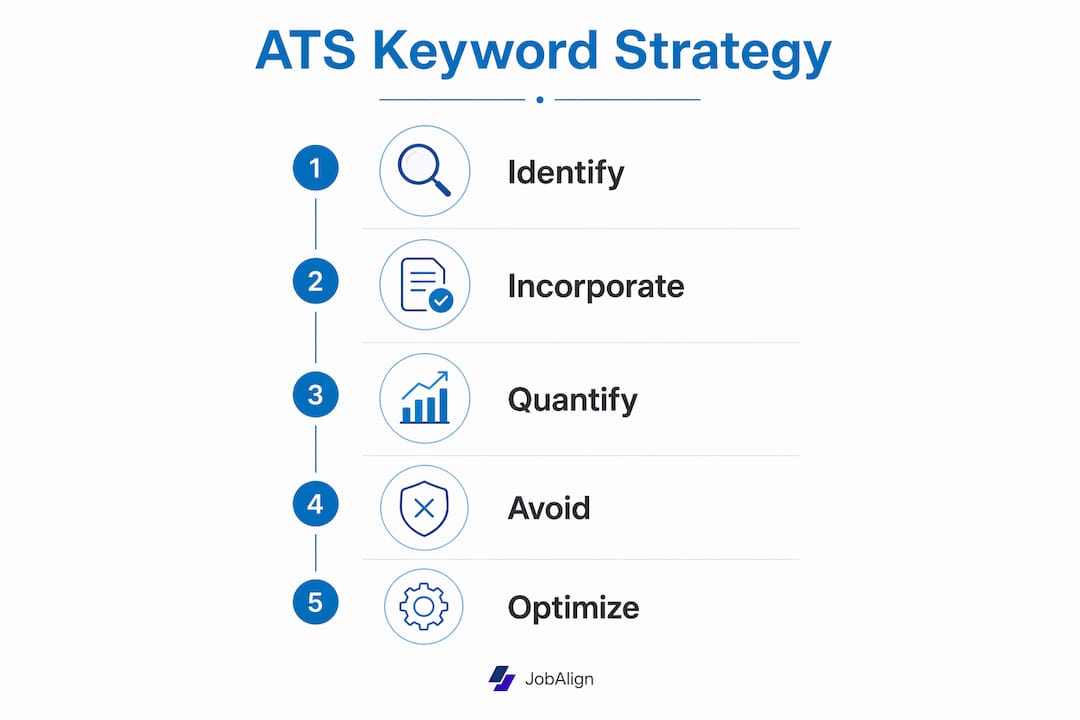
Don’t stop at the job posting. Look at LinkedIn profiles of people currently in that role at the target company. The language they use to describe their work often reflects what the hiring team values most.
Where to place keywords for maximum impact:
- Headline and summary: Set the context immediately with your target role and top skills
- Work experience bullets: Weave keywords into accomplishment statements, not just skill lists
- Skills section: List both spelled-out terms and acronyms (e.g., “Customer Relationship Management (CRM)”)
- Section headers: Use standard labels like “Work Experience” and “Skills” so the ATS maps your content correctly
The most effective bullet format follows a simple structure: What you did + How you did it + Why it mattered. For example: “Reduced customer churn by 18% by implementing a proactive outreach program targeting at-risk accounts.” That sentence contains the keyword, the method, and the result. It works for both the ATS and the recruiter.
Keyword stuffing, including hiding white text or repeating terms without context, gets detected by modern ATS and can get you disqualified. Context matters more than count.
Pro Tip: Resumes with quantified achievements receive 40% more interview requests. Every bullet that can include a number, should.
Which formatting choices help you pass ATS screening?
The most frequent resume failure point isn’t weak content. It’s technical readability. A beautifully designed resume with columns, graphics, or a custom font can lose more than half its content when an ATS tries to parse it. Single-column resumes parse successfully 94% of the time, which is why simple layouts remain the gold standard.
Formatting rules that protect your content:
- Use standard fonts like Arial, Calibri, or Times New Roman in black
- Avoid headers, footers, tables, columns, borders, shading, and graphics
- Write out months and years in full (e.g., “March 2023,” not “3/23”)
- Use standard section headers like “Education,” “Work Experience,” and “Skills”
- Submit as an MS Word (.docx) file when possible; text-based PDFs are acceptable if not image-flattened
Pro Tip: Front-load your most relevant qualifications in the top third of your resume. Recruiters spend an average of six seconds on an initial scan, and ATS systems weight earlier content more heavily in some configurations.
Practical tips to boost your ATS compatibility beyond keywords
Tailoring your resume for every single application sounds like a full-time job. The smarter approach is the role-version strategy: build 2–4 strong base resumes, each targeting a distinct role type, then make targeted edits for individual postings. 84% of recruiters skip resumes that aren’t customized, so some level of tailoring is non-negotiable.
Beyond that, here are the practical details that trip up even experienced job seekers:
- Proofread carefully. Spellcheck misses context errors. Read your resume aloud or use a tool like Grammarly to catch what automated checks miss.
- Keep formatting consistent. Dates, fonts, and bullet styles should match throughout the entire document.
- Complete every application field. Recruiters filter by fields you might leave blank, including optional ones.
- Ask for an employee referral. Many companies fast-track referred applications through the ATS entirely.
- Maintain a professional LinkedIn profile. ATS platforms increasingly sync with social media, so your online presence is part of the picture.
- Test your resume. Tools like DAXTRA or Resunate let you check ATS compatibility before you submit.
One more thing: don’t over-optimize. A resume stuffed with keywords but written in choppy, unnatural sentences will lose the recruiter even after passing the ATS. Balance machine-readable structure with writing that a real person actually wants to read.
What’s changing in resume optimization for 2026?
The biggest shift in 2026 is the rise of AI-assisted resume builders that automate keyword identification and customization at scale. AI tools now help job seekers create ATS-friendly formats faster, reducing the manual effort of tailoring without sacrificing relevance.

Skills-first and hybrid resume formats are gaining ground, especially in tech and creative fields. Employers increasingly want to see measurable achievements front and center rather than a chronological list of job duties. The “What + How + Why” bullet formula described earlier fits this shift perfectly.
Here’s what the most effective 2026 resume strategies have in common:
- AI-assisted keyword matching tied directly to the job description
- Role-version base resumes with quick targeted edits per application
- Skills-first sections that lead with competencies before diving into work history
- Quantified bullets throughout, not just in senior-level roles
- ATS template testing before every submission
JobAlign is built specifically for this workflow. It syncs with your LinkedIn profile, extracts your relevant experience, and generates a fully tailored, ATS-optimized resume for each application automatically. No manual reformatting, no guessing which keywords to include. JobAlign’s technology reports an 87% success rate at passing ATS filters, and you can generate a tailored resume for each posting without complicated setup. If you want to put the techniques in this guide to work without spending an hour on every application, try JobAlign and see how fast the process can move.
Key Takeaways
Resume optimization works because it aligns your language, structure, and content with both ATS scoring criteria and recruiter expectations, turning a generic document into a targeted application.
| Point | Details |
|---|---|
| ATS usage is near-universal | Nearly 98% of Fortune 500 companies use ATS, making optimization non-optional for serious job seekers. |
| Formatting drives parse success | Single-column resumes parse successfully 94% of the time; avoid tables, graphics, and multi-column layouts. |
| Callbacks jump with optimization | ATS-optimized resumes achieve an 11.7% callback rate versus 4.2% for generic resumes. |
| Role-version strategy saves time | Build 2–4 tailored base resumes and make targeted edits per posting rather than starting from scratch each time. |
| Quantified bullets win interviews | Resumes with quantified achievements receive 40% more interview requests than those without. |