What Makes a Resume Stand Out in 2026

A standout resume does three things at once: it clears the Applicant Tracking System (ATS) filter, earns a second look from a hiring manager, and makes your value obvious within the first few seconds of reading. Hiring managers who have reviewed thousands of resumes consistently say the same thing: they want proof of impact, not a list of job duties. The resumes that get interviews share a clear pattern.
Here is what separates them from the rest:
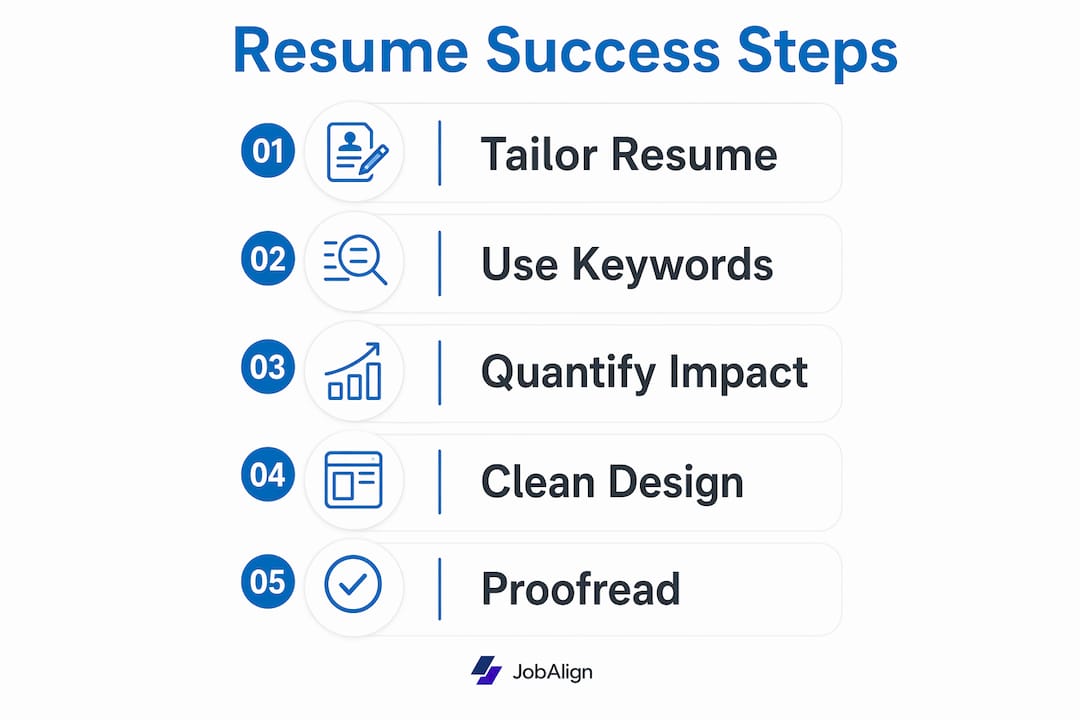
- Keyword optimization that mirrors the language in the job description
- Measurable achievements with real numbers and outcomes, not vague responsibilities
- Tailored content written specifically for each role, not a generic template
- Clean, ATS-friendly layout with readable fonts and clear section headings
- A strong summary that communicates your value in two to three sentences
- No clutter, no outdated information, and no formatting that confuses ATS software
According to Monster’s 2026 resume trend analysis, resumes that compete today need keyword optimization, an ATS-friendly layout, and quantifiable accomplishments to move forward in the hiring process.
How to tailor your resume for each job application
Generic resumes do not work. A resume written for “any marketing role” will lose to one written specifically for the marketing coordinator position at a healthcare company. The difference is tailoring, and it starts with reading the job description carefully.
- Pull out the exact skills, tools, and phrases the employer repeats most often
- Rewrite your bullet points to reflect those priorities, using the employer’s own language
- Adjust your summary statement so it speaks directly to the role and company
- Move the most relevant experience to the top of each section
- Use a skills-first or combination format when your most relevant qualifications are not from your most recent job
Georgetown University’s Career Center recommends comparing your resume directly to the job description and using the employer’s website to identify the language and values they repeat. That context helps you tailor more effectively than just matching keywords.
Pro Tip: Use an AI resume tool to speed up tailoring. JobAlign syncs with your LinkedIn profile and generates a customized, ATS-optimized resume for each specific job posting in minutes, so you never have to start from scratch.
Does your resume design actually help or hurt you?
Most job seekers spend too much time on visual design and not enough on structure. A resume with colorful graphics, multi-column layouts, or embedded tables might look polished to a human eye, but ATS software often cannot parse it correctly. The result: your resume gets rejected before anyone reads it.
- Use a single-column, text-based layout that ATS can read reliably
- Choose professional, legible fonts like Calibri or Helvetica at around 12-point size
- Keep margins consistent and use clear section headings (Experience, Education, Skills)
- Leave enough white space so the document is easy to skim in six seconds
- Limit color to one subtle accent, if you use it at all
- Aim for one page if you have fewer than ten years of experience
Clean, single-column formats are preferred by both hiring managers and ATS because they allow candidate data to be read reliably. Fancy formatting like tables or graphics often causes ATS rejection before a human ever sees the document.
The Indeed editorial team confirms that fonts like Calibri and Helvetica at roughly 12-point size improve both scanning speed and comprehension for recruiters reviewing dozens of resumes in a sitting.

How to highlight your skills and accomplishments effectively
Hiring managers do not want to read what you were responsible for. They want to know what you actually did and what changed because of it. That shift from duties to outcomes is what separates a forgettable resume from one that gets a callback.
- List hard skills and certifications that directly match the role’s requirements
- Include AI literacy and digital tool proficiency, since these are increasingly expected across industries
- Start every bullet point with a strong action verb: “led,” “built,” “reduced,” “launched”
- Attach a number to every accomplishment you can: percentages, dollar amounts, team sizes, time saved
- Provide brief context for awards or recognitions so their significance is clear
- Group your skills near the top of the resume so recruiters can assess fit immediately
Quantifying your impact with metrics, percentages, and clear outcomes helps differentiate you from candidates who only list tasks. “Managed social media” tells a recruiter nothing. “Grew Instagram engagement by 43% in six months by shifting to video-first content” tells them everything.
Using clear, strong language throughout your resume
Word choice on a resume is not about sounding impressive. It is about being clear and specific. Vague language like “assisted with” or “helped support” signals that you were not the one driving results. Strong language signals ownership.
- Replace weak verbs (“helped,” “worked on,” “was responsible for”) with direct ones (“led,” “delivered,” “cut,” “achieved”)
- Keep each bullet point to one or two lines, focused on a single outcome
- Match your language tone to the industry: formal for finance and law, direct and energetic for tech and startups
- Use consistent past tense for previous roles and present tense for your current position
- Write your summary in first person without the pronoun “I,” keeping it tight and value-focused
Harvard College Career Services advises using action verbs that are more descriptive than common fillers like “completed” or “responsible for.” The goal is to make every line pull its weight.
Common resume mistakes to avoid in 2026
The Indeed editorial team flags cluttered design, irrelevant job history, generic summaries, and missing keyword optimization as the most common reasons resumes fail to pass ATS or hold recruiter attention. These are not rare mistakes. They show up on the majority of resumes submitted for competitive roles.
- Cluttered layouts with graphics, tables, or multiple columns that break ATS parsing
- Irrelevant experience from roles more than ten to fifteen years ago that do not relate to the target job
- Generic summaries that say nothing specific (“results-driven professional with strong communication skills”)
- Typos and inconsistent formatting, which signal carelessness to any hiring manager
- One-size-fits-all resumes sent to every job without any customization
- Unexplained employment gaps, which raise questions a brief note could easily answer
Stat to know: Approximately 75% of resumes are rejected by ATS before a human ever reads them, often due to formatting errors or missing keywords.
What your resume header and summary should accomplish
Your header and summary are the first things a recruiter sees, and they set the tone for everything that follows. A weak summary wastes that moment. A strong one makes the recruiter want to keep reading.
- Place your full name at the top in a larger font size (16–18 point works well)
- Include a professional email address, phone number, and your city and state
- Add your LinkedIn URL and a portfolio link if your field expects one
- Write a three-sentence summary that names your specialty, your strongest skill, and one concrete result
- Use an objective statement instead of a summary if you are changing careers or entering the workforce for the first time
- Keep every word in the summary tied to the specific role you are applying for
A well-structured header with reliable contact information and a concise summary quickly communicates your value and makes your resume memorable. This section should highlight your core skills and career goals as they relate to the position, not your career in general.
Proofreading and final checks before you submit
One typo can end an application. That sounds harsh, but hiring managers who review thousands of resumes say errors signal a lack of attention to detail, which is a dealbreaker for most roles. The fix is a structured review process, not just a quick read-through.
- Read your resume out loud to catch awkward phrasing and missing words
- Check that dates, job titles, and company names are accurate and consistent
- Verify that your tailored keywords are still in place after any edits
- Confirm that formatting is consistent across all sections, including bullet style and spacing
- Ask a trusted colleague or mentor to review it with fresh eyes
Pro Tip: Run your resume through a grammar tool like Grammarly or ProWritingAid, then have a human review it too. Software catches spelling errors; people catch tone and clarity issues that software misses.
Consistent formatting, accurate dates, and grammar checks measurably improve resume quality and increase the likelihood of landing an interview.
How AI and ATS optimization can transform your results in 2026
ATS software works by parsing your resume for keywords, structure, and relevance to the job description. If your resume is not formatted correctly or lacks the right terms, the system scores it low and moves on. Understanding this is the first step to beating it.
- Use standard section headings (Experience, Education, Skills) that ATS recognizes
- Place keywords from the job description naturally throughout your resume, not crammed into a hidden block
- Spell out acronyms and also include the abbreviated form (for example, “Registered Nurse (RN)”) since you do not know which version the system searches for
- Keep your file in a standard format, typically PDF or Word, unless the application specifies otherwise
- Use AI resume tools to analyze job descriptions and suggest keyword gaps you may have missed
AI-driven resume builders help tailor resumes with relevant keywords and formatting for ATS, improving interview chances significantly. JobAlign’s technology yields an 87% success rate in passing ATS filters by automating keyword optimization and customization for each application. It syncs directly with your LinkedIn profile, so the process takes minutes rather than hours.
Hiring managers now prioritize clear evidence of skills and measurable value over generic resume formats. AI has shifted resumes from static documents into targeted tools that prove your fit for a specific role.

Should you include certifications and professional development?
Yes, and you should be selective about which ones you feature. A certification that directly supports the role you are applying for belongs near the top of your skills or education section. A certification from ten years ago in an unrelated field probably does not need to be there at all.
List certifications with the full name, the issuing organization, and the year you earned or renewed them. If a certification is in progress, include it with an expected completion date. For professional development, focus on recent training, workshops, or courses that show you are keeping your skills current. Georgetown University’s Career Center notes that any training or certification relevant to the job should be included in your resume. Online courses from platforms like Coursera or LinkedIn Learning count, especially when they align with the role’s technical requirements.
How to address employment gaps and career changes
Employment gaps are not automatic red flags, but leaving them unexplained is. A brief, honest note in your resume or cover letter removes the question before it becomes a concern. Recruiters understand that people take time off for caregiving, health, education, or personal reasons.
For career changers, the combination format works best. Lead with a skills section that highlights transferable abilities, then follow with your work history. This structure lets you control what the recruiter sees first. Reframe your past experience in language that fits the new industry. A teacher moving into corporate training does not just list classroom management; they highlight curriculum development, group facilitation, and performance assessment. If your gap included freelance work, volunteering, or coursework, list it. Treat it as experience, because it is.
Key Takeaways
A resume stands out when it combines tailored content, clean formatting, measurable results, and ATS-ready structure into one document that makes a hiring manager’s decision easy.
| Point | Details |
|---|---|
| Tailor every application | Rewrite your resume for each job description using the employer’s own language and priorities. |
| Use ATS-friendly formatting | Single-column, text-based layouts with standard headings pass ATS parsing reliably. |
| Quantify your accomplishments | Attach numbers, percentages, and outcomes to every achievement you can. |
| Write a focused header and summary | Your name, contact info, and a three-sentence value summary set the tone for the whole document. |
| Leverage AI for optimization | Tools like JobAlign achieve an 87% ATS pass rate by automating keyword matching and customization. |
The thing most job seekers get wrong about standing out
After reviewing the patterns across thousands of resumes, one mistake comes up more than any other: job seekers treat their resume as a record of their past instead of a pitch for their future. They list every job they have ever held, describe what they were supposed to do, and send the same document to fifty employers. Then they wonder why they are not hearing back.
The resumes that actually get interviews are built backward. Start with the job description. Work out what the employer needs. Then select and frame your experience to prove you can deliver exactly that. Every line on the page should answer one question: “Why should we hire this person for this specific role?” If a line does not answer that question, cut it.
Flashy design does not compensate for weak content. A beautifully formatted resume with vague bullet points will lose to a plain, well-written one every time. The hiring managers who have seen the most resumes are the least impressed by visual tricks and the most impressed by specificity. “Reduced customer churn by 18% in Q3 by redesigning the onboarding email sequence” is worth more than any color palette or creative layout.
AI tools have genuinely changed what is possible here. You can now optimize your resume with AI to analyze a job description, identify keyword gaps, and rewrite your bullet points in minutes. JobAlign does this by pulling directly from your LinkedIn profile, so you are not starting from a blank page. The best resume tips for 2026 all point in the same direction: be specific, be tailored, and let the results speak.