Turn Responsibilities Into Resume Achievements in 4 Steps

Write achievement-focused bullets that show measurable impact. Use responsibility language only for context, in early-career roles, or when a job genuinely requires it, like federal applications. The verdict is simple: recruiters and ATS scans both reward outcomes over task lists, and this guide gives you the frameworks and copy-ready examples to make the switch, bullet by bullet.
TL;DR:
- Specific metrics such as increasing sales by 28% or reducing onboarding time from 6 weeks to 3 make achievements more compelling than vague responsibilities.
- Using frameworks like STAR, XYZ, or PARQ helps craft concise, measurable achievement bullets that stand out to recruiters and ATS algorithms.
- Prioritizing achievement-based bullets in the experience or summary sections ensures key impacts are immediately visible to readers.
- Replacing responsibility phrases with quantifiable results and relevant keywords improves scanability and relevance during fast recruiter and ATS screenings.
Table of Contents
- Resume Achievements vs Responsibilities: What’s the Real Difference?
- Why Do Recruiters and ATS Systems Prefer Achievements?
- Which Formula Should You Use: STAR, XYZ, or PARQ?
- How Do You Rewrite a Responsibility as an Achievement?
- What Do Before-and-After Achievement Bullets Look Like by Role?
- Where Should Achievements Go on Your Resume?
- What Mistakes Quietly Weaken Achievement Bullets?
- How Can a Resume Tool Speed Up This Rewrite?
- An Editor’s Take on Achievement-First Resumes
- Try Jobalign to Turn Your Resume Bullets Into Achievements Faster
- Sources
- FAQ
Resume Achievements vs Responsibilities: What’s the Real Difference?
A responsibility is what you were assigned to do. An achievement is what happened because you did it. That’s the entire distinction, and once you see it, you’ll spot weak bullets on your own resume in seconds.
Responsibilities read like job descriptions, because they usually are copied straight from one:
- “Responsible for managing social media accounts.”
- “Handled customer complaints and support tickets.”
- “Oversaw inventory and supply ordering.”
Achievements describe the result of doing that work well:
- “Grew Instagram engagement 34% in six months through a redesigned content calendar.”
- “Resolved 95% of support tickets within 24 hours, cutting escalations by half.”
- “Reduced inventory waste by $18,000 annually by renegotiating supplier order minimums.”
Career centers frame this as building on the “what” with a measurable “result.” Achievements matter because they give a recruiter evidence, not a claim.
Why Do Recruiters and ATS Systems Prefer Achievements?
Recruiters do not read resumes. They scan them, and the scan is fast enough that vague responsibility bullets simply disappear.
Recruiters spend roughly 6 to 10 seconds on that first pass, which means a bullet has to signal relevance and impact almost instantly. A line like “responsible for team leadership” gives the scanner nothing to grab onto. A line like “led a 6-person team to a 22% increase in quarterly output” gives them a reason to keep reading, and a question to ask you in the interview.
That second part is easy to underestimate. Achievement bullets aren’t just decoration. They become the built-in talking points an interviewer reaches for, which means you walk into the conversation already knowing what they’ll ask about.
None of this replaces keyword alignment. ATS software still filters on the specific terms in the job posting, so an achievement stripped of relevant keywords can still get buried. The winning formula is results plus the right vocabulary, not one instead of the other.
Which Formula Should You Use: STAR, XYZ, or PARQ?
You don’t need to memorize career theory to write a strong bullet. You need one repeatable formula, applied consistently. Here are the three worth knowing, each suited to a slightly different situation.
- STAR (Situation, Task, Action, Result): Best for a single strong story, especially when you need to explain context briefly before the payoff. Virginia Tech’s career services recommend this structure specifically for converting duties into quantified statements.
- XYZ (“Accomplished X by measured by Y, doing Z”): Best for compact bullets when you already know the number and don’t need much setup.
- PARQ (Problem, Action, Result, Quantify): Best when you’re staring at a responsibility bullet and need a checklist to force a metric out of it.
One example per framework:
STAR: “Inherited a backlog of 200 unresolved support tickets (Situation), was tasked with clearing it within a quarter (Task), restructured the triage process and trained two junior reps (Action), reducing backlog to zero and cutting average resolution time by 40% (Result).”
XYZ: “Increased quarterly sales 28% by rebuilding the outbound email sequence for a 5-person SDR team.”
PARQ: "Customer onboarding took 3 weeks and caused early churn (Problem). Built a self-serve onboarding flow (Action).
Pro Tip: You don’t need full STAR for every line. TopResume’s guidance suggests saving the complete Situation-Task-Action-Result version for your two or three biggest wins, and using a trimmed XYZ or PARQ line for everything else. A resume where every bullet reads like a mini case study is exhausting, not impressive.
How Do You Rewrite a Responsibility as an Achievement?
Every duty-heavy bullet can be converted with the same four-step process. Run it role by role rather than trying to fix your whole resume in one sitting.
- Inventory your evidence. Pull old performance reviews, monthly reports, dashboards, or even email threads where a number got mentioned. Most people have more data sitting in their inbox than they realize.
- Choose the strongest available metric. Pick a percentage, dollar figure, headcount, or timeframe. If no hard number exists, choose a credible qualitative result, like “reduced onboarding confusion” or “improved cross-team handoffs.”
- Apply a framework. Draft the bullet as action verb, then context, then result. “Led,” “cut,” “built,” and “negotiated” outperform “responsible for” and “helped with” every time.
- Layer in keywords from the job posting. Match the terminology the employer used (e.g., “stakeholder management” instead of your own phrase “working with other departments”) so the bullet earns both a human read and an ATS match.
Before you move to the next bullet, run this quick validation pass:
| Check | Question to ask |
|---|---|
| Metric present | Is there a number, percentage, or dollar figure? |
| Action verb | Does the bullet start with a strong verb, not “responsible for”? |
| Scope stated | Is it clear how big the team, budget, or project was? |
| Keyword match | Does it echo language from the target job posting? |
| Length | Is it one line, ideally under 20 words? |
If a bullet fails two or more of those checks, it’s still a responsibility wearing an achievement’s clothes. Rewrite it before moving on.
What Do Before-and-After Achievement Bullets Look Like by Role?
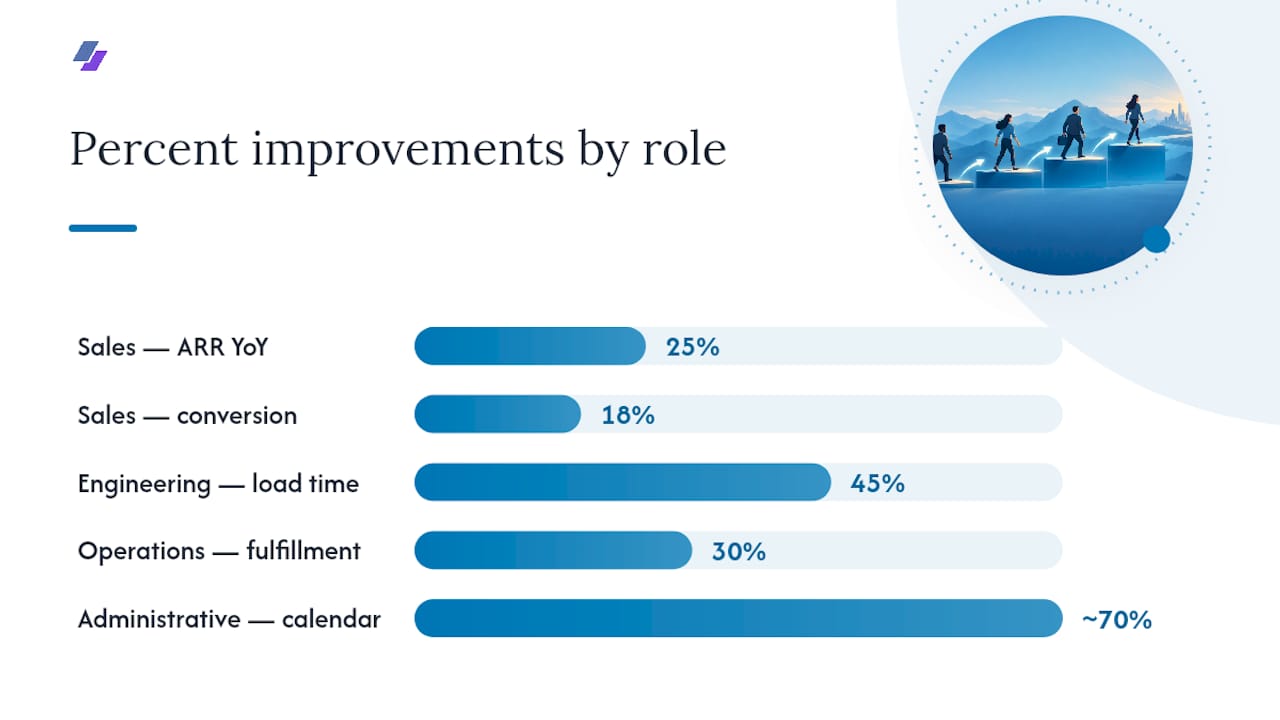
Seeing the conversion happen across different jobs makes the pattern stick faster than any explanation. Here’s the same rewrite logic applied to five common roles.
Sales
- Before: “Responsible for managing a portfolio of client accounts.”
- After: “Grew a 40-account portfolio to $1.2M in annual recurring revenue, a 25% year-over-year increase.”
- Before: “Made outbound calls to prospective customers.”
- After: “Booked 60+ qualified demos monthly through a revamped cold-calling script, lifting conversion rate 18%.”
Marketing
- Before: “Managed email marketing campaigns.”
- After: “Redesigned email nurture sequence, increasing open rate from 22% to 38% across 15,000 subscribers.”
- Before: “Assisted with content creation for the blog.”
- After: “Wrote and published 45 SEO-optimized articles that drove a 3x increase in organic traffic within a year.”
Engineering
- Before: “Responsible for backend development and bug fixes.”
- After: “Cut average page load time 45% by refactoring the caching layer, improving retention on mobile users.”
- Before: “Worked on the deployment pipeline.”
- After: “Automated the deployment pipeline, reducing release time from 4 hours to 20 minutes.”
Operations
- Before: “Oversaw daily warehouse operations.”
- After: “Reorganized warehouse layout, cutting order fulfillment time by 30% across a 50-person shift.”
- Before: “Managed vendor relationships.”
- After: “Renegotiated three vendor contracts, saving approximately $60,000 annually.”
Administrative
- Before: “Handled scheduling and office supply orders.”
- After: “Streamlined executive scheduling across a team of 8, cutting calendar conflicts by roughly 70%.”
When you don’t have an exact figure, an honest approximation still beats a bare duty statement. “Supported a team of roughly 10 people” or “processed monthly reports for a department of about 25” gives a recruiter real scope without inventing precision you don’t have. Early-career resumes can lean more on scope and consistency (managed X, supported Y) since there’s less history to quantify; senior resumes should lean harder on dollar figures, percentages, and team size.
Where Should Achievements Go on Your Resume?
Placement matters almost as much as the writing itself. A great bullet buried in the wrong spot still gets missed.
- Summary or profile section: Reserve this for your single most impressive, most relevant accomplishment. One sentence, front-loaded with the number.
- Experience section: This is where most achievement bullets live, one to three per role. Save four or more only for a role with several major wins worth highlighting.
- Optional “key achievements” section: Useful if you’re changing careers or want to surface older wins that would otherwise sit too far down the page.
Keep the formatting disciplined: lead with the number or result where possible, keep verb tense consistent (past tense for past roles, present tense only for your current one), and cap each line at roughly one to two sentences so it stays scannable.
What Mistakes Quietly Weaken Achievement Bullets?
Even after learning the frameworks, a few habits sneak achievements back into responsibility territory.
- Weak opening verbs: “Helped with,” “worked on,” and “assisted in” undercut ownership even when the result is strong.
- Missing scope: “Managed a team” says nothing without a headcount or budget attached.
- No metric or approximation: A vague “improved efficiency” reads as filler next to a specific percentage.
- Keyword omission: A great story with none of the job posting’s language still risks getting filtered out by ATS software.
Pro Tip: Run a final pass reading only your first word of each bullet down the page. If you see a wall of “responsible,” “helped,” and “worked,” that’s your fix-it list, not a style issue.
Micro-example: “Assisted with onboarding new hires” becomes “Redesigned new-hire onboarding, cutting ramp-up time from 6 weeks to 3.”
How Can a Resume Tool Speed Up This Rewrite?
Doing this manually works, and plenty of strong resumes are hand-built line by line. But the process has a bottleneck: matching each rewritten achievement to the right keywords for every single job posting takes real time when you’re applying broadly.
A resume tool can sync with your LinkedIn profile to pull your existing experience, then analyze the job description you’re targeting to surface the terms an ATS is scanning for. That doesn’t replace the thinking you just learned. It removes the repetitive part, the inventory step and the keyword matching step, so you can spend your energy on picking the right metric and framing the result. If you’re applying to one role a week, manual editing is often enough. If you’re customizing resumes for a dozen postings a month, that’s where a tool earns its keep.

An Editor’s Take on Achievement-First Resumes
Most advice on this topic treats responsibilities as the enemy, and that’s a little lazy. Responsibilities aren’t wrong, they’re incomplete. The mistake isn’t listing what you did, it’s stopping there instead of finishing the sentence with what happened as a result.
Pick one role on your resume right now and run it through the four-step method: inventory a real number, choose your framework, write the bullet, layer in a keyword from a job posting you actually want. Then track what changes, callback rate, interview requests, whatever you can measure over the next few weeks. That feedback loop tells you more than any checklist ever will.
— Johan
Try Jobalign to Turn Your Resume Bullets Into Achievements Faster
Jobalign gives you a faster path from duty-list to achievement-focused resume by syncing directly with your LinkedIn profile, pulling your real experience, and matching it against the specific job description you’re applying to. Instead of manually hunting for keywords in every posting, users can generate tailored resumes with ATS keyword optimization and receive a personalized cover letter for each application. It follows the same logic covered here: inventory your experience, rewrite it around results, match the language to the posting, then export. Start with the free LinkedIn resume tool to see your existing bullets converted automatically, or compare plans like Solo and Starter on the pricing page if you’re applying to multiple roles this month.
Sources
For deeper frameworks, Virginia Tech’s career services guide breaks down PARQ and STAR formulas step by step. Federal applicants should review the Department of Labor’s resume essentials guide and the SEC’s guide to writing an accomplishment record, both of which detail how public-sector applications weigh achievements differently than private-sector resumes.
- How to Write Strong Descriptions (Resume Bullet Point Formula) – Career and Professional Development | Virginia Tech
- The Resume Mistake That’s Keeping You Invisible to Recruiters | Nexford
FAQ
What Are Good Achievements to Put on a Resume?
Good achievements are specific, measurable, and tied directly to the role you’re applying for, things like revenue growth, cost savings, time reductions, or team leadership with a clear outcome. If you lack hard numbers, a well-scoped qualitative result, like reduced onboarding time or improved client retention, still works.
Can You Give Examples of Personal Achievements to List?
Strong examples include exceeding a sales target by a specific percentage, leading a project that shipped early or under budget, mentoring junior staff who were later promoted, or resolving a recurring operational problem that saved time or money. The strongest ones connect directly to skills the target job actually needs.
What Should You Write for Your Top Three Achievements?
Choose the three accomplishments with the clearest measurable impact and the closest relevance to the job posting, ideally one from a recent role, one showing leadership or ownership, and one tied to a metric the employer clearly cares about. Rank them by relevance to the specific job, not by how impressive they sound in isolation.
What Are 5 Important Accomplishments to Highlight?
A well-rounded set usually covers a quantified result (revenue, savings, efficiency), a leadership moment, a problem you solved, a process you improved, and one recognition or promotion earned through performance. Not every resume needs all five for every role. Pick the ones that map to the job description in front of you.
Does a resume tool help turn responsibilities into achievements?
Certain tools can pull your experience from LinkedIn and match it against a specific job description, helping to surface the keywords and phrasing an ATS expects alongside rewritten achievement bullets. Current plans and pricing, including Solo, Starter, Pro, and Ultimate, are listed on the Jobalign pricing page.