15 Resume Action Verbs That Turn Vague Bullets Into Measurable Wins

Start every resume bullet with a specific, varied action verb, then pair it with a measurable outcome or clear context. That combination does the double duty of pulling a hiring manager’s eye down the page while satisfying the keyword scans that Indeed and Yale’s Office of Career Strategy both point to as standard practice. The verb gets you noticed. The number gets you believed.
TL;DR:
- Strong action verbs should be paired with measurable results to clearly demonstrate your accomplishments and skills.
- Tense consistency within each job entry is crucial, using past tense for previous roles and present tense for current responsibilities.
- Incorporating relevant keywords naturally and avoiding repetition enhances both ATS compatibility and reader engagement.
- Quantifying achievements with percentages, dollar amounts, or scope details significantly increases their impact and credibility.
- Using automated tools can streamline the process of tailoring verbs and keywords for each job application, saving time and improving effectiveness.
Table of Contents
- Categorized Action Verbs for Every Resume Section
- What Makes an Action Verb the Right Choice?
- Weak Bullets vs. Strong Bullets, Side by Side
- The ATS and Proofreading Checklist
- Using Action Verbs Across Chronological, Functional, and Combination Formats
- Common Mistakes That Undercut Strong Verbs
- When to Prioritize Clarity Over a Fancier Verb
- Let Jobalign Apply This Verb-and-Metric Formula for You
- Sources
- FAQ
Categorized Action Verbs for Every Resume Section
You don’t need 300 verbs memorized. You need the right 15 for your field, ready to grab when you’re staring at a blank bullet point. University career centers, including MIT’s Career Advising & Professional Development office, organize their verb banks by function rather than alphabet, and that grouping is the whole trick. When you know which bucket your accomplishment falls into, the right word shows up fast.
Here are eight categories worth bookmarking, with verbs pulled from the functions job seekers ask about most.
Leadership and management:
- Spearheaded, orchestrated, mentored, delegated, championed, restructured, supervised, cultivated
Results and achievement:
- Increased, reduced, generated, accelerated, surpassed, delivered, secured, maximized
Communication and presentation:
- Presented, negotiated, counseled, briefed, persuaded, articulated, liaised, facilitated
Technical and engineering:
- Engineered, automated, deployed, configured, debugged, integrated, migrated, provisioned
Analytical and research:
- Analyzed, evaluated, modeled, forecasted, audited, benchmarked, diagnosed, synthesized
Creative and design:
- Designed, crafted, conceptualized, storyboarded, illustrated, branded, prototyped, produced
Customer service and support:
- Resolved, assisted, triaged, de-escalated, onboarded, advised, responded, retained
Clerical and detail-oriented work:
- Processed, cataloged, reconciled, audited, scheduled, compiled, filed, tracked
Notice that a few verbs (audited, for instance) show up in more than one list. That’s normal. Job functions overlap, and the right verb depends on what you actually did, not which category it’s filed under. If you’re building out a leadership-heavy resume, the product manager keyword guide walks through how these verbs pair with the metrics recruiters expect to see in that role.
What Makes an Action Verb the Right Choice?
Picking a verb isn’t about sounding impressive. It’s about accuracy, and accuracy comes from a simple formula: Verb + what you did + how you did it + result. “Managed a budget” tells a recruiter almost nothing. “Managed a marketing budget across multiple regional teams, cutting overspend by a significant margin” tells them everything they need in one line.
Three rules keep that formula from falling apart:
- Match your tense to your timeline. Past roles get past tense (led, built, closed). Your current job gets present tense (lead, build, close). Mixing them within the same resume is one of the fastest ways to look careless.
- Kill repetition on sight. If “managed” appears four times, a recruiter reads it once and skims the rest. The Muse recommends scanning your own draft for repeated verbs before you scan it for anything else.
- Borrow language from the job posting, don’t drown in it. If the posting says “cross-functional collaboration,” and you led cross-functional work, use that phrase once. Stuffing the same keyword into every bullet reads as robotic to a human reader even when it flatters the ATS.
Quantify wherever you can. That means percentages, dollar amounts, headcount, time saved, or a clear before/after process change. If you genuinely have no number, a scope detail works as a stand in, like “across 3 states” or “for a 40-person team.”
Pro Tip: Read your bullet out loud. If it sounds like a job description instead of something a person actually accomplished, the verb is probably too generic. Swap it for one that names the specific action.
Weak Bullets vs. Strong Bullets, Side by Side
Seeing the fix in context teaches the pattern faster than any list. Here’s the swap in action across six functions, with the verb change and the metric that turned each one from filler into evidence.
- Weak: “Responsible for managing a project team.” → Strong: “Led a small cross-functional team to deliver a product launch ahead of schedule.”
- Weak: “Helped increase sales in my region.” → Strong: “Generated substantial new regional revenue by restructuring the outbound sales cadence.”
- Weak: “Worked on backend systems.” → Strong: “Engineered a caching layer that significantly improved API response time.”
- Weak: “Did research for the marketing team.” → Strong: “Analyzed customer churn data across many accounts to identify key retention risk factors.”
- Weak: “Handled customer complaints.” → Strong: “Resolved the majority of escalated support tickets promptly, improving customer satisfaction scores.”
- Weak: “Made graphics for the website.” → Strong: “Designed multiple landing page templates that improved conversion rates.”
That research example does double work: it swaps a dead verb for a strong one and slips in a keyword (“customer churn data”) a data analytics posting would likely scan for. The examples of strong work experience bullets guide has more of these paired rewrites if you want to keep practicing the pattern before you touch your own draft.
Career guides consistently point out that swapping a vague verb for a specific one, then attaching a number, increases the odds a bullet actually registers with a recruiter. It’s a small edit with an outsized effect on how a resume reads in the first six seconds of a scan.
The ATS and Proofreading Checklist
Run this before you submit anything. It takes about four minutes and catches the mistakes that quietly tank an application.
ATS alignment:
- Every bullet starts with an action verb, not “responsible for” or “duties included.”
- Keywords from the job posting appear naturally, not crammed into every line.
- Formatting stays simple: no tables, text boxes, or graphics the parser can’t read.
Proofreading pass:
- No verb repeats more than twice across the whole resume.
- Numbers formatted consistently (all percentages, all dollar signs, no mixing “25%” with “twenty five percent”).
- No passive voice (“was tasked with”) slipped back in during edits.
UCLA’s Career Center frames this well: ATS credibility comes from consistent formatting and honest keyword relevance, not from gaming a scanner with hidden text or invisible characters.
Pro Tip: Print your resume and read it upside down, line by line. It sounds strange, but it forces your brain to see the words instead of the meaning, which makes typos and repeated verbs jump out immediately.
Using Action Verbs Across Chronological, Functional, and Combination Formats
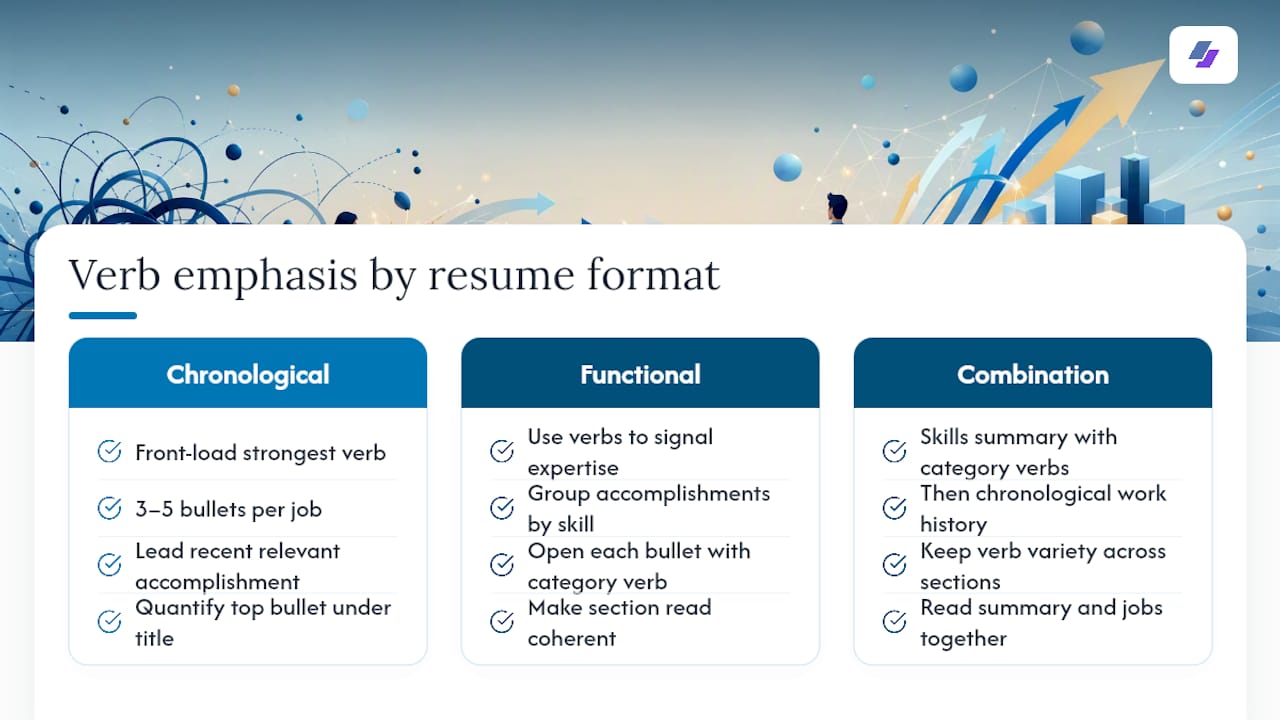
The verb rules don’t change by format. Where you place the emphasis does.
In a chronological resume, the most common format, each job entry gets its own cluster of 3 to 5 bullets, and the strongest verb should lead your most recent, most relevant accomplishment. Recruiters skim top to bottom, so front load your best quantified line under each job title.
A functional resume groups accomplishments by skill category instead of employer, which means your verbs are doing even more work to signal expertise since there’s no job title or company name giving context. If you’re building a “Project Leadership” section, open every bullet in that block with a leadership verb (directed, coordinated, championed) so the category reads as coherent rather than like a grab bag of unrelated wins.
A combination resume blends both: a skills summary up top using strong category verbs, followed by a chronological work history. Keep verb variety in mind across both sections. It’s easy to accidentally repeat “managed” in your summary and then again in your first job bullet. Read the two sections back to back before you finalize anything.
Whichever format you’re using, the underlying test is the same: could a recruiter understand what you accomplished from the bullet alone, without needing your job title for context?
Common Mistakes That Undercut Strong Verbs
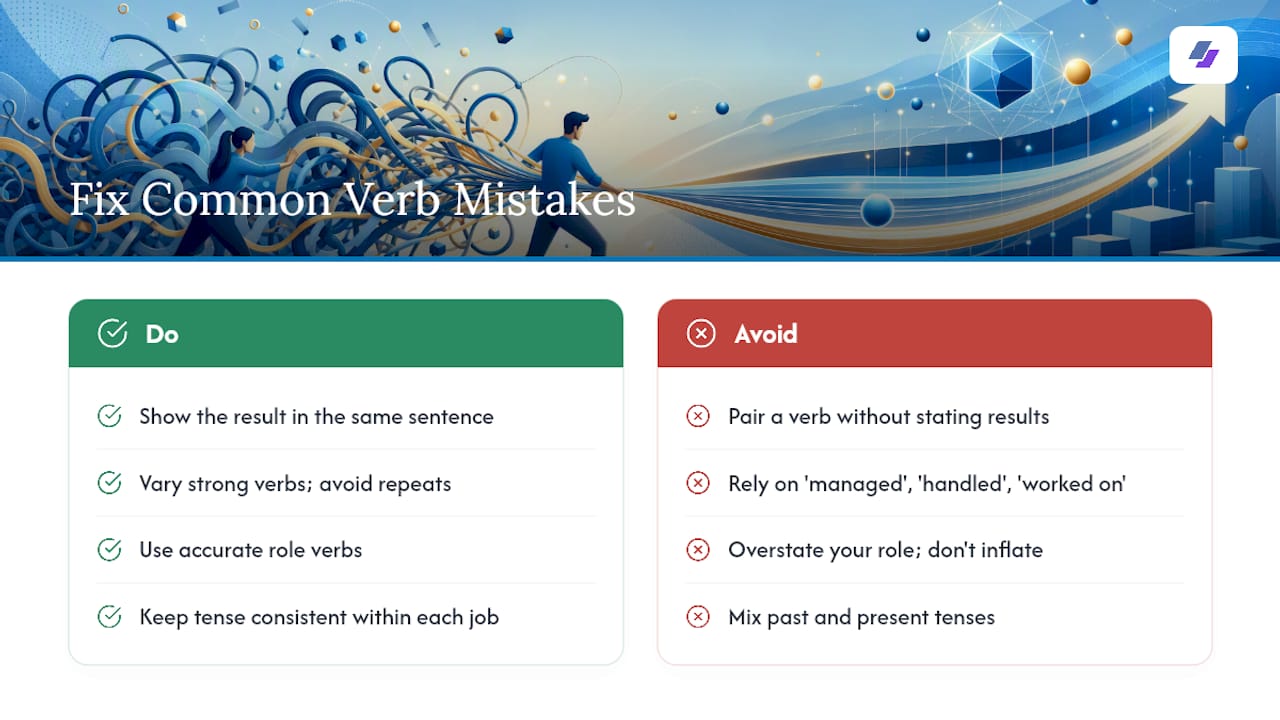
The verb choice matters less than what happens around it. A few habits quietly sabotage even a well-chosen word.
Pairing a strong verb with no result. “Spearheaded a new onboarding initiative” sounds impressive until a recruiter asks, “and then what happened?” If you can’t answer that in the same sentence, the verb is decoration.
Using the same three verbs for everything. “Managed,” “handled,” and “worked on” show up so often that recruiters barely register them anymore. Indeed’s list of resume power words exists partly to break that habit.
Choosing a verb that overstates your role. If you supported a project rather than led it, “assisted” or “contributed to” is more accurate than “directed.” Inflated verbs get caught in interviews when a follow-up question exposes the gap.
Mixing tenses within the same job entry. One bullet in past tense, the next in present, under the same job title, reads as sloppy even to a recruiter skimming quickly.
Burying the verb mid-sentence. “Team performance was improved by me through…” should be “Improved team performance by…” Lead with the action every time.
When to Prioritize Clarity Over a Fancier Verb
Sometimes the more impressive-sounding verb is the wrong call. A shorter, plainer word that’s instantly clear beats a thesaurus pick that makes a recruiter pause to parse it. Match your verb choice to the audience reading first, whether that’s an ATS scan, a recruiter’s six-second skim, or a hiring manager reading closely, and to the job posting’s own language. Impact from a real number will always outperform a flashier word choice.
— Johan
Let Jobalign Apply This Verb-and-Metric Formula for You
Rewriting bullets by hand for every single application is where this advice usually breaks down, but an AI rewriting tool can help paraphrase and test verb variety efficiently. You know the formula, but doing it 15 times for 15 different job postings eats an entire weekend. This step can be automated by tools that sync with your LinkedIn profile, extract relevant experience and skills, then rebuild each bullet aligned with the specific job description, swapping in stronger verbs and inserting keywords that ATS filters scan for.
You still get to review and tweak everything, but the heavy lifting of matching verb choice to job posting happens automatically, every time, instead of once for a generic master resume. If you want to see how your current bullets translate, start with a free LinkedIn resume export and generate a tailored, ATS-ready version in a couple of minutes.
Sources
- Resume Action Verbs – Office of Career Strategy – Yale University
- Indeed
- Resume action verbs | MIT Career Advising & Professional Development
- 185+ Action Verbs to Make Your Resume Stand Out | The Muse
- Action Words to Get Your Résumé Noticed | Grammarly
FAQ
What are good action verbs for a resume?
Strong choices vary by function, but reliable ones include spearheaded, generated, engineered, negotiated, resolved, and analyzed, each paired with a measurable result rather than used alone.
What are examples of strong action verbs?
Twenty solid options across common categories: led, launched, increased, reduced, negotiated, designed, automated, analyzed, mentored, secured, resolved, cataloged, forecasted, restructured, delegated, presented, onboarded, migrated, audited, and accelerated.
How many action verbs should I know for my resume?
You don’t need hundreds memorized. A working set of 15 verbs relevant to your field, drawn from categorized lists like the ones from Yale or The Muse, covers most bullets you’ll write.
Which verbs should I avoid on a resume?
Avoid vague, overused phrases like “responsible for,” “helped with,” and “team player.” Replace them with a specific verb tied to what you actually did and the result it produced.
Can software help me pick the right action verb for each job?
Yes. Tools like Jobalign analyze the job description you’re applying to and adjust verb choice and keyword placement in your resume automatically, which saves the manual rewriting each application would otherwise take.