Strong Work Experience Bullets: Ready-to-Use Examples

The formula that works every time: lead with the result, quantify it, then explain how you got there. That structure, used consistently, is what separates bullets that get callbacks from bullets that get skipped. Here are six copy-ready examples across experience levels, following Columbia Career Education’s guidance to start with a strong action verb and add contextual detail:
- Entry-level: Reduced customer wait time by 18% by redesigning the intake form used across a 12-person front desk team.
- Entry-level: Built and maintained a Python data-cleaning script that cut weekly reporting prep from 4 hours to 45 minutes.
- Mid-level: Grew email subscriber list from 14,000 to 31,000 in 9 months by launching a gated content series targeting mid-funnel leads.
- Mid-level: Negotiated 3 vendor contracts, saving $47,000 annually while maintaining existing SLA terms.
- Senior: Led a cross-functional team of 11 to migrate 2.4 million customer records to Salesforce, completing the project 3 weeks ahead of schedule.
- Senior: Restructured the regional sales territory model, increasing average rep quota attainment from 71% to 94% within two quarters.
One quick rule on ordering: lead with the result when the outcome is impressive on its own. Lead with the action when the type of work is what the job description prioritizes.
Key Takeaways
Strong work experience bullets follow a consistent structure: lead with a result or strong action verb, quantify the impact, and add just enough context to show scope.
| Point | Details |
|---|---|
| Use APR or XYZ structure | Format every bullet as Action + Project + Result, or Accomplished X measured by Y by doing Z. |
| Quantify with baselines | State “from X to Y” or a percentage with a starting point so the improvement has real context. |
| Tailor to the job posting | Mirror the top 3 required skills and exact tool names to pass ATS keyword scoring. |
| Fix weak openers first | Replace “responsible for” and “helped with” with ownership verbs: Led, Built, Grew, Reduced. |
| Jobalign automates tailoring | Jobalign syncs with LinkedIn and generates ATS-optimized bullets matched to each job description. |
Table of Contents
- How do STAR, APR, and XYZ frameworks structure your bullets?
- Which action verbs show ownership and scale?
- How do you quantify results when you don’t have exact numbers?
- Adaptable, role-specific strong bullet examples you can copy and tweak
- How do you tailor bullets for the job description and pass ATS checks?
- What weak-bullet patterns should you fix right now?
- What hiring managers actually notice in the first few seconds
- Jobalign automates the tailoring work so you can apply faster
- Sources
How do STAR, APR, and XYZ frameworks structure your bullets?
Three frameworks dominate career-center guidance, and each compresses the same information differently.
STAR (Situation, Task, Action, Result) is the most thorough. On a resume, you collapse Situation and Task into a short clause or drop them entirely, then let Action and Result carry the bullet. Yale’s Office of Career Strategy recommends structuring accomplishment statements as Action + Project + Result with quantifiable outcomes wherever possible.
APR (Action + Project/Problem + Result) is a tighter single-line format that works well when the context is obvious from your job title. The University of Arizona Center for Career Readiness describes APR as an effective one-line format that compresses situation and task for brevity, leading with a result when possible.
XYZ, popularized by Google recruiters, reads: Accomplished X, as measured by Y, by doing Z. CareerReload notes that XYZ and STAR-like structures force result-first phrasing and are recommended for concise, high-impact bullets.
| Framework | Template | Best for |
|---|---|---|
| APR | [Action verb] + [project/problem] + [result with metric] | Most roles; clean and scannable |
| STAR (compressed) | [Action] + [context/scope] + [result] | Complex projects needing brief context |
| XYZ | Accomplished [X], measured by [Y], by doing [Z] | Roles where the metric is the headline |
Micro-prompts to extract your details:
- What changed because of your work? (revenue, speed, quality, headcount)
- What was the scope? (team size, budget, geography, volume)
- What tools or methods did you use?
- What was the baseline before you started?
- How long did the project or improvement take?
- Did anyone else notice? (awards, promotions, client feedback)
Which action verbs show ownership and scale?
Weak openers like “responsible for” or “helped with” signal participation, not ownership. Every bullet should open with a verb that tells the reader exactly what you drove. Here are high-impact verbs by category:
- Leadership: Led, Directed, Oversaw, Spearheaded, Championed, Mentored, Coached
- Growth and sales: Grew, Increased, Expanded, Acquired, Converted, Upsold, Negotiated
- Technical and build: Engineered, Developed, Architected, Deployed, Automated, Integrated, Migrated
- Efficiency and cost-saving: Reduced, Eliminated, Consolidated, Optimized, Streamlined, Restructured
- Communication and training: Presented, Trained, Facilitated, Authored, Translated, Advised
Three selection rules worth keeping in mind:
- Match seniority. “Assisted” fits a first internship. “Directed” fits a VP. Using a junior verb on a senior role undersells you.
- Vary across bullets. Starting three consecutive bullets with “Managed” flattens your impact. Rotate verbs to show range.
- Avoid vague starters. “Worked on,” “participated in,” and “was involved with” tell a recruiter nothing about your contribution.
Before: Responsible for social media accounts across three platforms.
Before: Helped the team with onboarding new employees. After: Designed and delivered a 3-day onboarding program for 40 new hires, reducing time-to-productivity by an estimated 2 weeks.
How do you quantify results when you don’t have exact numbers?
Numbers are the fastest signal a recruiter processes. Wellesley Career Education recommends turning duty statements into accomplishment statements by adding measurable details, frequency, and scope, even when exact figures aren’t available.
| Metric type | Example phrasing | When to use it |
|---|---|---|
| Revenue / sales | “Generated $1.2M in new ARR” | Sales, BD, account management |
| Percentage growth | “Increased conversion rate by 22%” | Marketing, product, operations |
| Time saved | “Cut reporting cycle from 5 days to 1” | Ops, engineering, finance |
| Cost reduced | “Saved $80K annually in vendor fees” | Procurement, ops, finance |
| Headcount managed | “Led a team of 14 across 3 time zones” | Management, project roles |
| Customer satisfaction | “Raised NPS from 31 to 58 over 2 quarters” | Customer success, support |
| Volume / scale | “Processed 2,000+ support tickets monthly” | Support, operations, admin |
Always state the baseline so the improvement has context — “from X to Y” is clearer than “by Z%.”*
Adaptable, role-specific strong bullet examples you can copy and tweak
These bullets follow APR or XYZ structure. One bullet per role group is annotated to show its parts.
1. Marketing
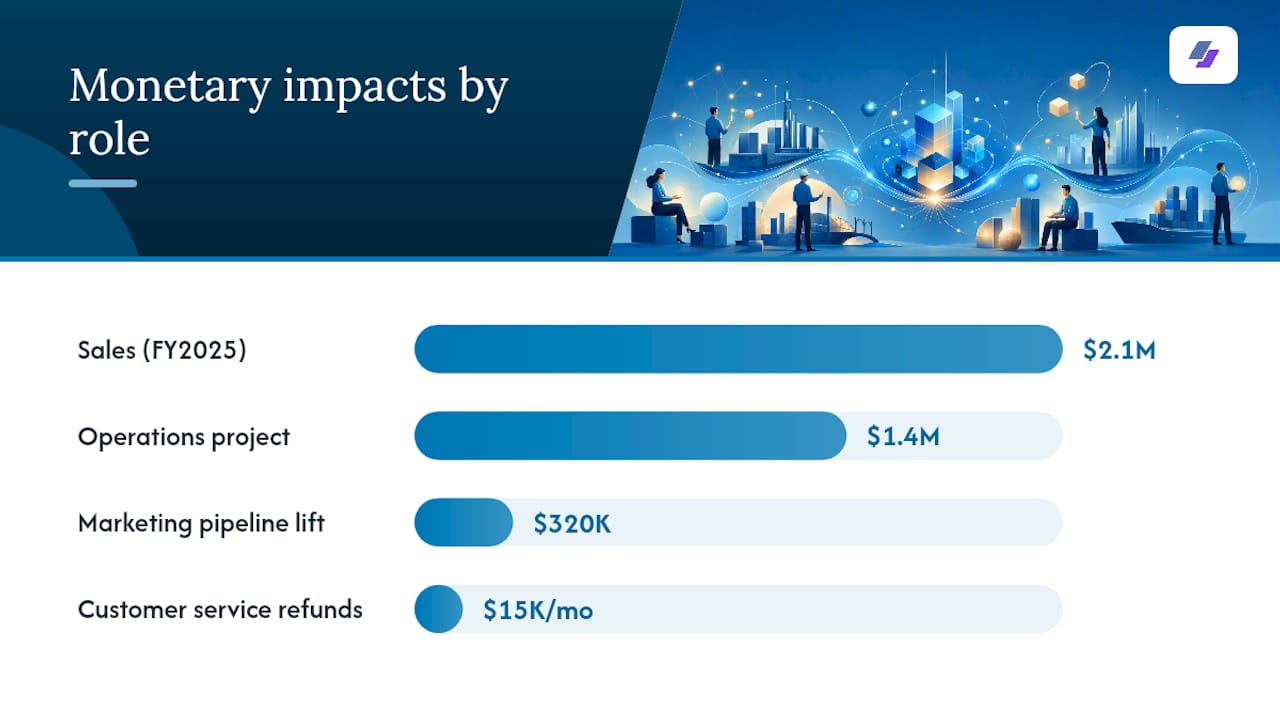
- Launched a 6-email nurture sequence that moved 1,400 leads from awareness to demo request, lifting pipeline by $320K. (Action: Launched | Project: nurture sequence | Result: $320K pipeline lift)
- Reduced paid search cost-per-lead by 41% by restructuring ad groups and adding 200 negative keywords.
- Produced 12 case studies per quarter that became the top-cited assets in the sales cycle.
2. Sales
- Closed $2.1M in new business in FY2025, finishing 118% of annual quota.
- Rebuilt the outbound prospecting cadence, increasing qualified meetings booked per rep from 4 to 11 per week. (Action: Rebuilt | Project: prospecting cadence | Result: meetings nearly tripled)
- Retained 3 at-risk enterprise accounts worth $600K combined by negotiating custom SLA packages.
3. Engineering
- Refactored the authentication service, cutting average login latency from 1.8s to 210ms. (Action: Refactored | Project: auth service | Result: 8x latency improvement)
- Automated nightly data pipeline using Apache Airflow, eliminating 6 hours of manual work per week.
- Mentored 4 junior engineers through code review cycles, reducing critical bug rate by 27% over one release cycle.
For developer-specific ATS keywords and technical bullet examples, the role requires tighter metric framing around latency, uptime, and throughput.
4. Operations and project management
- Managed a $1.4M warehouse relocation project, delivering on time and $60K under budget. (Action: Managed | Project: warehouse relocation | Result: on time + $60K saved)
- Standardized 14 cross-department SOPs, reducing onboarding time for new ops staff by 3 weeks.
- Coordinated logistics for 8 simultaneous product launches across North America and EMEA.
5. Customer service
- Resolved an average of 95 tickets per day with a 97% first-contact resolution rate. (Action: Resolved | Project: daily ticket queue | Result: 97% FCR)
- Trained 12 new support agents on the CRM workflow, cutting average handle time by 19%.
- Identified a recurring billing error pattern and escalated to engineering, preventing an estimated $15K in monthly refunds.
6. Entry-level and internships
- Analyzed 3 months of sales data in Excel, producing a competitive pricing report adopted by the VP of Sales. (Action: Analyzed | Project: pricing report | Result: adopted by VP)
- Assisted in coordinating 4 campus recruiting events with 200+ attendees each, managing logistics end-to-end.
For entry-level candidates, project-based resume framing lets you substitute coursework and independent projects when paid experience is limited.
Senior roles: Condense scope into one clause and let the metric do the work. “Oversaw a 22-person engineering org through a platform migration that reduced infrastructure costs by $1.1M annually” covers team size, project type, and financial impact in 18 words.
How do you tailor bullets for the job description and pass ATS checks?
Tailoring is not copying. Wellesley Career Education is clear: mirror keywords and prioritize the top required skills while remaining truthful. Here is a six-point checklist:
- Match the job’s own verbs. If the posting says “managed cross-functional teams,” use “managed,” not “oversaw.”
- Identify the top 3 required skills and confirm each appears at least once in your bullets.
- Mirror required tool names exactly. “Salesforce” and “SFDC” are not interchangeable in an ATS parser.
- Reorder bullets by relevance. Your most job-relevant accomplishment goes first in each role block.
- Keep nouns and metrics near keywords. ATS systems score proximity; “increased Salesforce pipeline by $400K” scores better than “increased pipeline by $400K using our CRM.”
- No tables, text boxes, or graphics inside the resume file. Most parsers skip content inside those elements entirely.
Quick ATS formatting tests:
- Copy your resume text into a plain Notepad or TextEdit file. If sections scramble or disappear, your layout has parsing problems.
- Save as both PDF and DOCX and compare. Some older ATS systems parse DOCX more reliably.
- Avoid special characters (smart quotes, em dashes, decorative bullets) that can render as junk characters in a parser.
For a full formatting checklist, the Jobalign ATS resume guide covers common parser failure points in detail.
What weak-bullet patterns should you fix right now?
The six most common traps, each with a one-line fix:
- Duty-only: “Responsible for managing social media” → “Grew Instagram engagement rate from 1.2% to 4.7% by shifting to short-form video content.”
- Vague verb: “Helped with product launches” → “Coordinated 3 product launches across 5 regional markets, hitting go-live dates for all three.”
- No metric: “Improved customer satisfaction” → “Raised CSAT score from 72 to 89 over two quarters by implementing a post-call follow-up protocol.”
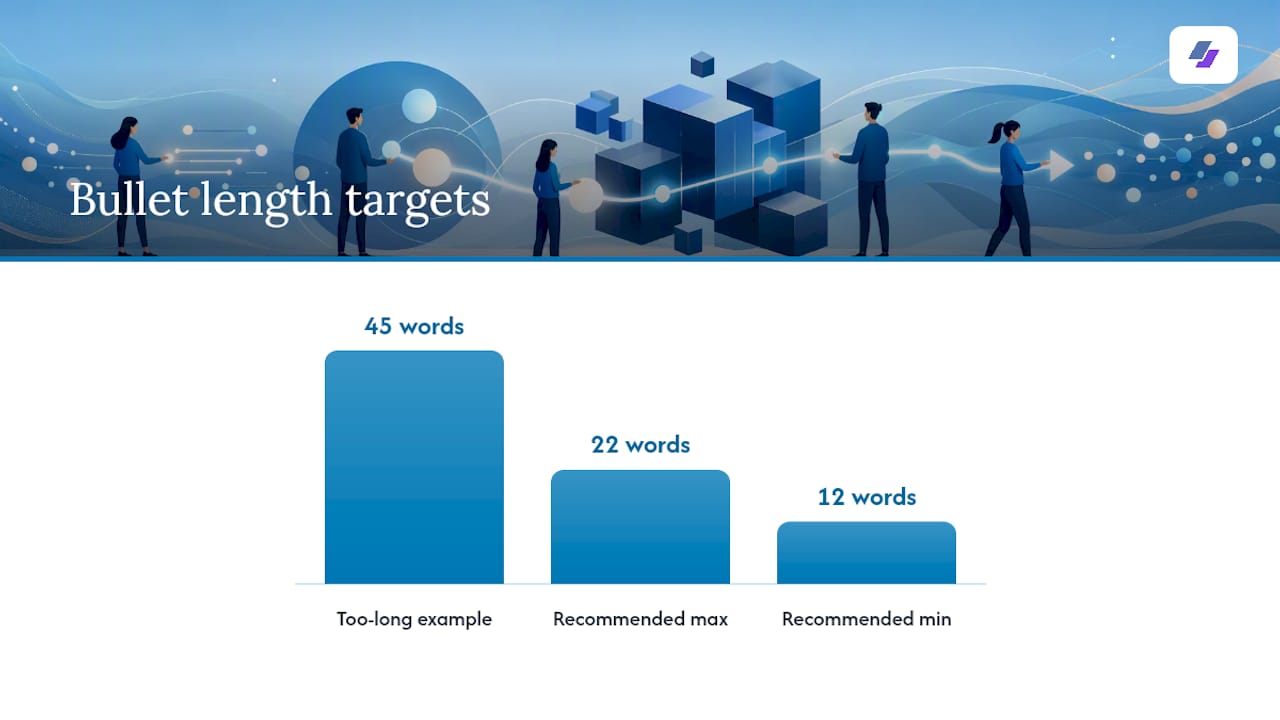
- Too long: A 45-word bullet crammed with subordinate clauses → trim to 12–22 words, one accomplishment per bullet.
- Passive voice: “Sales targets were exceeded” → “Exceeded quarterly sales targets by 23% for 3 consecutive quarters.”
- Repeated verb: Three bullets in a row starting with “Managed” → rotate to Led, Directed, Oversaw.
Wellesley’s before/after examples show exactly how adding scope and measurable outcomes transforms a generic duty line into a standout accomplishment.
On length: aim for 12–22 words per bullet. Use parallel structure (all bullets in a role start with the same grammatical form) and keep tense consistent: past tense for previous roles, present tense for your current one.
What hiring managers actually notice in the first few seconds
Recruiters spend roughly 6–8 seconds on an initial resume scan. In that window, they are not reading; they are pattern-matching for three things: a recognizable job title, a number, and a keyword that matches the role. The frameworks in this article are not academic exercises. They are a direct response to how resumes get evaluated under time pressure.
What I find most candidates underestimate is the baseline problem. A bullet that says “increased revenue” is invisible. The difference between the second and third version is not more words; it is the how, which is what a hiring manager actually wants to verify in an interview.
The other thing worth saying plainly: quantifying does not require perfect data. Reasonable estimates, clearly framed, are better than vague claims.
Jobalign automates the tailoring work so you can apply faster
Writing strong bullets is one thing. Rewriting them for every job posting is another. Jobalign syncs directly with your LinkedIn profile, analyzes each job description, and generates a tailored, ATS-optimized resume with the right keywords placed in the right positions. You get a personalized resume per posting without rebuilding from scratch each time. If you are applying to multiple roles and need each resume to reflect the specific language of each posting, generate your first tailored resume free and see the difference in minutes.
Sources
- Writing Impactful Resume Bullets – Office of Career Strategy – Yale University
- Resumes with Impact: Creating Strong Bullet Points | Columbia Career Education
- Write Impressive Bullet Points Using APR Format – Center for Career Readiness
- How to Write Effective Resume Bullets | Wellesley Career Education
- How to List Work Experience on Your Resume (With Examples)