Make ATS Match: 15–25 Sales Resume Keywords, Copyable Bullets

Sales resume keywords are the specific skills, tools, methodologies, and metrics that applicant tracking systems and recruiters scan for when screening candidates. The single highest-impact move you can make is pulling keywords straight from the job description and pairing every one with a quantified result. Do that consistently, and you fix both problems at once: the ATS matches your resume, and the recruiter sees proof you can actually sell.
TL;DR:
- Prioritize including specific, quantifiable results tied to keywords such as quota attainment, ARR, win rate, or deal size to demonstrate proven success.
- Use strong action verbs like managed, owned, grew, and negotiated to clearly show ownership and impact in each sales activity.
- Name the tools and methodologies explicitly, such as Salesforce, HubSpot, MEDDIC, or Challenger Sale, especially when they are common in job postings.
- Place the most important keywords in the summary, skills section, and experience bullets to ensure both ATS and recruiters see them early in the review process.
- Focus on proof-based keywords rather than vague buzzwords, and avoid keyword stuffing by dedicating one tool or skill per bullet with an associated achievement or metric.
Table of Contents
- What Are Sales Resume Keywords, and Why Do ATS and Recruiters Care?
- The Keyword Bundles You Can Copy Directly Into Your Resume
- Where to Place Keywords So the ATS and the Recruiter Both See Them
- How to Write a Bullet That Actually Gets Read Twice
- Matching Keywords to Your Specific Sales Niche
- The Buzzwords and Habits That Quietly Sink a Sales Resume
- Watching JobAlign Turn a Job Posting Into a Keyword-Ready Resume
- What I’d Prioritize If I Were Job Hunting Right Now
- Try JobAlign Before Your Next Application Goes Out
- Sources
- FAQ
What Are Sales Resume Keywords, and Why Do ATS and Recruiters Care?
An applicant tracking system doesn’t read your resume the way a human does. It parses the text, matches it against the keywords loaded into the job requisition, and scores or ranks you accordingly. If the posting says “Salesforce” and your resume says “CRM software,” you may lose the match entirely. Some parsers get partial credit for synonyms; plenty don’t.
Recruiters, once your resume clears that filter, do their own version of the same scan, just faster and with more context. They’re skimming for proof you’ve done the job before, at the scale they need, using the tools they already run. A recruiter spending six seconds on your resume isn’t reading sentences. They’re hunting for familiar words in familiar places.
That’s why keyword choice matters more in sales than almost any other function. Sales is a numbers business, and both the software and the human reviewing your resume expect to see it treated that way.
Sales resume keywords generally fall into four buckets:
- Skills: prospecting, negotiation, account management, pipeline management, consultative selling
- Tools: Salesforce, HubSpot, Excel, LinkedIn Sales Navigator
- Methodologies: MEDDIC, SPIN Selling, Challenger Sale
- Metrics: quota attainment, ARR, MRR, win rate, deal velocity
Buzzwords like “passionate,” “hardworking,” or “results-driven” don’t fall into any of those categories because they carry no verifiable substance. Recruiters have seen every one of those words a thousand times, and career-coaching guidance consistently flags them as filler that should be replaced with a concrete verb and a number instead.
The Keyword Bundles You Can Copy Directly Into Your Resume
Think of your resume in three layers: the action verbs that open each bullet, the skills and tools that prove capability, and the metrics that prove results. Weak verbs are the easiest fix and the one most people skip.
| Weak verb | Stronger swap |
|---|---|
| Helped | Drove |
| Worked on | Owned |
| Was responsible for | Managed |
| Talked to clients | Negotiated |
| Did outreach | Prospected |
| Made calls | Cold-called |
| Handled accounts | Retained |
| Improved sales | Grew |
Career-services research backs this swap specifically: replacing generic filler with a sharper verb signals ownership and outcome in a way “helped” never can.
Core sales skills worth weaving into your summary, skills section, and bullets include prospecting, cold calling, pipeline management, territory management, consultative selling, contract negotiation, account expansion, upselling, cross-selling, and client retention. These aren’t buzzwords because each one describes a discrete, checkable activity. Indeed’s employer research lists most of these among the top skills hiring managers search for in candidate profiles, and it specifically recommends naming your tools rather than describing them generically.
That tool list matters as much as the skill list. Salesforce and HubSpot are the two CRMs that show up most often in job postings, so if you’ve used either, name it explicitly rather than writing “CRM experience.” Excel still appears constantly in postings that involve forecasting, commission tracking, or pipeline reporting. LinkedIn Sales Navigator has become close to standard for anyone doing B2B prospecting, and leaving it off your resume when you’ve used it daily is a missed match.
Methodologies are the layer most candidates forget entirely, and they’re often the fastest way to stand out. If you were trained in MEDDIC, SPIN Selling, or Challenger Sale, name the framework by name. Sales leaders searching for a specific methodology are often filtering directly on that term, and a resume that names it signals you can hit the ground running under their process rather than needing to be retrained.
Pro Tip: If you don’t know which methodology your last company used, look at how you were coached to qualify deals. Asking about pain, budget, and decision timeline before quoting price is a SPIN behavior even if nobody in the room ever said “SPIN.”
Metrics tie the whole structure together. Quota attainment (stated as a percentage), ARR or MRR growth, average deal size, sales cycle length, win rate, and pipeline value are the numbers recruiters expect a sales resume to contain somewhere in nearly every bullet. A layered keyword strategy that mixes primary metrics, methodology terms, and tech stack references performs better in both ATS scoring and recruiter skims than a resume that leans on any single category. The same guidance recommends landing on roughly 15 to 25 relevant keywords woven naturally through the document rather than piling on every term you can think of.
Where to Place Keywords So the ATS and the Recruiter Both See Them
Placement matters almost as much as word choice. A resume that buries “Salesforce” once in a paragraph of dense text is weaker than one that repeats it strategically across three sections, because both the parser and the human reviewer are scanning specific zones first.
Your summary, at the top of the resume, should carry your two or three most important keywords: your role level, your industry, and your single strongest metric. Something like: “B2B SaaS Account Executive with strong average quota attainment managing a multi-million dollar pipeline using Salesforce and MEDDIC qualification.” That one sentence hits role, industry, metric, tool, and methodology at once.
Your skills section is where you list the rest in scannable form, not sentences. Aim for a moderate number of terms pulled directly from the job posting: a mix of tools, methodologies, and core skills. Keep it a clean list, not a paragraph.
Your work experience bullets are where metrics do the heaviest lifting, and each bullet should carry at least one keyword tied to a number. Certifications, if you have any (Salesforce Certified Administrator, Sandler Training, Challenger Sale certification), belong in their own short section near the bottom, since ATS parsers often scan for certification titles specifically.
- Summary: 2 to 3 top keywords, plus one headline metric
- Skills section: 8 to 12 keywords in list form
- Experience bullets: keyword + metric in nearly every line
- Certifications: exact certification names, verbatim
One formatting note that trips people up: save and submit your resume as a PDF built from a standard word processor or resume tool, not a scanned image or a heavily designed graphic layout. Most modern ATS platforms parse PDFs fine, but text boxes, columns, and graphics inside a PDF can scramble the parsing order. When in doubt, a clean single-column layout is the safest bet.
How to Write a Bullet That Actually Gets Read Twice
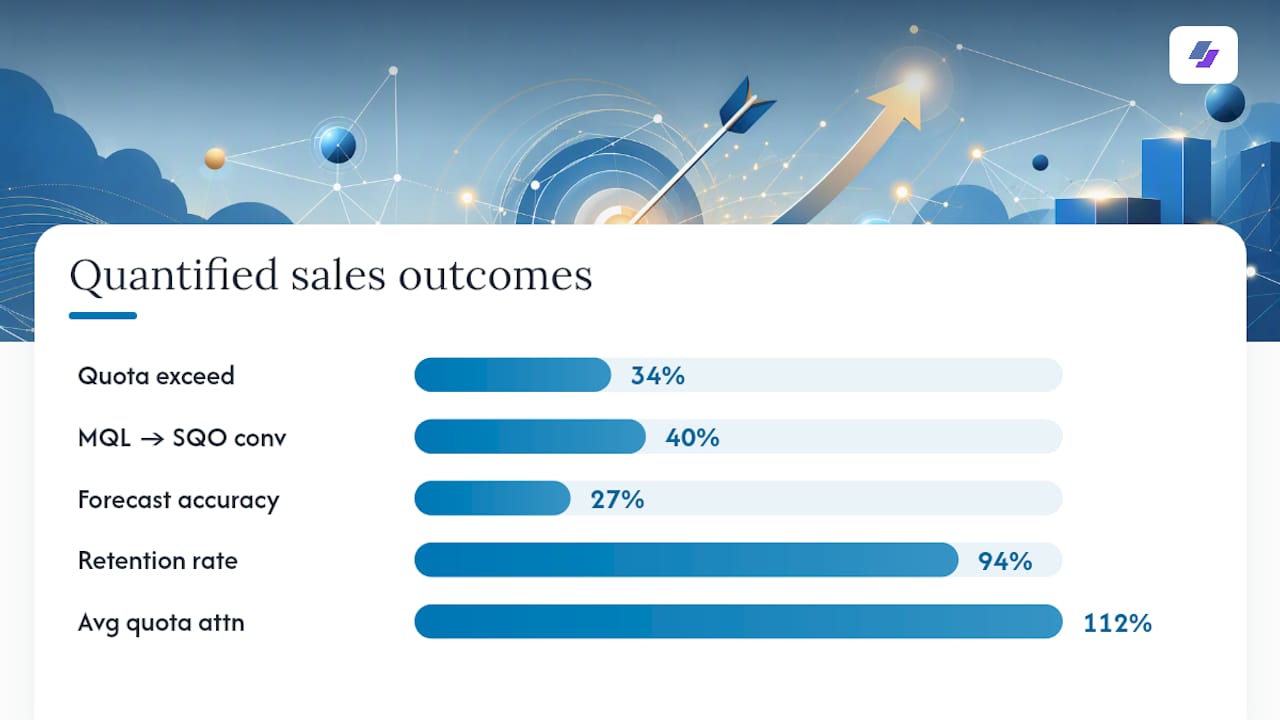
Every strong sales bullet follows the same skeleton: Keyword + Action Verb + Metric, sometimes with the method or tool named as a fourth piece. The keyword tells the ATS and the recruiter what skill or category you’re demonstrating. The action verb shows ownership. The metric proves it happened and quantifies how well. Drop any one piece and the bullet gets noticeably weaker.
Here’s how that plays out in practice, rewritten across different sales roles and seniority levels:
- SDR, before: “Made outbound calls and set up meetings for the sales team.” After: “Prospected 60+ daily outbound calls, booking 22 qualified meetings per month and exceeding quota by 34%.”
- SDR, before: “Worked with marketing on lead generation.” After: “Partnered with marketing to convert 40% of inbound MQLs into sales-qualified opportunities using HubSpot lead scoring.”
- Account Executive, before: “Responsible for closing new business.” After: “Closed $1.8M in new ARR across 45 enterprise accounts, applying MEDDIC to qualify deals before quoting.”
- Account Executive, before: “Managed the sales pipeline.” After: “Managed a $3.2M pipeline in Salesforce, improving forecast accuracy by 27% quarter over quarter.”
- Account Manager, before: “Kept clients happy and renewed contracts.” After: “Retained 94% of a 120-account book and grew net revenue 18% through targeted upselling.”
- Account Manager, before: “Helped clients get more value from the product.” After: “Drove product adoption through quarterly business reviews, lifting renewal rates from 81% to 96%.”
- Sales Manager, before: “Led a team of sales reps.” After: “Coached a nine-rep team to 112% average quota attainment using Challenger Sale training.”
- Sales Manager, before: “Improved team performance.” After: “Cut average sales cycle length from 68 to 51 days by standardizing SPIN-based discovery calls.”
Every one of those “after” versions still describes the same real work. The only thing that changed was making the keyword, the verb, and the number visible instead of implied.
If you genuinely don’t have an exact number for a role, a percentage range, a rank (“top 3 of 22 reps”), or a comparative proxy (“grew territory revenue year over year”) still beats no number at all. ATS-focused resume guidance points to the same pattern: concrete verbs plus any quantification consistently outperform vague, unquantified claims in getting a resume noticed.
Matching Keywords to Your Specific Sales Niche
A generic keyword list gets you halfway. The other half is speaking the specific language of your industry, because a hiring manager in medical device sales and one hiring for retail floor sales are not scanning for the same terms at all.
SaaS sales postings lean heavily on ARR, MRR, demo-to-close rate, product-led growth, renewal rate, and technical demos. If you sell software, name the specific sales motion (inbound, outbound, product-led) alongside the metric.
Medical device and healthcare sales postings look for clinical education, hospital procurement processes, GPO (group purchasing organization) relationships, and stakeholder engagement across clinical and administrative buyers. These roles reward keywords that show you can navigate a longer, more regulated buying cycle.
Retail and inside sales postings often center on POS systems, foot traffic conversion, merchandising, and upselling at the point of sale. B2B and B2C roles diverge sharply too: B2B rewards deal size, sales cycle length, and stakeholder mapping; B2C rewards volume metrics like calls per day or conversion rate.
- Entry-level: emphasize activity metrics (call volume, meetings booked, quota percentage) since tenure is short
- Senior-level: emphasize revenue impact, team leadership, and strategic account growth instead
The Buzzwords and Habits That Quietly Sink a Sales Resume
Certain phrases do real damage because they promise substance and deliver none. “Passionate about sales,” “results-driven professional,” and “team player” all read as filler unless a metric follows immediately after. Recruiters have seen these thousands of times, and action-verb research from career-services professionals specifically calls these out as the words to cut first.
Keyword stuffing is the other trap, usually appearing as a wall of tool names crammed into one line (“Salesforce, HubSpot, Excel, Zoom, Outreach, Gong, Salesloft”) with no context for how each one was used. ATS platforms and human reviewers both catch this fast, and it reads as padding rather than experience.
- Cut: “Passionate, results-driven sales professional”
- Fix: “Account Executive who grew a $1.2M territory by 31% in 18 months”
- Cut: a stacked list of six tools in one bullet with no verb or metric
- Fix: one tool named per bullet, tied to a specific action and result
| Mistake | Why it hurts | Quick fix |
|---|---|---|
| Buzzwords without proof | Reads as filler, no signal | Replace with a metric-backed verb |
| Keyword stuffing | Looks like padding, not experience | One tool per bullet, tied to a result |
| Vague claims (“improved sales”) | No way to verify impact | Add a percentage or dollar figure |
Watching JobAlign Turn a Job Posting Into a Keyword-Ready Resume
Here’s what that process looks like in practice when you’re applying to several roles in the same week and don’t have hours to rebuild your resume from scratch each time.
- Paste the job description into JobAlign, and the platform reads it against your synced LinkedIn profile.
- JobAlign extracts the specific keywords the posting emphasizes, tools, methodologies, and skill phrases included.
- Those keywords get prioritized and slotted into your summary, skills section, and bullets automatically.
- A tailored, ATS-formatted resume is generated, ready to export as a clean PDF.
You still apply the keyword-plus-verb-plus-metric formula yourself, since only you know the real numbers behind your work. What JobAlign automates is the matching and placement part, the part that eats the most time when you’re customizing a resume for every single application instead of sending the same one everywhere.
What I’d Prioritize If I Were Job Hunting Right Now
If you take one thing from this: stop optimizing for keyword count and start optimizing for keyword proof. My three priorities for 2026 are tailoring to each specific posting, naming your actual tools and methodologies instead of vague equivalents, and quantifying every claim you can defend in an interview.
Run this checklist before you submit anything: pull keywords from the posting itself, place your top three in the summary, list 8 to 12 in skills, back every bullet with a number, and read it once more for buzzwords hiding without proof behind them. For deeper formatting guidance, JobAlign’s resume examples are worth a look before your next application.
— Johan
Try JobAlign Before Your Next Application Goes Out
Rewriting a resume by hand for every posting is exactly the work JobAlign exists to remove. It syncs directly with your LinkedIn profile, reads the job description you’re applying to, and produces a tailored, ATS-optimized resume with the right keywords already placed, without you rebuilding a document from scratch each time.
Start with the free LinkedIn resume to see your first ATS-ready draft at no cost. When you’re applying to more than one role a week, the Solo, Starter, Pro, and Ultimate plans unlock unlimited tailored resumes starting at €4.80. Generate your next resume now and see the keywords JobAlign pulls from your target job posting before you apply.
Sources
- Top 205 action verbs for your resume
- Top 50 sales skills to look for in candidates
- 60+ High impact sales resume keywords for 2026
FAQ
What Are the 5 P’s of a Resume?
There’s no single agreed-upon “5 P’s” framework in resume writing, so treat any version you see as informal shorthand rather than an industry standard. What consistently matters for a sales resume is tailoring content to the posting, proving results with metrics, and using precise keywords rather than vague claims.
What Are Good Keywords for a Resume in Sales?
Strong sales keywords include specific skills (prospecting, account management, negotiation), named tools (Salesforce, HubSpot, Excel, LinkedIn Sales Navigator), methodologies (MEDDIC, SPIN Selling, Challenger Sale), and metrics like quota attainment or ARR growth. A layered mix of these categories tends to perform better than leaning on any single type.
What Are the 6 Basic Selling Skills?
Definitions vary depending on the source, but skills that consistently appear across sales job postings include prospecting, active listening, needs qualification, objection handling, negotiation, and closing. Employer research on in-demand sales skills supports listing these explicitly rather than describing them generically on a resume.
What Key Skills Should I Include on a Sales Resume?
Include pipeline management, consultative selling, account expansion, contract negotiation, and CRM proficiency named by tool (Salesforce, HubSpot). Pair each skill with a metric wherever possible, since a skill listed without proof carries far less weight with recruiters than one backed by a number.
Can JobAlign Help Me Match Keywords to a Specific Job Posting?
Yes. JobAlign syncs with your LinkedIn profile and reads the job description you’re applying to, then extracts and prioritizes the keywords that posting emphasizes before generating a tailored resume. Current pricing for unlimited resume generation is listed on the JobAlign pricing page.