Avoid Resume Buzzwords: 5 Minute Audit and Copy Ready Rewrites

The fastest way to fix a weak resume is to cut vague buzzwords and rebuild each bullet with Action + Context + Result, plus the exact keywords from the job posting. Skip the personality adjectives, name what you did, where, and what happened because of it. Below, you’ll find the worst offenders, copy-ready rewrites, and a 5-minute checklist to clean up your resume today.
TL;DR:
- Overused buzzwords like “managed” and “results-driven” appear millions of times, losing their impact and failing to distinguish your resume from others.
- Replacing vague adjectives with specific achievements and measurable results enhances credibility and helps pass ATS scans.
- Incorporating exact keywords from the job posting into Action + Context + Result statements increases the likelihood of passing ATS filters and catching recruiters’ attention.
- A quick five-minute scan focusing on passive phrasing, generic language, and repeated keywords can significantly improve resume clarity.
- Using tools like JobAlign can automate the process of rewriting bullets with relevant keywords and optimized structure, saving time on customization.
Table of Contents
- Why avoid resume buzzwords in the first place?
- What are the most overused resume buzzwords to avoid?
- How do you replace buzzwords with Action + Context + Result?
- Should you still use keywords from the job posting?
- What’s a quick way to scan a resume for buzzwords?
- How reliable is this advice?
- When is it okay to keep a resume buzzword?
- How JobAlign turns this rewrite process into a 2-minute step
- Sources
- FAQ
Why avoid resume buzzwords in the first place?
Hiring managers spend seconds, not minutes, on a first resume pass. When they hit the fifth “results-driven” or “team player” in a stack of applications, their brain stops registering the word. That’s cognitive tuning-out, and it happens fast.
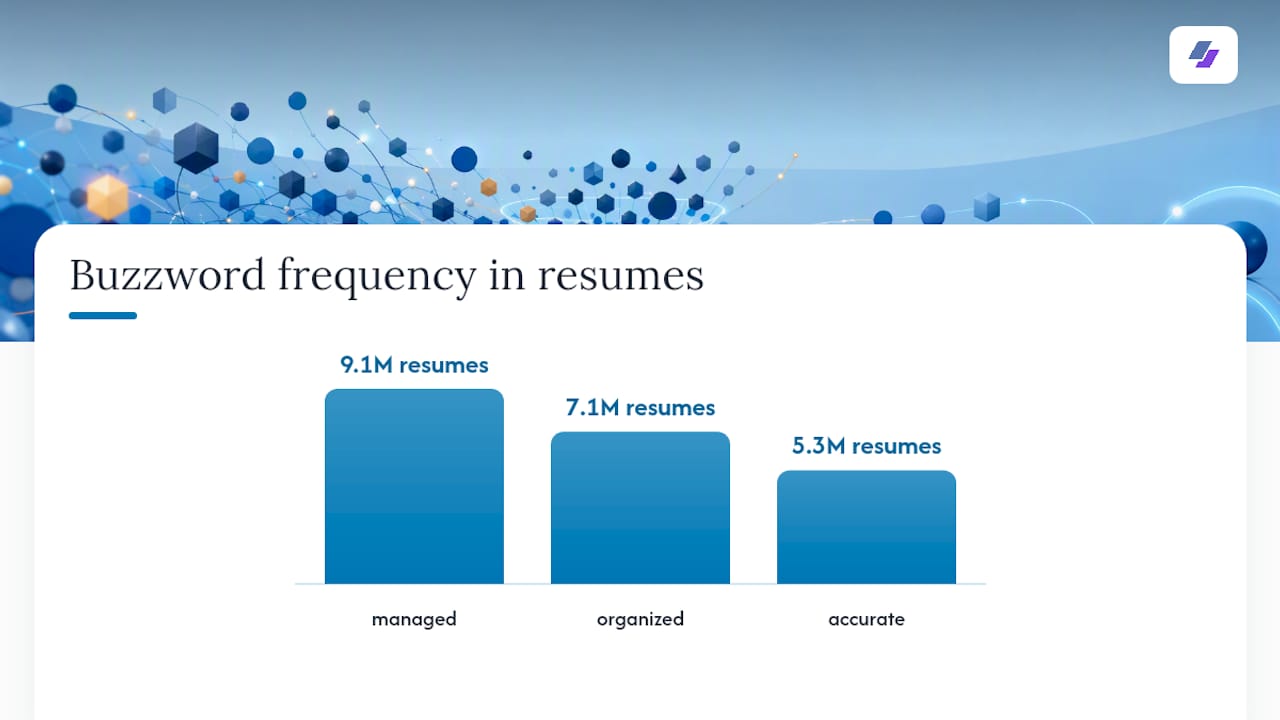
Large-scale resume analysis backs this up with real numbers. ResumeCoach’s review of 111 million resumes found “managed” on 9.1 million of them, “organized” on 7.1 million, and “accurate” on 5.3 million. When a word shows up that often, it stops telling a recruiter anything unique about you.
Here’s the distinction that trips people up: a buzzword and a keyword are not the same thing. “Detail-oriented” is a buzzword, an unproven claim about your personality. “Salesforce,” “HIPAA compliance,” or “Python” are keywords, specific and checkable. The goal isn’t to strip your resume of all descriptive language. It’s to replace personality claims with job-relevant terms an ATS and a recruiter can both verify.
What are the most overused resume buzzwords to avoid?
Most weak resumes fall into four traps: hollow personality adjectives, tired action verbs, vague metrics, and passive phrasing that hides who actually did the work. Here’s how to spot and fix each one.
Personality adjectives (claims with no evidence):
- “Hardworking” → Cut it entirely, or replace with a specific achievement that proves it.
- “Detail-oriented” → “Caught 12 pricing errors during monthly audit, saving $8,000 in overcharges.”
- “Team player” → “Coordinated with a 6-person cross-functional team to launch a product two weeks ahead of schedule.”
- “Results-driven” → Delete. Let the actual result in your next bullet do the talking.
Weak, overused verbs:
- “Managed” → “Oversaw a $250,000 marketing budget across three regional campaigns.”
- “Responsible for” → “Led onboarding for 15 new hires, cutting ramp-up time by 20%.”
- “Helped with” → “Built the onboarding email sequence that reduced support tickets by 30%.”
- “Worked on” → Name the actual deliverable: “Redesigned the checkout flow” or “Wrote the Q3 content calendar.”
Vague or missing metrics:
- “Improved efficiency” → “Cut invoice processing time from 3 days to 6 hours by automating approvals.”
- “Increased sales” → “Grew territory revenue 18% year over year, exceeding quota by $40,000.”
Passive phrasing:
- “Duties included…” → Start with an action verb: “Trained,” “Negotiated,” “Built.”
- “Was tasked with…” → State what you did, not what someone assigned you.
Role matters here, too. A client-facing role’s fix leans on relationship and revenue language instead of tools. Same formula, different vocabulary.
How do you replace buzzwords with Action + Context + Result?
The Action + Context + Result framework turns a fuzzy claim into a verifiable line. Action is the verb. Context is where, how, or with what. Result is the outcome, ideally a number. When you don’t have a number, scope works as a stand-in: team size, budget, frequency, region, or tools used.
Here’s the formula in practice across different jobs:
- Vague: “Responsible for customer service.” Rewrite: “Resolved 40+ support tickets daily for a SaaS product, maintaining a 95% satisfaction score.”
- Vague: “Helped grow social media presence.” Rewrite: “Grew Instagram following from 2,000 to 18,000 in 8 months through weekly content series.”
- Vague: “Managed a team.” Rewrite: “Led a 5-person design team across two office locations to deliver 12 client projects per quarter.”
- Vague: “Improved processes.” Rewrite: “Redesigned the intake workflow, cutting new-client onboarding time from 10 days to 3.”
- No hard number available: “Supported the finance department.” Rewrite: “Reconciled monthly statements for a 40-person department across 3 cost centers.” Scope alone makes this credible.
Pro Tip: Whenever you write a bullet, ask: “Could I say a number, a scope, or a specific tool here instead of an adjective?” If the answer is yes, that’s your rewrite.
Should you still use keywords from the job posting?
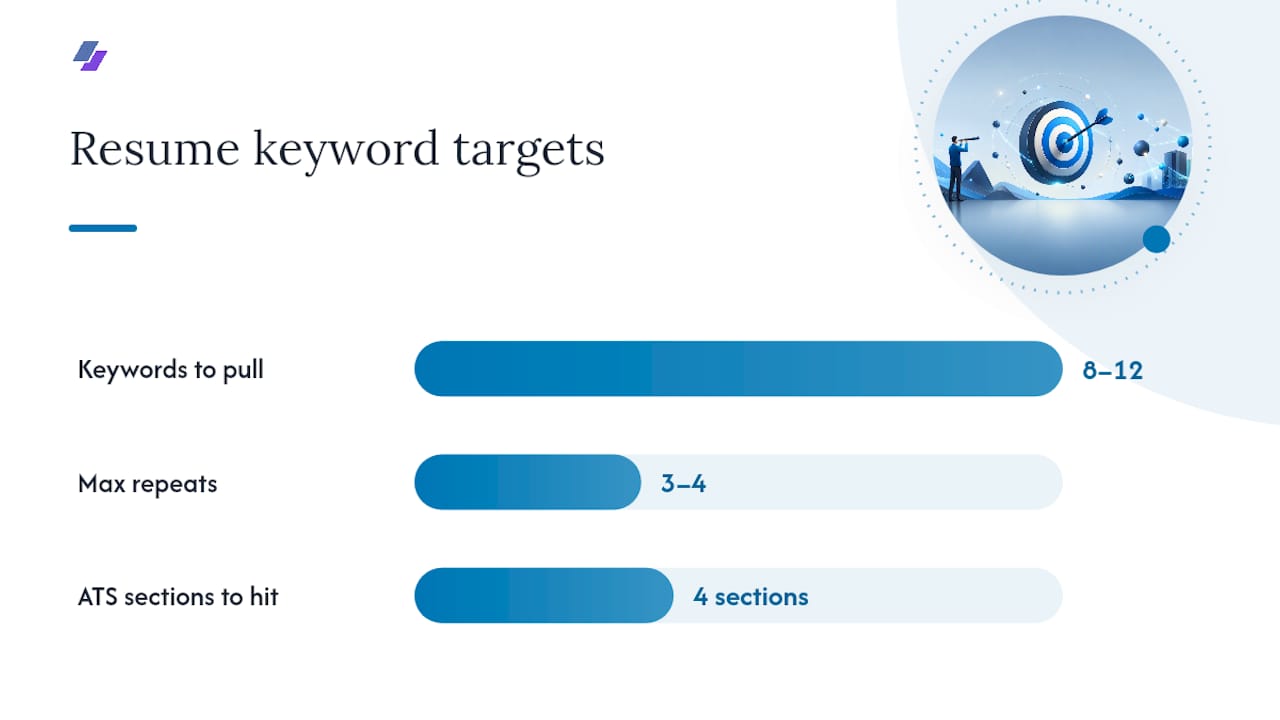
Yes, but placement matters more than repetition. ATS software scans your headline, skills section, bullet points, and any project descriptions for terms that match the job posting. Miss those sections and even a strong resume can get filtered out before a person sees it.
A few rules keep you out of stuffing territory:
- Pull 8 to 12 keywords directly from the job description, prioritizing tools, certifications, and job titles.
- Place each keyword where it’s true, not where it’s convenient. Don’t list “Tableau” in skills if you’ve never opened it.
- Watch for AI-like phrasing that repeats the same three adjectives in every bullet. Recruiters notice generic, templated language and read it as a red flag, not effort.
- One practical density check: if the same word appears more than three or four times on a one-page resume, swap some instances for real evidence.
A natural layout looks like this: headline states your target role plus one differentiator (“Senior Product Manager, B2B SaaS”), skills section lists the exact tool names from the posting, and each bullet works one keyword into a full Action + Context + Result sentence rather than dropping it in isolation. For a deeper breakdown of where each keyword type belongs, JobAlign’s ATS keyword guide walks through placement by section.
What’s a quick way to scan a resume for buzzwords?
Set a timer for five minutes and run through this order:
- Read your summary and top 3 bullets out loud. If a sentence sounds like something you’d never actually say in an interview, rewrite it.
- Search your document for “responsible for,” “team player,” “hardworking,” “results-driven,” and “detail-oriented.” Replace every instance you find.
- Check your skills section for buzzwords disguised as skills (“communication,” “leadership”) versus real, ATS-matched terms (“Salesforce,” “Agile,” “SQL”).
- Proofread once more for passive phrasing (“duties included”) and swap in an action verb.
Fix your headline and top bullets first. That’s where recruiters and ATS scoring weigh the most.
How reliable is this advice?
This guidance comes from Johan, drawing on published resume research and career-services standards rather than personal opinion alone. The scale of the buzzword problem is well documented: analysis of 111 million resumes shows how thoroughly words like “managed” have lost their punch. JobAlign’s resume optimization guide covers the ATS side of this in more depth, including formatting choices that affect parsing accuracy.
When is it okay to keep a resume buzzword?
Keep a descriptor only when it’s chained to proof, “collaborative” earns its place next to a specific cross-team win you’d repeat in an interview. Save broader personality claims for your cover letter or LinkedIn summary, where narrative has more room. If you used AI to draft your summary, read it back and cut anything that sounds like it could describe anyone.
— Johan
How JobAlign turns this rewrite process into a 2-minute step
Doing this manually for every application gets tedious fast, especially when you’re customizing bullets for each job posting. JobAlign syncs directly with your LinkedIn profile, pulls your actual experience, and rebuilds each bullet using the same Action + Context + Result structure covered above, matched against the specific job description you’re applying to. Instead of guessing which keywords matter, JobAlign extracts them from the posting and places them where ATS software expects to find them.
You can create tailored resumes without rewriting from scratch each time. Generate your first ATS-optimized resume from your LinkedIn profile and see how the rewrites compare to what you have now.
Sources
- Job Hunting? Cut These 3 Overused Words from Your Resume Now | Money
- Resume bullet statements (Action + Context + Result) | University of Nebraska–Lincoln Careers
FAQ
What words should I avoid using on a resume?
Skip vague personality adjectives like “hardworking,” “team player,” and “detail-oriented,” along with overused verbs like “managed” and “responsible for.” Replace each with a specific action, context, and measurable result.
What is the 7-second rule for resumes?
It refers to the idea that recruiters form an initial impression of a resume in about the first several seconds of scanning it, which is why your headline and top bullets need to lead with specifics, not buzzwords.
What counts as a red flag on a resume?
Common red flags include unexplained employment gaps, vague bullets with no measurable outcome, and language that reads like generic, AI-generated filler rather than a real account of your work.
How do I know if my resume has too many buzzwords?
If the same adjective or verb shows up more than three or four times on a one-page resume, or if you can’t back a claim with a number, tool, or scope, it’s a buzzword that needs a rewrite.
Can JobAlign help remove buzzwords from my resume automatically?
Yes. JobAlign rebuilds your resume bullets using your LinkedIn data and the job description’s own language, replacing generic phrasing with specific, ATS-aligned wording for each application.