Get Past ATS With a Career Change Resume Format Backed by Wharton

Use a combination (hybrid) resume: it puts your transferable skills front and center while keeping the job titles and dates that Applicant Tracking Systems (ATS) and recruiters expect to see. This format works because it lets you lead with proof you can do the new job, without hiding the timeline that shows you’re a real, hireable candidate. Below, we’ll break down exactly how to build it.
TL;DR:
- Using a hybrid resume format allows you to highlight transferable skills upfront while maintaining an honest, concise employment timeline.
- Tailoring your professional summary and skills section with keywords from target job descriptions is crucial for passing ATS filters in career switches.
- Rewriting old bullets to emphasize numbers, achievements, and relevant skills can effectively translate past experience into your new field.
- Listing relevant education, certifications, or projects can help bridge gaps when paid experience in the new industry is limited.
- Creating a separate, tailored resume for each role and thoroughly proofreading increases your chances of getting noticed by recruiters and ATS software.
Table of Contents
- Why the Combination Format Usually Wins for Career Changers
- Building Your Resume From the Top Down
- How to Rewrite Old Bullets So They Read as Relevant
- Getting Past the ATS Filter With the Right Keywords
- Templates You Can Copy Right Now
- Using Education, Certifications, and Projects to Prove You’re Serious
- Your Final Checklist Before You Hit Submit
- What Most Career Changers Get Wrong
- Let JobAlign Handle the Keyword Mapping for You
- Sources
- FAQ
Why the Combination Format Usually Wins for Career Changers
Three resume formats compete for your attention, and only one of them was built for exactly this situation. A chronological resume lists jobs in reverse order with bullets under each. It’s what ATS software and recruiters are trained to expect, but it puts your least relevant job title (the one you’re leaving behind) right at the top.
A functional resume groups skills into categories and buries or removes the timeline. Career coaches used to love this for pivots, but it backfires now. ATS Verification’s guidance on career-change resumes warns against using a pure functional format to mask a pivot, since ATS parsers and recruiters can penalize resumes that omit standard chronological employment fields. It looks like you’re hiding something because you usually are.
The combination (hybrid) format takes the best of both. You open with a skills or competencies section that proves relevance, then follow with a condensed, honest work history. Wharton Executive Education points to hybrid resumes as the strongest choice for career changers specifically because they let you highlight transferable skills first while still presenting a clear employment timeline.
Here’s a quick decision rule:
- Staying in the same field, just moving up? Chronological still works fine.
- Changing industries or job functions? The hybrid format is your best bet.
- Have limited paid experience in the new field but strong projects or volunteer work? Hybrid, with a projects section pulled up near the top.
Building Your Resume From the Top Down
Order matters more than most people think. Recruiters spend seconds, not minutes, on a first pass, so what sits in the top third of the page does the heavy lifting.
- Professional summary (the bridge narrative). Two to three sentences that connect your past to your future. A solid formula: “[Years] years in [old field], now applying [core transferable skill] to [new field]. Known for [quantified result].” Indeed’s career-change resume guidance recommends tailoring this summary directly to the target role and backing it with measurable achievements, not vague enthusiasm.
- Core competencies / skills section. List 8 to 12 skills, grouped if it helps (technical skills, leadership skills, tools). Under two or three of them, add a one-line evidence snippet, like “Data analysis: built reporting dashboards used by 40+ staff.”
- Relevant experience. Group bullets by skill or accomplishment area rather than strictly by job. This is where you translate old work into new language.
- Professional history. A condensed, chronological list of titles, companies, and dates, with minimal detail. This section exists to satisfy the timeline, not to repeat what you already said above.
- Education, certifications, and projects. Placement depends on relevance. If a certificate is central to your pivot, move it above your work history.
Pro Tip: Put your bridge sentence in the summary, not the objective line. A forward-looking sentence that names your target field puts the exact keywords ATS and hiring managers read first, right where they’re looking.
How to Rewrite Old Bullets So They Read as Relevant
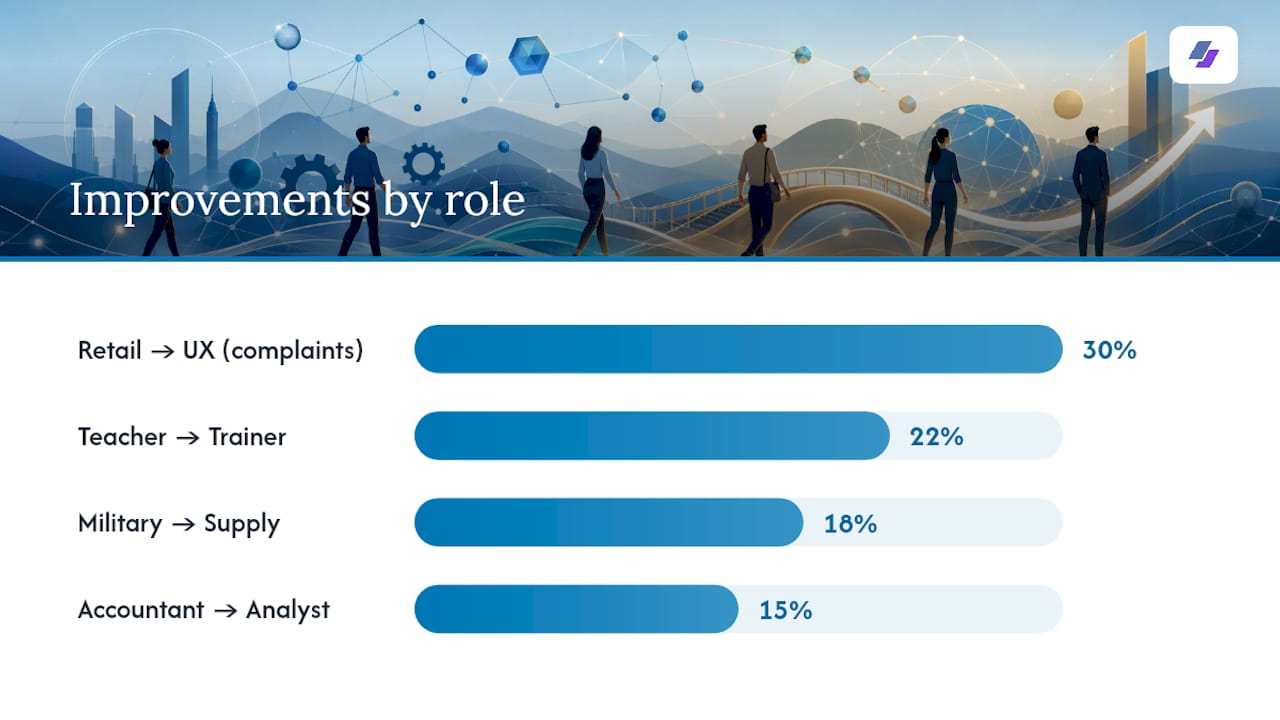
The rewrite process has three steps: pull keywords from target job postings, identify which of your past actions map to those keywords, and quantify the result. TailorForge’s guide to reframing experience recommends grouping achievements by transferable skill category first, then adding a short chronological history underneath to keep recruiters oriented.
Keep the real job title and real dates. Only the description changes. Here’s what that looks like in practice:
- Retail manager → UX researcher. Before: “Managed customer complaints and resolved issues daily.” After: “Conducted 200+ informal customer interviews, identifying friction points that informed three process changes and cut complaint resolution time by 30%.”
- Teacher → corporate trainer. Before: “Taught high school biology to classes of 30 students.” After: “Designed and delivered curriculum for groups of 30, using data-driven assessment to improve learning outcomes by 22% year over year.”
- Accountant → data analyst. Before: “Reconciled monthly financial statements.” After: “Analyzed monthly financial datasets to identify discrepancies, reducing reporting errors by 15% through improved audit processes.”
- Military logistics coordinator → supply chain manager. Before: “Coordinated transport of supplies for a 200-person unit.” After: “Managed end-to-end logistics for a 200-person operation, optimizing delivery routes and cutting transport delays by 18%.”
Notice the pattern: every “after” bullet keeps a number. Wharton’s research on career-change resumes also stresses that proofreading and a peer read remain high-impact final steps, since small errors in an otherwise strong rewrite still distract and can cost you an interview.
Getting Past the ATS Filter With the Right Keywords
ATS software matches your resume against the new field’s language, not your old job titles. If your résumé says “customer service representative” but the job posting says “client success associate,” a poorly configured filter may not connect the dots. That gap is exactly what sinks a lot of career-change applications before a human ever sees them.
The fix is methodical, not creative. ATS Verification recommends pulling 3 to 5 real job descriptions for your target role and extracting the skill and tool phrases that show up repeatedly. Those repeated terms are your keyword set.
- Collect 3 to 5 job postings for the exact role you want.
- Highlight every recurring skill, tool, and qualification phrase.
- Map each keyword to a bullet or summary line on your resume. If you can’t map it honestly, that’s a gap to address through a course or project, not a keyword to fake.
- Use standard section headers like “Professional Experience” and “Skills,” since unusual labels can confuse parsers.
- Save as a simple PDF or .docx, avoid text boxes, columns, and graphics that ATS software often can’t read, and skip headers/footers for critical information.
Our guide on tailoring your resume to a job posting walks through this keyword-mapping process in more depth if you want to see it applied line by line.
Templates You Can Copy Right Now
You don’t need to write your summary from scratch. TailorForge’s reframing guide offers three summary patterns that consistently work for career changers, and they’re worth adapting word for word.
Expertise-bridge: “[X] years in [old field] building [core skill]. Now bringing that expertise to [new field], with a focus on [specific outcome].”
Passion-discovery: “After [X] years in [old field], I pursued [certification/project] in [new field] and discovered [specific strength]. Ready to apply [skill] to [target role].”
Dual-strength: “Combining [old field] experience with new training in [new field], I bring a rare mix of [skill A] and [skill B] to [target role].”
For the skills section, group hard and soft skills separately so ATS parsers and human readers can scan quickly:
| Skill category | Example items |
|---|---|
| Technical/hard skills | SQL, Google Analytics, Salesforce, Adobe Creative Suite, Python |
| Analytical skills | Data visualization, forecasting, A/B testing, budget analysis |
| Leadership/soft skills | Cross-functional collaboration, stakeholder communication, project ownership |
A compact mini-resume snippet, in order, looks like this:
Jane Doe | jane@email.com | linkedin.com/in/janedoe
Summary: 8 years in retail operations, now applying process optimization and team leadership to supply chain roles. Reduced inventory discrepancies by 20% through improved tracking systems.
Core Competencies: Inventory Management • Process Optimization • Team Leadership • Vendor Relations • Data Analysis
Relevant Experience: Led inventory audits across 5 locations, cutting shrinkage by 12%. Managed vendor negotiations resulting in $40K annual savings.
Browsing a library of ATS-ready resume examples by role can help you see how this structure adapts to your specific target field.
Using Education, Certifications, and Projects to Prove You’re Serious
When paid experience in your new field is thin, education and side projects carry real weight, as described in Archiwa zmiana pracy | Soulmedic - Centrum Psychoterapii. Excelsior OWL’s career-change resume guidance points out that highlighting relevant coursework, certificates, and projects is a common and effective way to bridge the gap when formal work history falls short.
- List certifications with the date earned and a one-line outcome (“Google Data Analytics Certificate, 2026: built a capstone dashboard analyzing 10,000+ retail transactions”).
- If a certification or course is still in progress, write “In Progress, expected [month/year]” rather than omitting it.
- Add a Projects or Volunteer section if it demonstrates skills your paid work doesn’t, and link a portfolio if you have one.
- Prioritize recency and relevance over prestige. A three-month freelance project last year often outweighs a decade-old degree.
Your Final Checklist Before You Hit Submit
Run through this before sending anything out:
- Tailor your summary and top three bullets to the specific job posting, not a generic version of your pivot story.
- Run a keyword check against the job description and adjust your skills section if anything’s missing.
- Get a peer read. A second set of eyes catches phrasing that only makes sense in your head.
- Save as an ATS-friendly PDF and name the file professionally (FirstName_LastName_Resume.pdf).
- Build one tailored resume per role rather than mass-sending a single version, and track which version went where.
Pair the resume with a short cover letter and, if relevant, a portfolio link when you apply.
What Most Career Changers Get Wrong
The mistake I see most often isn’t a formatting error. It’s writing the resume for the job you had, then hoping the reader connects the dots to the job you want. That’s backward. Every strong pivot resume works because someone did the translation work first, and that’s precisely the part most people skip when they’re tired, discouraged, or just eager to hit submit.
Resume-building platforms can sync with LinkedIn profiles to generate tailored, ATS-optimized resumes with multiple variations, helping avoid the need to reuse a single draft. The blog and example library exist because the translation step, not the formatting, is where most career changers actually get stuck.
— Johan
Let JobAlign Handle the Keyword Mapping for You
Rewriting bullets and hunting keywords across five job postings takes real time, and Jobalign was built specifically to shortcut that work for career changers. It syncs with your LinkedIn profile, reads the job description you’re targeting, and generates a tailored, ATS-optimized resume with the right keywords already mapped into your bullets, not left for you to guess at.
You can start with a free LinkedIn resume to see how your current profile translates into a first draft. From there, generating a fresh, tailored version for every application is unlimited on paid plans, which run from the Solo plan at €4.80 one time up to Ultimate at €24.90 one time, detailed on the pricing page. No long resume-writing marathon required, just a synced profile and a job posting.
Sources
This guide draws on Wharton Executive Education, Excelsior OWL, ATS Verification, and TailorForge. For copy-ready layouts, browse ATS-optimized resume templates.
- How to Write a Career-Change Resume With Template | Wharton Executive Education
- Career Change Resume (2026) — Getting Past the ATS | ATS Verification
- Career Change Resume: How to Reframe Your Experience (With Templates + Examples) | TailorForge
- Resume examples for making a career change (Plus tips) | Indeed
FAQ
What Is the 30-30-30 Rule for Career Change?
There’s no single, widely agreed-upon definition of a “30-30-30 rule” for career changes in resume writing, and this article won’t invent one to sound authoritative. If you’ve seen the term used elsewhere, treat it as informal advice rather than an established industry standard.
How Do You Explain a Career Change on a Resume?
You explain it through your professional summary, using a short bridge sentence that connects your past experience to your target role, then reinforce that story through skill-grouped bullets rather than a separate explanation paragraph. Indeed’s guidance on career-change resumes recommends leaning on measurable achievements to make that connection concrete instead of just asserting it.
What Is the 7-Second Rule in Resumes?
Recruiters often make very quick initial pass/reject decisions on a resume, which is why the top third of your page needs to carry your strongest, most relevant proof points immediately. This is exactly why the hybrid format leads with skills and summary before the timeline.
What’s Another Way to Say Career Change?
Common alternatives include “career pivot,” “career transition,” and “career switch.” All three describe the same move: applying skills built in one field to a different industry or job function, which is the exact scenario this resume format is built for.