How to Frame Self-Employment on a Professional Resume

Yes — include relevant self-employment on your resume, and present it exactly like a professional role. Three things to do right now: pick a specific role title (“Growth Marketing Consultant,” not “Self-employed”), place the entry in your Experience section or a dedicated Freelance section, and write at least one bullet with a measurable result. That combination tells recruiters what you did, confirms you were accountable to real clients, and gives ATS systems the keywords they need to rank your application.
According to Boston University’s career guidance, freelance and self-employed work is powerful on a resume when it’s relevant — the key is using a clear title, placing the work in the right section, and emphasizing measurable outcomes. Vague framing is what kills these entries, not the work itself.
Key Takeaways
Framing self-employment on a professional resume comes down to one discipline: treat every independent role as a professional position with a specific title, a defined scope, and at least one measurable outcome.
| Point | Details |
|---|---|
| Use a specific role title | Replace “Self-employed” with a functional label like “Freelance UX Designer” or “Independent Marketing Consultant.” |
| Place work strategically | Use the Experience section for primary work; a separate Freelance section when it ran alongside salaried roles. |
| Write metric-driven bullets | Structure every bullet as action + scope + result; quantify with numbers, percentages, or dollar amounts. |
| Mirror job description keywords | Scan the JD for three to six priority nouns and tools, then rewrite bullets to include them naturally for ATS. |
| JobAlign automates the tailoring | JobAlign syncs your LinkedIn profile and generates a keyword-matched, ATS-optimized resume for each specific application. |
Table of Contents
- Should you include self-employment on this specific application?
- Where should self-employed work go on your resume?
- How to write the role line, company name, and dates
- How to write achievement-focused bullets for freelance projects
- How to group many short gigs into one clean entry
- Practical ways to handle dates and explain gaps
- How to make freelance entries pass ATS filters
- Copy/paste-ready ATS-friendly resume snippets
- Red flags recruiters notice — and one-line fixes
- What actually convinces a hiring manager about self-employed candidates
- JobAlign turns your LinkedIn profile into a tailored, ATS-ready resume
- Sources
Should you include self-employment on this specific application?
Not every gig belongs on every resume. Run this quick checklist before you add an entry.
- Relevance test: Does the work map to the core requirements or keywords in the job description? A three-month UX project belongs on a product designer’s resume; a weekend landscaping side hustle probably does not.
- Credibility test: Can you describe the scope concretely? Repeated clients, a clear deliverable, or a measurable result all pass. “Helped a few people with their websites” does not.
- Narrative test: Does this entry support your career story — filling a skill gap, showing progression, or demonstrating leadership? If it muddies the picture, abbreviate or omit it.
- When to omit: Short, unrelated gigs (under two months, no transferable skills), work that contradicts your target role’s culture, or anything you cannot verify with a reference or a deliverable.
When in doubt, align the entry to the target job before deciding. If you can reframe it with the right keywords and a concrete outcome, it usually earns its place.
Where should self-employed work go on your resume?
Placement depends on how central the work is to your story. The Muse recommends treating self-employment like conventional employment and choosing the format that best communicates consistency and progression.
Option 1 — Standard Experience entry. Use this when self-employment was your primary work for a defined period. It sits in your Experience section alongside any salaried roles, in reverse-chronological order. This is the cleanest option for career changers or anyone whose freelance work was full-time.
Option 2 — Dedicated Freelance or Independent Consulting section. Use this when you held a salaried job simultaneously, or when you want to separate a portfolio of project work from a traditional employment history. A section heading like “Freelance Projects” or “Independent Consulting” signals intentionality without burying the work.
Option 3 — Hybrid approach. One short experience line (“Freelance UX Designer, 2022–Present”) in the Experience section, plus a “Selected Projects” block below it with three to five named engagements. This works well for designers, developers, and consultants whose deliverables are the proof. A project-based resume structure formalizes this approach if you want a full template.
How to write the role line, company name, and dates
The role line is where most self-employed resumes lose credibility. “Self-employed” as both the title and the company name tells a recruiter nothing and looks like a placeholder. Here is how to fix it.
| Element | Weak version | Strong version |
|---|---|---|
| Role title | Self-employed | Senior UX Designer (Freelance) |
| Company line | Self-employed | Independent Contractor / [Your LLC Name] |
| Dates | 2020–2022 | January 2020–March 2022 |
| Location | Remote | Remote (US clients) |
ResumeSolving’s guidance is direct: pick a label that matches how a background check would describe you — “Freelance [Role],” “Independent Contractor,” or “Sole Proprietor” — and add one credibility line so the entry does not read like a gap filler. If you formed an LLC, use the business name as the company line. If you did not, “Freelance [Role Title]” works cleanly.
For ongoing work, write “2021–Present.” For part-time or fractional engagements running alongside a full-time job, add “(part-time)” or “(fractional)” in parentheses after the date range. Never leave dates vague — “various years” is a red flag.
How to write achievement-focused bullets for freelance projects
The bullet is where self-employment either earns credibility or loses it. Indeed’s resume guidance is clear: summarize the business role, responsibilities, and notable projects using action-oriented bullets, include client names when possible, and quantify outcomes.
Recommended structure: Action verb + scope/context + measurable result.
Sample bullets across common fields:
- Designer: “Redesigned e-commerce checkout flow for a mid-market apparel brand; reduced cart abandonment rate by 18% over 90 days.”
- Marketer: “Managed paid social campaigns for three B2B SaaS clients; delivered average cost-per-lead reduction of 22% within the first quarter.”
- Developer: “Built and deployed a custom Shopify storefront for a DTC skincare brand; site launched on schedule and processed $40K in sales in the first month.”
- Consultant: “Advised a regional logistics firm on supply-chain process gaps; recommendations adopted across two distribution centers, cutting order-processing time by 15%.”
Use collaborative verbs — “partnered with,” “advised,” “led,” “co-developed” — to counter the “works alone” bias that some hiring managers carry about independent workers. ResumeSolving notes that language like “Partnered with” and “Advised” signals teamwork and accountability, not just solo output.
Pro Tip: When clients are under NDA, describe the client type and environment instead of the name — “B2B manufacturing teams,” “Series A fintech startup” — and add “references available on request” at the end of the entry. You preserve verifiability without breaking confidentiality.
How to group many short gigs into one clean entry
Listing every two-week project as a separate role creates visual clutter and signals instability. Upwork’s resume guide recommends listing freelance positions in reverse-chronological order with project dates and summaries, but consolidation is the smarter move when you have many short engagements.
Group by role type or industry, not by client. One consolidated entry might look like this:
For portfolio-heavy fields, add a URL to a curated project page. The linked page should include the client category, the problem you solved, your deliverable, and the result. Keep it scannable — hiring managers spend seconds, not minutes, on portfolio links. Skip client logos unless you have written permission; describing client categories (“Fortune 500 retail brand”) is safer and often more impressive.
Practical ways to handle dates and explain gaps
Gaps during self-employment are common and rarely disqualifying — if you frame them clearly. Story makes the point plainly: consolidate similar work under one role and present a coherent professional story rather than a fragmented list of short stints.
For multi-client periods, a single date range covering the whole period works: “March 2020–August 2023.” You do not need to list every client’s start and end date separately.
If there was a genuine gap between a business closure and your next role, a brief phrase handles it honestly: “Independent Consultant — project-based work; references available.” That phrasing signals you were active, not idle, and that your work is verifiable.
For failed ventures or pivots, brevity is your friend. “Co-founded [Company Name], 2019–2021 (wound down)” is clean and honest. Recruiters respect candor about business closures far more than a conspicuous blank period or an inflated title that does not hold up to a reference check.
How to make freelance entries pass ATS filters
JobAlign’s ATS guide shows that freelance entries become ATS-friendly when you mirror the job description’s nouns and tools in natural bullets and add standard role-language in the title line. Here is a practical workflow.
Step 1: Pull three to six priority keywords from the job description — role nouns (“project manager,” “Agile”), tools (“Jira,” “Salesforce”), and outcome language (“cross-functional,” “stakeholder management”).
Step 2: Check your existing bullets. If the keyword is absent but the skill is present, rewrite the bullet to include it naturally.
Step 3: Confirm your role title uses the same language the job description uses. “Digital Marketing Specialist (Freelance)” parses better than “Independent Marketing Pro” when the JD says “Digital Marketing Specialist.”
Here is a before-and-after rewrite:
| Version | Bullet text |
|---|---|
| Before | “Ran social media for several small businesses and grew their followings.” |
| After | “Managed organic social media strategy across Instagram and LinkedIn for four SMB clients; grew combined following by 8,200 in six months using platform-native analytics and Hootsuite scheduling.” |
The “after” version names tools (Hootsuite), platforms (Instagram, LinkedIn), a client count, and a specific result. Every one of those elements is a potential ATS match. Avoid stuffing in keywords that do not reflect real work — ATS systems are increasingly sophisticated, and a recruiter who reads “proficient in Salesforce” and then asks a question about it will notice the gap immediately.
Copy/paste-ready ATS-friendly resume snippets
These two sample entries are built to pass ATS parsing and hold up to recruiter scrutiny. JobAlign’s platform generates entries like these automatically when you sync your LinkedIn profile and target a specific job description — the 87% ATS pass rate reflects how much keyword alignment matters.
Sample 1 — Marketing Consultant
Sample 2 — Software Developer
To adapt either snippet: swap the tools and platforms for the ones in your target job description, replace the client categories with your own, and update the metrics with your real numbers. Resume examples by role can give you a starting point if you need a format for a different field.
Red flags recruiters notice — and one-line fixes
Recruiters who review self-employed candidates consistently flag the same issues. Here is what to watch for, and how to correct each one fast.
- Vague title (“Self-employed” or “Freelancer”): Replace with a specific role label — “UX Researcher (Freelance)” or “Independent Financial Consultant.”
- No client context (“Worked with various clients”): Add a client category and count — “Served eight mid-market B2B clients in the healthcare and logistics sectors.”
- No outcomes in bullets (“Responsible for social media”): Rewrite with a result — “Grew LinkedIn following by 3,400 in four months through a weekly thought-leadership series.”
- Too many tiny listings: Consolidate under one role with “Selected engagements” sub-bullets.
- Inflated titles (“CEO of [one-person LLC]”): Use the functional title — “Independent Consultant” or “Freelance Designer” — unless the CEO role was substantive and verifiable.
- Unexplained date gaps: Add a brief phrase — “Independent project work; references available” — to cover any gap between engagements.
The underlying principle, as Boston University’s career center puts it, is that vagueness is the main reason self-employment entries lose credibility. Every red flag above is a form of vagueness. The fix is always specificity.
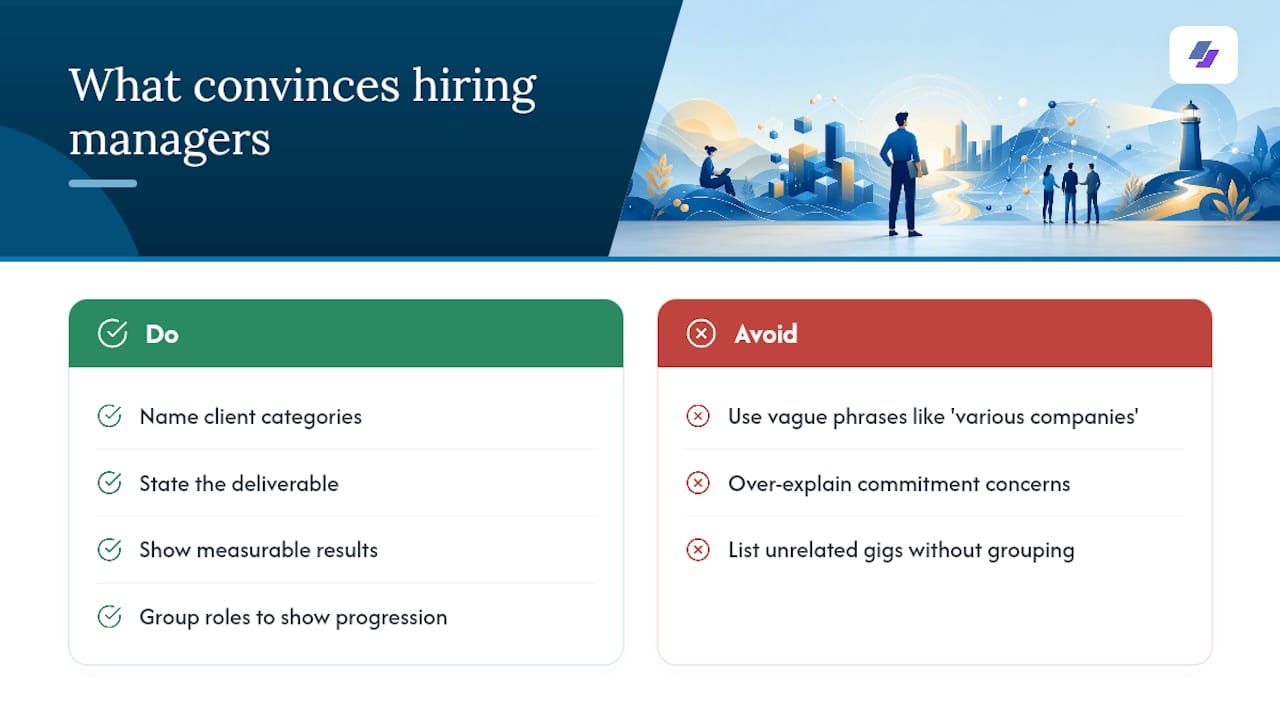
What actually convinces a hiring manager about self-employed candidates
The conventional wisdom says hiring managers are skeptical of self-employment because of “commitment concerns.” That framing is mostly wrong, and leaning into it leads candidates to over-explain and under-demonstrate.
What actually moves the needle is not reassurance — it is evidence. Hiring managers are not asking “Will this person show up?” They are asking “Can I verify what this person says they did?” A resume that names client categories, states a deliverable, and shows a measurable result answers that question before the interview. One that says “Consulted for various companies” does not.
The second thing that convinces is consistency. A candidate who ran a freelance practice for three years, served clients in the same industry, and grew their scope over time reads as more disciplined than someone who bounced between unrelated gigs. Grouping your work by role type and showing progression — from smaller clients to larger ones, from execution to strategy — tells that story without a cover letter explanation.
Make verification easy. List a portfolio URL, note that references are available, and use client categories that a recruiter can cross-reference on LinkedIn. The easier you make it to confirm your work, the less skepticism you face.
JobAlign turns your LinkedIn profile into a tailored, ATS-ready resume
Every self-employed resume problem covered above — vague titles, missing keywords, bullets without metrics — gets harder when you are applying to multiple jobs and need a different version of your resume for each one. JobAlign solves that specific problem.
Connect your LinkedIn profile, paste in a job description, and JobAlign’s engine analyzes the role, extracts the keywords that matter, and generates a tailored resume that converts your freelance entries into ATS-friendly role lines and bullets. No manual rewriting for every application. The result is a custom resume for each job that mirrors the job description’s language while keeping your real outcomes front and center.
If you have been doing the rewriting manually, try JobAlign’s free resume generator and see how your self-employment history looks when it is properly framed and keyword-matched for a specific role.
Sources
- How to Format a Resume with Freelance Work
- How to write a self-employed resume
- How to List Freelance Work On a Resume 2026 - Upwork
- Self-Employed on a Resume: Wording That Sounds Credible (Even If You Worked Alone) - ResumeSolving
- Resume for the Self Employed A No-BS Guide
- Can You Have Self-Employment on a Resume? Yes— …