Professional Summary for Project Manager: Examples and Templates

Your project manager professional summary needs three things: a role-level signal, a delivery outcome, and a scope metric. That’s it. Hiring managers spend about six seconds on an initial scan, so every word must earn its place.
One-line formula: [Cert.] [Role + years/level] | [Specialization/approach] | [Top outcome or scope metric] | [Tools/methods]
Use that formula to build any of the three quick-start snippets below. Paste, swap the bracketed text, and you’re done.
- Entry-level: “Emerging project coordinator with a CAPM certification and experience in Agile sprint support, consistently delivering sprint cycles on schedule for cross-functional teams.”
- Mid-level: “PMP-certified project manager driving software delivery across Agile and Waterfall environments, managing budgets and aligning stakeholders across multiple business units.”
- Senior: “Senior program manager (PMP, PMI-ACP) leading enterprise IT transformations, delivering large portfolios on time and reducing delivery risk through hybrid governance frameworks.”
Table of Contents
- What a professional summary is — and what it is not
- How to write a strong project manager resume summary
- Which skills and ATS keywords belong in your summary
- How long should your summary be, and where does it go?
- Editable sample summaries by level and industry
- Five steps to tailor your summary to a specific job posting
- Where to put certifications in your summary
- Common mistakes that weaken a PM summary
- ATS optimization checklist for your PM summary
- How to adapt your summary for different PM roles
- Key Takeaways
- What hiring managers actually notice in the first 10 seconds
- JobAlign builds your tailored PM summary in minutes
- Useful sources
What a professional summary is — and what it is not
A resume professional summary is a short marketing pitch, typically 2–4 lines, placed at the top of your resume. It tells a hiring manager who you are, where you perform best, and what you deliver. Think of it as your 20-second verbal introduction, written down.
Here’s where a lot of candidates go wrong: they confuse a resume professional summary with a project summary document. A project summary is a piece of project documentation. It describes a project’s status, objectives, schedule, budget, and risks for stakeholders. According to ProjectManager.com, a project summary must hook the stakeholder and cover deliverables, timelines, and resource needs. That’s a completely different purpose.
Your resume summary is about you, not a project. It answers: “What kind of PM are you, and what do you consistently produce?” The role of a professional summary on a resume is to give a recruiter immediate context before they read a single bullet point in your experience section.
- Placement: directly under your name and contact information, above your skills section or work history.
- Audience: a recruiter or hiring manager who has 6–10 seconds before deciding to read further.
- Tone: confident, outcome-focused, and specific to the role you’re targeting.
Pro Tip: If a hiring manager asked you to introduce yourself in 20 seconds, your professional summary should be that answer — not a list of duties, but a statement of what you deliver and how.
How to write a strong project manager resume summary
Writing a sharp summary takes five steps. Do them in order and you’ll avoid the vague, generic language that kills most PM summaries.
- Identify your role focus. Are you a generalist PM, an Agile coach, a construction PM, or an IT delivery lead? Pick one primary identity for this application.
- Choose one top delivery outcome. What’s the single most impressive result you’ve produced? On-time delivery rate, cost savings, scope reduction, team size managed?
- Quantify the scope. Add a number: budget managed, team size, number of projects, or timeline compressed. Scope signals seniority.
- Add methodology, tools, and certifications. One or two method words (Agile, Waterfall, hybrid) and a certification (PMP, CAPM) if you have one. Keep tools to what you actually use.
- Edit for ATS keywords and clarity. Cut filler phrases. Replace vague language with delivery verbs. Check that your first sentence contains at least one keyword from the job posting.
Before (vague): “Results-driven project manager with experience leading teams and delivering projects on time and within budget.”
After (outcome-focused): “PMP-certified project manager with 7 years delivering Agile software projects for Fortune 500 clients, managing cross-functional teams of up to 20 and budgets up to $3M.”
The difference is specificity. The “before” version could describe anyone. The “after” version describes you, with evidence. For a deeper walkthrough, JobAlign’s guide on writing a targeted resume summary covers the full tailoring process step by step.
Trimming checklist:
- Remove: “results-driven,” “detail-oriented,” “passionate about,” “proven track record”
- Replace: “responsible for” → “managed” or “led”
- Replace: “worked with stakeholders” → “aligned 6 cross-functional stakeholders to a unified delivery roadmap”
- Check: does your first sentence contain a role title, a method word, and a metric?
Which skills and ATS keywords belong in your summary
PMI recommends replacing generic phrases like “results-driven” with specific evidence of what was delivered, improved, or enabled. That same principle applies to skills: don’t list “communication skills” — show communication as a delivery behavior.
High-priority skill clusters for a PM summary:
- Leadership and team management: “led cross-functional teams of 15,” “mentored 4 junior PMs,” “built delivery teams from scratch”
- Stakeholder communication: “aligned C-suite stakeholders,” “facilitated weekly steering committee reviews,” “managed client expectations across 3 time zones”
- Delivery and schedule control: “maintained 95% on-time delivery rate,” “reduced project cycle time by 20%,” “managed 12 concurrent workstreams”
- Budget and financial oversight: “managed $5M capital budget,” “delivered 8% under budget across 6 projects”
- Methodology expertise: Agile, Scrum, Waterfall, Kanban, hybrid, PMBOK, SAFe
ATS keyword phrases to weave in naturally:
- Project lifecycle management
- Risk mitigation and issue resolution
- Resource allocation
- Scope management
- Change management
- Vendor and contract management
Tools worth naming (only if you’ve used them): Jira, MS Project, Smartsheet, Asana, Monday.com, Confluence, Trello, ServiceNow.
The goal is to mirror the language in the job posting. If the posting says “cross-functional collaboration,” use that phrase, not “working with different teams.” You can find a full ATS keyword list for project managers to cross-reference against your target postings.
How long should your summary be, and where does it go?
Length depends on your seniority. Here’s the practical breakdown:
- Entry-level: 1–2 sentences, 30–40 words. You don’t have 10 years to summarize; lead with your strongest credential and one outcome.
- Mid-level: 2–3 sentences or 40–55 words. Include role identity, methodology, and one scope metric.
- Senior/executive: 2 sentences plus one tight bullet, or 55–70 words across a two-page resume. The extra line can carry a second major outcome or a second certification.
Placement is non-negotiable: the summary goes directly under your name and contact block, before your skills section and before your work history. Indeed’s resume guidance confirms this as the standard structure hiring managers expect. Recruiters scan top-to-bottom; burying your summary below a skills table means it may never get read.
Formatting checklist:
- Use short sentences or tight fragments, not paragraph walls.
- Bold your role title or certification once if your template allows it (e.g., PMP-certified).
- Place your most important keyword in the first 10 words of the summary.
- Avoid text boxes, headers, or footers — ATS systems often can’t parse them.
- Keep the summary in plain text, not a table or text box, so ATS can read it cleanly.
Editable sample summaries by level and industry
These samples are ready to adapt. For each one, we’ve noted which keywords to swap when tailoring to a specific posting. Templates like these are also available through ProjectManager.com’s resume template library and JobAlign’s project manager resume page.
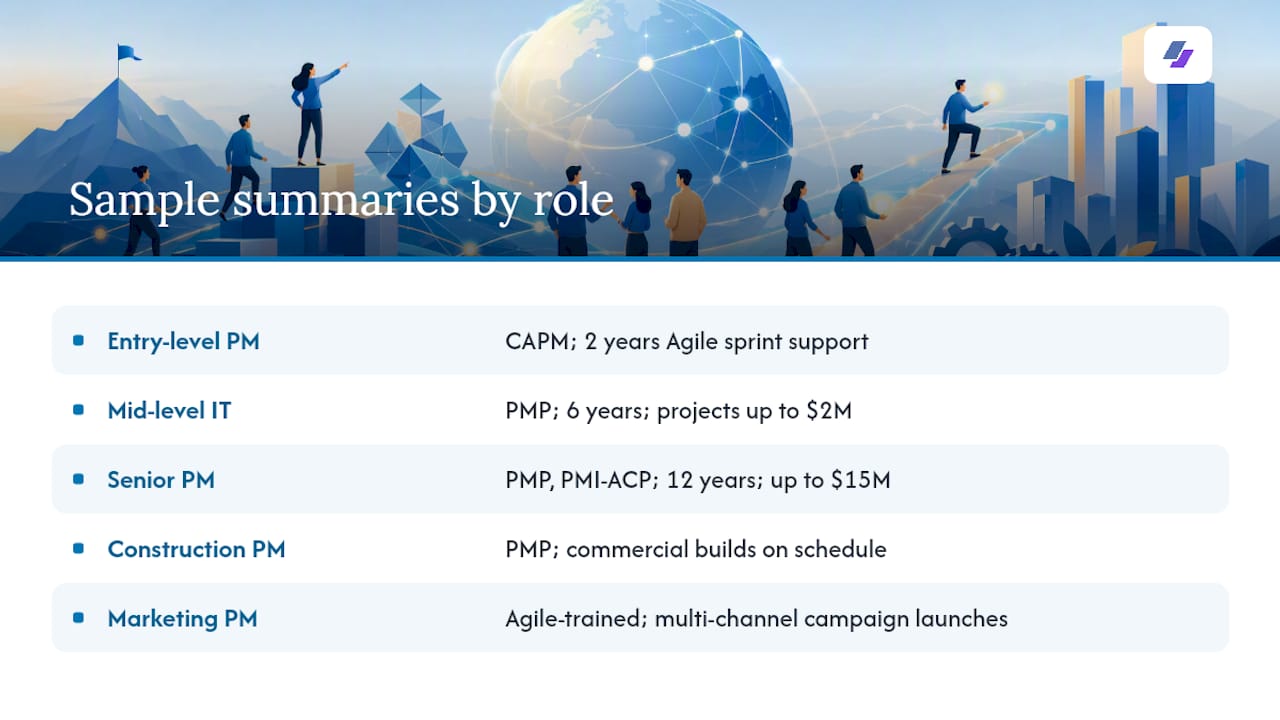
Entry-level PM One-liner: “CAPM-certified project coordinator with 2 years of Agile sprint support, delivering on-time releases for software teams of 8–12.” Two-sentence: “CAPM-certified project coordinator with 2 years supporting Agile software delivery teams. Consistently maintained sprint velocity and facilitated retrospectives that reduced blockers by 30%.” Swap: Replace “Agile sprint support” with your actual methodology; replace “software teams” with your industry.
Mid-level IT project manager One-liner: “PMP-certified IT project manager with 6 years delivering cloud migration and SaaS implementation projects up to $2M across financial services clients.” Two-sentence: “PMP-certified IT project manager with 6 years managing cloud migration and SaaS rollouts for financial services clients. Delivered 14 projects on schedule while managing cross-functional teams of up to 18 and budgets up to $2M.” Swap: Replace “cloud migration” with your tech domain; adjust budget and team size to your actual scope.
Senior PM / program manager One-liner: “Senior program manager (PMP, PMI-ACP) leading enterprise digital transformation portfolios across healthcare and retail.” Two-sentence: “Senior program manager with PMP and PMI-ACP credentials and 12 years directing enterprise digital transformation programs. Oversees portfolios up to $15M, aligns executive stakeholders across 5 business units, and applies hybrid Agile-Waterfall governance to reduce delivery risk.” Swap: Replace “healthcare and retail” with your industries; adjust portfolio value and governance method.
Construction PM One-liner: “PMP-certified construction project manager delivering commercial builds on schedule and within contract scope.” Swap: Replace “commercial builds” with residential, infrastructure, or renovation; adjust dollar range.
Marketing/agency PM One-liner: “Agile-trained project manager coordinating multi-channel campaign launches for agency clients, managing concurrent projects and cross-vendor timelines.” Swap: Replace “multi-channel campaign launches” with your campaign type; add a budget figure if you managed one.
Pro Tip: Copy the exact job title from the posting into your summary’s first sentence. ATS systems often score for exact-match role titles, and hiring managers notice when your summary mirrors their language.
Five steps to tailor your summary to a specific job posting
This process takes under 10 minutes and makes a measurable difference in ATS scoring.
- Extract 3–5 prioritized requirements. Read the job posting and highlight the top skills, outcomes, and environment signals (Agile shop? Waterfall? Regulated industry?). These are your targets.
- Match your delivery examples to those requirements. For each requirement, identify one result from your history that proves you’ve done it. If the posting asks for “stakeholder management,” your match might be “aligned 8 VP-level stakeholders to a revised delivery roadmap.”
- Insert 1–2 exact keyword phrases from the posting into your first sentence. If the posting says “cross-functional program delivery,” use that phrase verbatim in your summary. ATS systems reward exact matches.
- Trim non-matching content. If your summary mentions construction experience and you’re applying to a software PM role, cut it. Every word should serve this application.
- Run a final clarity check. Read your summary aloud. If it sounds like a job description instead of a personal statement, rewrite the verbs to be first-person delivery actions: “delivered,” “managed,” “reduced,” “aligned.”
Where to put certifications in your summary
Certifications are credibility tokens. Placed correctly, they pass both ATS keyword filters and the hiring manager’s eye test.
When to include a certification in the summary itself:
- You hold a PMP, PMI-ACP, or CAPM and the posting lists it as required or preferred
Formatting options:
- Bracketed after role title: “Project Manager (PMP)” — clean and ATS-readable.
“In progress” certifications:
PMI advises placing high-value certifications prominently near the top of the resume for immediate credibility. The summary or a dedicated line directly below it are both strong positions.
Common mistakes that weaken a PM summary
Most weak summaries share the same handful of problems. Here’s what to watch for and how to fix each one fast.
- Vague language: “Results-driven professional with excellent communication skills.” Fix: replace with a delivery statement — “Delivered 12 software projects on time for a $4M annual portfolio.”
- Missing metrics: No numbers means no scope signal. Fix: add at least one figure (budget, team size, delivery rate, timeline).
- Keyword mismatch: Your summary says “project coordination” but the posting says “program management.” Fix: mirror the posting’s exact terminology.
- Overlong summary: Four or more dense sentences lose the recruiter. Fix: cut to 2–3 sentences or 40–60 words.
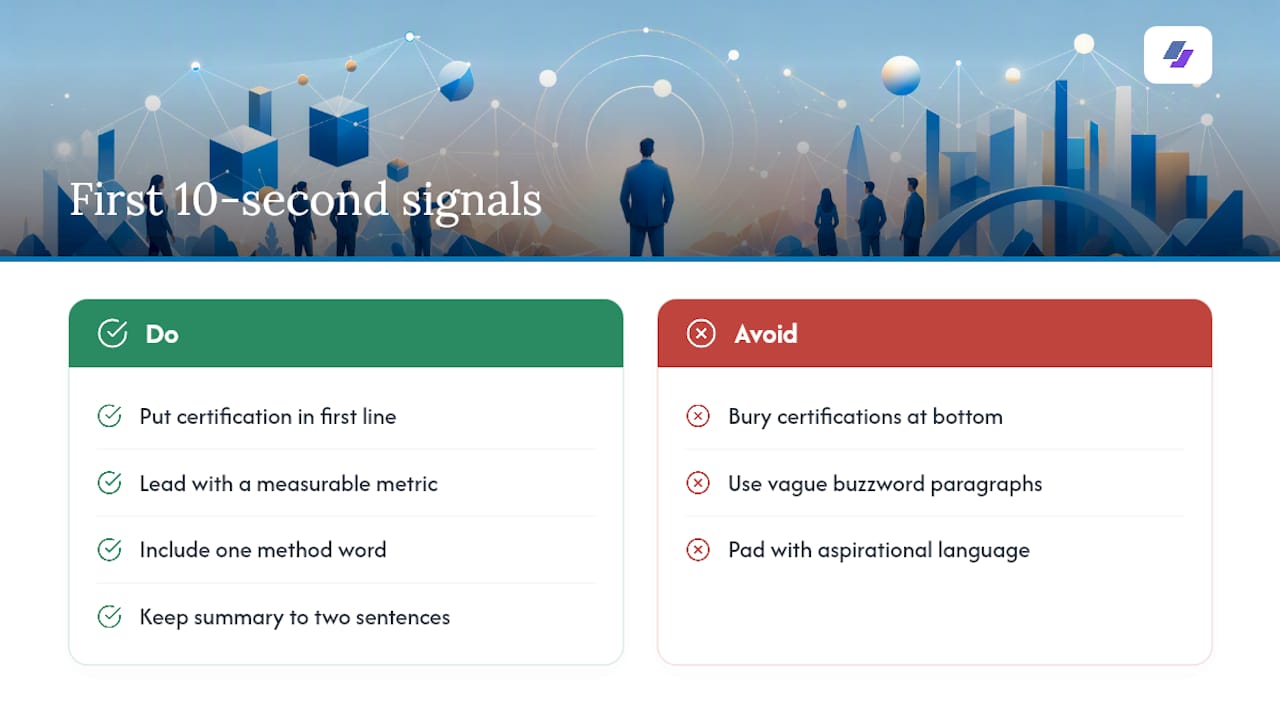
- Burying certifications: Listing PMP at the bottom of the resume wastes a credibility signal. Fix: move it to the summary or a dedicated line at the top.
- Listing responsibilities instead of outcomes: “Responsible for managing project timelines” tells a recruiter nothing. Fix: “Maintained 94% on-time delivery across 8 concurrent projects.”
Quick self-check:
- Does your summary contain a role title, a methodology word, and at least one metric?
- Does it match the language in the job posting?
- Is it under 70 words?
- Does it start with your strongest credential or outcome, not a filler phrase?
If you answered “no” to any of these, that’s your edit target. JobAlign’s guide on project-based resume writing also covers how to convert project deliverables into candidate outcomes if you’re stuck on the metrics step.
ATS optimization checklist for your PM summary
JobAlign reports that approximately 75% of resumes are rejected by ATS before a human ever reads them. The same platform’s optimization process achieves an 87% ATS pass rate for users who follow a structured keyword and formatting workflow. The Bureau of Labor Statistics tracks project management occupations as one of the most consistently in-demand professional categories, which means ATS competition for PM roles is high and getting higher.
| ATS Factor | What to Do | Common Mistake |
|---|---|---|
| Keyword placement | Put primary keywords in the first sentence of your summary | Keywords buried in bullet points only |
| Certification tokens | Include PMP, CAPM, or PMI-ACP in the summary or top section | Certifications listed only at the bottom |
| File format | Submit as PDF unless the posting specifies otherwise | .docx with tracked changes or complex formatting |
| No text boxes or tables | Write summary in plain paragraph text | Summary inside a styled text box ATS can’t parse |
| Job title match | Mirror the exact job title from the posting | Using a different title variant than the posting uses |
| Methodology keywords | Include Agile, Waterfall, Scrum, or hybrid where accurate | Generic “project management” with no method signal |
Practical verification steps:
- Paste your resume into a plain text editor. If the summary reads cleanly, ATS will likely parse it correctly.
- Compare your summary word-by-word against the job posting’s requirements section. Every required skill should appear at least once.
- Use JobAlign’s ATS resume guide to run a structured keyword check before submitting.
How to adapt your summary for different PM roles
The core formula stays the same across PM specializations, but the signal words change. Here’s how to shift your summary for four common role types.
Agile PM / Scrum Master hybrid: Lead with your Agile credentials (PMI-ACP, Certified ScrumMaster) and frame outcomes in sprint and velocity terms. “PMI-ACP certified Agile project manager with 5 years running Scrum ceremonies for distributed software teams, maintaining 90%+ sprint completion rates across 3-week cycles.”
Waterfall / traditional PM: Emphasize schedule control, milestone management, and formal governance. “PMP-certified project manager with 9 years executing structured Waterfall delivery for regulated industries, managing gate reviews and maintaining full audit trails for projects up to $6M.”
IT / software PM: Highlight technical domain fluency alongside delivery credentials. Name the tech stack or platform type (cloud, SaaS, ERP). For IT-specific context on which frameworks to feature, expense and project management tools used in IT environments can inform which platform names carry weight in your target sector.
Construction PM: Shift to contract management, subcontractor coordination, and safety compliance language. “Licensed construction project manager with 10 years delivering commercial and infrastructure projects from $1M to $12M, coordinating 20+ subcontractors and maintaining zero lost-time safety incidents.”
Marketing / agency PM: Focus on campaign timelines, vendor management, and multi-project coordination. Scope signals here are number of concurrent projects and client count, not budget size alone.
The underlying rule: read three job postings in your target role type and note which words appear in every one. Those are your non-negotiable summary keywords.
Key Takeaways
A strong professional summary for a project manager leads with a role identity, a delivery outcome, and a scope metric — in that order, in 40–60 words.
| Point | Details |
|---|---|
| Use the three-part formula | Combine role level, delivery outcome, and scope metric in your first sentence for immediate recruiter impact. |
| Quantify every claim | Replace vague phrases with numbers: budget managed, team size, delivery rate, or timeline compressed. |
| Mirror the job posting’s language | Insert 1–2 exact keyword phrases from the posting to pass ATS keyword filters and signal fit. |
| Place certifications at the top | PMP, CAPM, or PMI-ACP belongs in the summary or a dedicated line directly below it, not buried at the bottom. |
| Use JobAlign for ATS-optimized output | JobAlign syncs with your LinkedIn profile, analyzes the job description, and generates a tailored, ATS-optimized resume summary in minutes. |
What hiring managers actually notice in the first 10 seconds
Most resume advice focuses on what to include. The more useful question is what a hiring manager’s eye actually lands on first, and why.
Certification tokens work as pattern interrupts. “PMP” in the first line of a summary triggers an immediate credibility signal before the recruiter has processed a single sentence. It’s not that the PMP alone gets you hired; it’s that it buys you the next three seconds of attention. Senior candidates who bury their PMP in a certifications section at the bottom are leaving their strongest credibility signal where it can’t do any work.
Measurable outcomes do the same thing, but for a different reason. A number in the first sentence forces the reader to process a specific claim rather than skim past generic language. “Managed $8M portfolio” lands differently than “managed large-scale projects” because the brain has to stop and register the figure. That pause is attention, and attention is what gets your resume read past the summary.
What I find underestimated is the role of method words. “Agile,” “hybrid,” “PMBOK,” and “Waterfall” aren’t just keywords for ATS. They tell a hiring manager immediately whether you’ll fit their delivery culture. A company running SAFe at scale doesn’t want to train a pure Waterfall PM. A startup running two-week sprints doesn’t need someone whose entire background is formal gate reviews. One method word in your summary does more cultural filtering work than a full paragraph of soft-skill language.
Junior candidates often try to compensate for limited experience by writing longer summaries. That’s the wrong direction. A tight, honest two-sentence summary with one real metric outperforms a four-sentence summary padded with aspirational language every time. Hiring managers have seen every version of “passionate about delivering results.” They haven’t seen your actual delivery record unless you put it in the first sentence.
JobAlign builds your tailored PM summary in minutes
Writing a strong summary is one thing. Writing a new tailored version for every job posting you apply to is where most candidates fall short. That’s the gap JobAlign closes.
JobAlign syncs directly with your LinkedIn profile, pulls your relevant experience and skills, analyzes the job description you’re targeting, and generates an ATS-optimized resume with a tailored summary — keyword-matched, correctly formatted, and ready to download as a PDF. No manual keyword hunting, no reformatting for each application.
For project managers applying to multiple roles across different industries or seniority levels, that means a genuinely different, targeted summary for each posting without starting from scratch every time. The free resume generator lets you produce your first tailored resume immediately. When you’re ready to apply to more roles, credit packs add more postings, one credit each, and the credits never expire.
Useful sources
These are the primary sources referenced throughout this guide:
- Build a Resume That Stands Out for Project Manager Roles | PMI Blog
- Project Summary Template — Project Management Formula
- How to write a project summary | ProjectManager.com
- Project Manager resume examples and advice | Indeed
- Project management resume templates | ProjectManager.com blog
- JobAlign — AI-powered resume generator