Cover Letters for New Graduates: What They Do and Why They Matter

Your cover letter is a short, targeted pitch that answers two questions your resume cannot: “Why this role?” and “Why you?” For new graduates, it’s often the most direct way to show an employer who you are beyond your GPA and coursework.
Two things to know before you write a single word:
- A cover letter meaningfully helps you when the role is competitive, writing-intensive, or mission-driven, when you have a referral to mention, or when you need to explain a gap or career pivot.
- Its primary function is not to repeat your resume. It connects your academic background and experiences to the employer’s specific needs, making the case that you’re the right fit for this particular role.
Key Takeaways
A cover letter for new graduates is a short, targeted pitch that answers “Why this role?” and “Why you?” — and a well-written one can be the deciding factor in a competitive entry-level application.
| Point | Details |
|---|---|
| Core purpose | Answer “Why this role?” and “Why you?” — questions your resume structurally cannot address. |
| Structure to follow | Three paragraphs: hook and reason, one or two outcome-based examples, and a concise closing with a call to action. |
| Limited experience | Reframe class projects, volunteer work, and part-time jobs as outcome-oriented evidence using the STAR format. |
| AI use | Use AI to draft and brainstorm, then personalize with company-specific detail and a voice read-aloud check before sending. |
| Jobalign pairing | Generate an ATS-optimized resume with Jobalign, then write a matching tailored cover letter for a complete application package. |
Table of Contents
- Why does a cover letter matter for new graduates?
- How do you structure a cover letter as a new graduate?
- How do you write a strong letter with little work experience?
- What are the formatting rules and common mistakes to avoid?
- How should new graduates use AI to write their cover letter?
- Graduate cover letter examples: sample paragraphs and a fillable template
- What should you check before you submit your cover letter?
- What do university career centers and recruiter surveys actually say?
- What most graduates get wrong about cover letters
- Your resume and cover letter should work as a team
- Sources
Why does a cover letter matter for new graduates?
Career services at Harvard are direct about this: for internships and entry-level roles, a cover letter is often the best opportunity to show who you are. Your resume lists what you did. The letter explains why it matters for this job.
The role of cover letters for new graduates becomes clearest in specific situations:
- The job posting explicitly requests one.
- A professional contact referred you and you want to name them.
- The role is in a writing-heavy field: marketing, communications, nonprofits, research, or academia.
- You’re applying to a highly selective program or competitive employer.
- You need to explain something your resume can’t, like a semester gap or a non-traditional academic path.
Monster’s recruiter-survey reporting finds that a tailored letter tends to help in competitive situations, while a generic one can actively hurt your chances. That’s the key distinction: personalized letters open doors; copy-paste letters close them.
Stat to know: Survey data aggregated by Monster shows that many recruiters still expect cover letters and use them to evaluate a candidate’s fit and communication skills, with some surveys noting that cover letters can influence interview decisions.
Three real scenarios where the impact of a cover letter is clearest:
- Internship application: You have no full-time experience, so the letter lets you explain what drew you to this company and what you’ve done in class that’s directly relevant.
- Campus referral: A professor connected you with a hiring manager. Name them in the first paragraph. That single sentence changes how your application is read.
- Graduate program or analyst role: Highly competitive pools where every candidate has similar credentials. A specific, well-written letter is often the differentiator.
How do you structure a cover letter as a new graduate?
Northeastern University career services recommend opening with a specific reason for interest and grounding the body in one or two concrete accomplishment examples with outcomes. That maps directly to a three-paragraph structure you can use for every application.
Paragraph 1: Hook, role, and reason
Open with the position title and one specific reason you applied. Reference a company initiative, a product you use, or the person who referred you. Avoid “I am writing to apply for…” as your first line.
Starter: “When [Contact Name] mentioned that [Company] was expanding its [team/program], I knew this [Role] was the right fit for where I want to take my [skill/career direction].”
Paragraph 2: One or two evidence examples
Connect your most relevant experience to the job description using outcomes. Numbers help. Indeed advises keeping the letter to 250–400 words total, so each example should be two to three sentences at most.
Starter: “In my [class/role/project], I [action verb + what you did], which resulted in [outcome or metric].”
Paragraph 3: Closing and call to action
State your availability, express genuine interest in a conversation, and thank the reader. One sentence each.
Starter: “I’d welcome the chance to discuss how my background fits [Company]'s goals. I’m available [timeframe] and can be reached at [email/phone].”
Formatting specifics:
- Length: 250–400 words, three to five short paragraphs.
- Font: 10–12 pt, standard (Calibri, Georgia, or Arial).
- Header: match your resume header for a consistent look.
- Unknown hiring manager: use “Dear Hiring Manager” or “Dear [Team Name] Team.”
- File name:
FirstLast_CoverLetter_CompanyName.pdf
Pro Tip: Read your letter aloud before sending. If a sentence sounds stiff or formal in a way you’d never actually speak, rewrite it. Recruiters notice when a letter sounds like a form.
How do you write a strong letter with little work experience?
Good news: limited formal experience is not a disqualifier. Harvard’s career guidance is explicit that graduates should translate campus roles into outcome statements and never apologize for being early in their career. The goal is to reframe what you’ve done as professional-grade evidence.
Credible experience types to draw from:
- Class projects with a deliverable (research paper, product prototype, data analysis)
- Leadership roles in clubs, student government, or Greek life
- Volunteer work with a measurable contribution
- Freelance or side projects, even informal ones
- Part-time or seasonal jobs where you managed tasks, people, or budgets
Use this simple STAR micro-template for each example:
Situation → Task → Action → Result
Keep it to two sentences. The result is the most important part.
Sample bullets you can adapt:
- “As social media lead for my university’s marketing club, I grew our Instagram following from 200 to 1,400 in one semester by shifting to a consistent weekly content calendar.”
- “During a 10-week data analysis course project, I built a customer segmentation model in Python that reduced a mock campaign’s projected cost-per-acquisition by 18%.”
Both examples come from campus work. Both read as professional contributions because they name an action and a result. That’s the standard to aim for.
What are the formatting rules and common mistakes to avoid?
Tone and format signal professionalism before a recruiter reads a single sentence. Match the company’s culture: a startup cover letter can be slightly warmer and more direct; a law firm or financial institution expects a more formal register. MIT Career Advising notes that cover letters carry extra weight in fields where written communication is a core job skill.
Do:
- Use the exact job title from the posting.
- Mirror key phrases from the job description (this also helps with ATS keyword matching).
- Keep paragraphs to three to four sentences.
- Save as a PDF unless the application system specifies otherwise.
Don’t:
- Restate your resume bullet by bullet.
- Open with “I am a recent graduate seeking…” (generic and forgettable).
- Over-explain your lack of experience (“Although I don’t have much experience…”).
- Include unrelated personal details like hobbies unless they’re directly relevant.
- Use a generic letter for multiple applications. Recruiters spot them immediately.
Practical submission tips:
- File name:
FirstLast_CoverLetter_CompanyName.pdf - Email subject line: “Application for [Role Title] — [Your Name]”
- Email body: Two to three sentences max. State the role, attach the documents, and offer to provide anything else needed.
- Online forms: If the system asks you to paste the letter, remove the header block and paste the body paragraphs only.
Pro Tip: If the posting says “cover letter optional,” send one for any role you genuinely want. A tailored letter in that situation stands out precisely because most applicants skip it.
How should new graduates use AI to write their cover letter?
AI tools like ChatGPT can speed up the drafting process. The UCI Career Center is clear that AI is acceptable for generating structure and ideas, but submitting unedited AI output is a real risk. Recruiters notice generic language, and a letter that sounds like everyone else’s defeats the purpose.
A safe workflow:
- Use AI for: brainstorming your opening hook, generating alternative phrasings, drafting a structural outline, and checking grammar.
- Always add: the specific company detail that proves you researched the role, your own voice and phrasing, and at least one outcome-based example from your actual experience.
- Proofread by: reading the final draft aloud, checking for factual accuracy (AI occasionally invents details), and confirming the company name and role title are correct throughout.
Watch for this: AI-generated letters often default to phrases like “I am passionate about” and “I am excited to contribute.” These phrases appear in thousands of applications. Replace them with a specific observation about the company or a concrete result from your work.
The goal is to use AI for speed and then personalize until the letter sounds like you wrote it, because you did.
Graduate cover letter examples: sample paragraphs and a fillable template
These sample paragraphs show how to frame academic and part-time experience as relevant evidence. Adapt them to your own situation.
Sample 1: Academic project
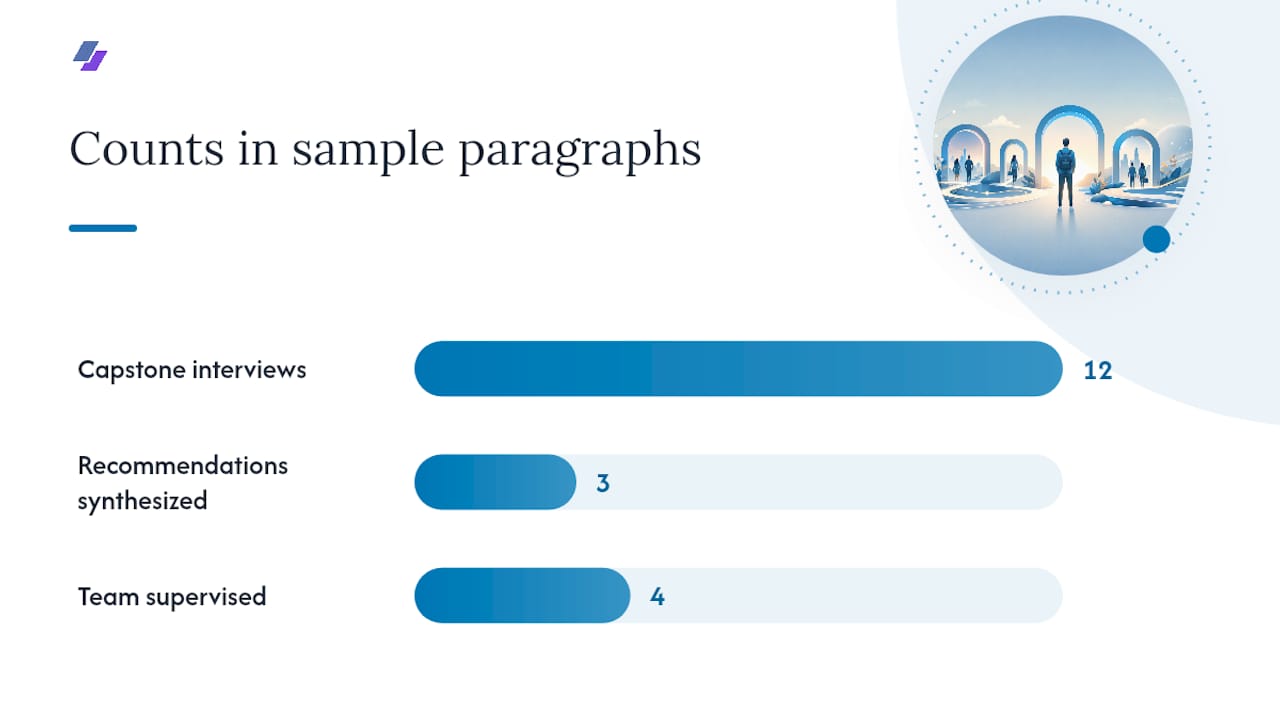
“In my senior capstone, my team designed a user research study for a local nonprofit’s donor retention problem. We conducted 12 interviews, synthesized the findings into three actionable recommendations, and presented to the organization’s board. That project is what drew me to [Company]'s focus on data-informed community programs.”
Sample 2: Part-time job
“As a shift supervisor at [Employer], I managed a team of four during peak hours and resolved customer issues on the spot. Over six months, our location’s satisfaction scores improved from 3.8 to 4.4 out of 5. I bring that same attention to team coordination and customer outcomes to this role.”
For more annotated graduate cover letter examples, the Jobalign blog shows how to tailor each paragraph to a specific company’s values and job description.
Fillable template:
Dear [Hiring Manager Name / Hiring Manager],
I’m applying for the [Role Title] position at [Company]. [One sentence: specific reason you’re interested — a company initiative, product, or referral.]
In my [class/role/project], I [action + what you did], which resulted in [outcome or metric]. [Optional second example in one to two sentences, tied to a second skill the JD mentions.]
I’d welcome the chance to speak with you about how my background fits [Company]'s work. I’m available [timeframe] and can be reached at [email]. Thank you for your time.
Sincerely, [Your Name]
Copyable first-line hooks:
- “When [Contact Name] mentioned [Company]'s [initiative], I immediately wanted to learn more about the [Role] opening.”
- “I’ve followed [Company]'s work on [specific project/product] for [time period], and the [Role] position aligns directly with what I’ve been building toward.”
- “The [Role] posting caught my attention because [one specific detail from the JD that matches your strongest skill].”
The University of Michigan Career Center also offers downloadable templates and annotated sample openings you can adapt for your field.
What should you check before you submit your cover letter?
Run through this list before hitting send. Small errors here cost interviews.
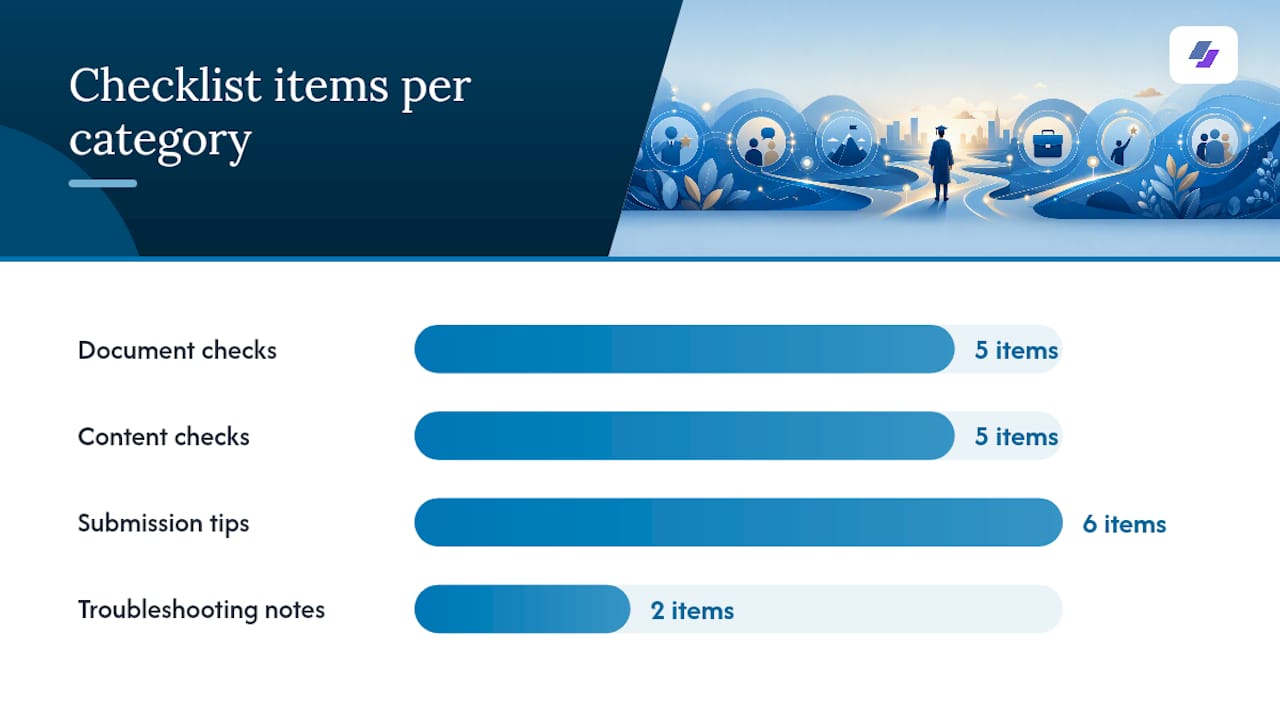
Document and file checks:
- Saved as PDF (unless the system requires .docx).
- File name follows the format:
FirstLast_CoverLetter_CompanyName.pdf. - Hiring manager’s name and title are spelled correctly.
- Company name is correct throughout, including in the body paragraphs.
- Role title matches the posting exactly.
Content checks:
- Opening line is specific to this role, not generic.
- At least one evidence example with an outcome is included.
- Key phrases from the job description appear naturally in the letter.
- No resume bullet points are copied verbatim.
- Letter is 250–400 words.
Submission tips:
- Online form: Paste body paragraphs only. Remove the header block. Check character limits before pasting.
- Email submission: Attach the PDF. Write two to three sentences in the email body. Use a clear subject line: “Application for [Role Title] — [Your Name].”
Two quick troubleshooting notes: if an online form cuts off your letter, shorten to the two most important paragraphs. If the system accepts only plain text, remove all formatting and use line breaks between paragraphs.
For a deeper look at ATS keyword alignment between your resume and cover letter, Jobalign’s keyword guide covers where to place role-specific terms so both documents pass ATS filters consistently.
What do university career centers and recruiter surveys actually say?
The evidence for cover letters is consistent across major career services. Harvard and Northeastern both frame the cover letter as the document that answers “Why this role?” and “Why you?” — questions a resume structurally cannot answer. For entry-level candidates, both institutions treat the letter as especially valuable because it creates a personal, role-specific connection that a list of credentials alone cannot.
On the recruiter side, Monster’s aggregated survey data shows that many recruiters still expect cover letters and use them to assess communication skills and fit. In competitive or writing-focused roles, a tailored letter tends to help; a generic one tends to hurt.
Indeed’s guidance reinforces the length and function: 250–400 words, tailored to the role, used to introduce context a resume can’t provide. That’s the standard most hiring managers expect.
One practical note from Jobalign: pairing an ATS-optimized resume with a tailored cover letter gives you the strongest possible application package. Your resume clears the automated filter; your letter makes the human case.
What most graduates get wrong about cover letters
Most graduates treat the cover letter as a formality, a box to check before submitting. That’s the wrong frame entirely.
Here’s what we’ve seen consistently: the graduates who get callbacks aren’t the ones with the most impressive credentials. They’re the ones who wrote a letter that made a recruiter feel like the application was written for them specifically. That’s a skill, and it’s learnable.
The conventional wisdom says “be yourself” in a cover letter. That advice is too vague to be useful. What actually works is being specific. One concrete detail about the company, one outcome-based example from your own experience, and a closing that sounds like a person wrote it. That combination outperforms a polished but generic letter every time.
If you’re early in your career and worried your experience isn’t impressive enough, stop apologizing for it in the letter. Reframe it. A semester managing a student organization’s $4,000 budget is budget management experience. A class project where you interviewed 12 users is user research experience. Name it, quantify it, and connect it to the role. That’s the move.
Your resume and cover letter should work as a team
A tailored cover letter is only half the equation. If your resume doesn’t pass the ATS filter before a human ever reads your letter, the letter doesn’t matter. That’s where Jobalign comes in.
Jobalign’s LinkedIn resume generator syncs directly with your LinkedIn profile, analyzes the job description, and produces an ATS-optimized resume with the right keywords already placed. You get a tailored resume per application, without rebuilding from scratch each time. Pair that with the cover letter template from this article and you’re submitting a complete, consistent application package.
Try generating your first tailored resume on Jobalign, or use the Resume Builder to create an entry-level resume, then draft your matching cover letter using the three-paragraph template above.
Sources
- How to Write a Cover Letter That Actually Gets You Hired in 2026 – Harvard FAS | Mignone Center for Career Success
- How to Write a Cover Letter That Actually Gets You Hired in 2026 – Northeastern University | Employer Engagement and Career Design
- Are Cover Letters Necessary? When You Do & Don’t Need One | Monster
- Cover Letter Resources - University Career Center