Job Application Guide for Graduates: 2026 Playbook

The single best move you can make right now is this: build a focused, tracked job-search system that targets one role family, tailors every resume for ATS, and uses LinkedIn plus an ATS-tailoring tool to convert applications into interviews. That’s the whole system. Everything else in this guide is how you execute it.
Here’s what to do in the next 24–72 hours:
- Turn on LinkedIn “Open to Work” (visible to recruiters only) and update your headline with your target role title.
- Build a one-page master resume that captures every experience, project, skill, and metric you have. This is your raw material, not what you submit.
- Create an application tracker in Google Sheets with columns for company, role, source, date applied, follow-up date, response, and next action.
- Send 5 tailored applications this week, each with a resume rewritten to mirror the specific job posting’s language.
- Use JobAlign to sync your LinkedIn profile and generate ATS-optimized PDFs for each role in minutes instead of hours.
Roughly 75% of resumes are filtered out by Applicant Tracking Systems before a human ever reads them. Tailoring is not optional. It’s the price of entry.
Table of Contents
- What does a 30/60/90-day job-search timeline look like for 2026 graduates?
- Where should you look for entry-level jobs in 2026?
- How do you apply efficiently with ATS-first tailoring and a repeatable workflow?
- How do you build credible experience when you have little formal work history?
- How do you prepare for interviews and negotiate your first offer?
- What follow-up cadence and email templates actually work?
- How to optimize your resume for ATS using JobAlign’s workflow
- Resume bullet bank, cover letter openers, and interview checklist
- Key Takeaways
- Why tailoring and tracking beat mass-applying every time
- JobAlign makes ATS tailoring fast enough to do for every application
- Sources and further reading
What does a 30/60/90-day job-search timeline look like for 2026 graduates?
A typical graduate job search can span several months. That’s not a reason to panic. It’s a reason to plan. The graduates who land faster are the ones who treat the search like a part-time job with weekly deliverables, not a passive activity.
Days 1–30: Build the foundation
| Week | Primary Goal | Deliverable |
|---|---|---|
| Week 1 | LinkedIn overhaul + master resume | Updated profile, one-page master resume, tracker live |
| Week 2 | First 5 tailored applications | 5 submitted apps, ATS-optimized PDFs |
| Week 3 | 3 informational interviews scheduled | Outreach sent to 10 alumni or contacts |
| Week 4 | Refine targeting based on response rate | Adjust role family or resume if response rate is below 10% |
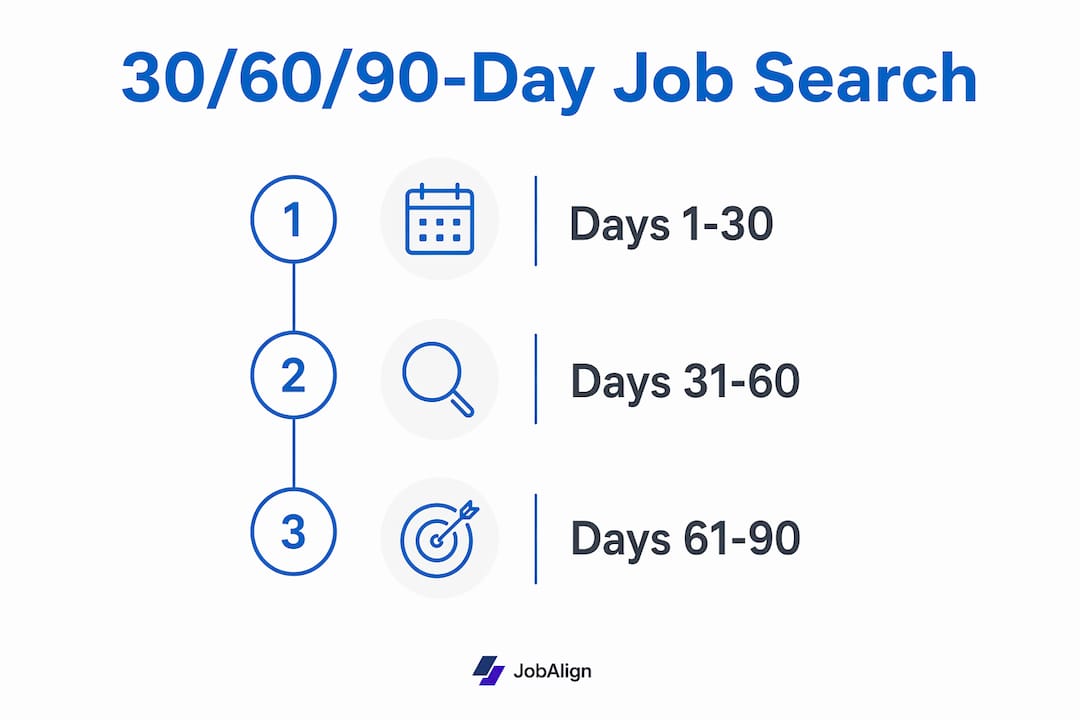
Your goal at 30 days is to have submitted multiple applications, received some responses or interviews, and gained insight into which role families are responding.
Days 31–60: Build momentum
By week five, you should be maintaining a steady rhythm of multiple applications per week, consistent networking touches, and regular interview practice. If you’re not getting responses, the problem is almost always targeting or resume alignment, not volume. Fix the funnel before you flood it.

At 60 days, a reasonable benchmark is having some active interview processes and at least one informational interview that produced a referral or a warm lead.
Days 61–90: Convert and close
This phase is about finishing what you started. Keep applications flowing at 5 per week, but shift more energy toward interview prep and follow-up. Negotiate any offers carefully (more on that below). If you haven’t received an offer by day 90, audit your tracker: look at your application-to-response rate, your interview-to-offer rate, and the quality of roles you’re targeting. One honest audit is worth 50 more spray-and-pray applications.

Where should you look for entry-level jobs in 2026?
Not all job boards are equal for new grads. Here’s how to prioritize your channels.
Handshake and your campus career center come first. Employers who post on Handshake are specifically recruiting students and recent graduates. Competition is lower, and many postings are exclusive to campus pipelines. If your school’s career center offers resume reviews or recruiter connections, use them before you apply anywhere else.
LinkedIn is your second channel, and it’s where most of your networking will happen. Use the alumni filter to find people who graduated from your school and now work at companies you’re targeting. A warm message to a fellow alum converts at a much higher rate than a cold application.
Pro Tip: When searching LinkedIn Jobs, filter by “Entry Level” and sort by “Most Recent.” Apply within the first 48 hours of a posting going live. Early applicants are statistically more likely to be reviewed before a recruiter closes the funnel.
Company career pages are underused by new grads. Applying directly through a company’s site often means less ATS competition than applying through an aggregator. Build a target list of 20–30 companies in your preferred industry and check their careers pages weekly.
Niche job boards depend on your field. For tech roles, look at Built In and Wellfound. For nonprofit and public-sector work, Idealist and USAJobs are worth bookmarking. For marketing and creative roles, LinkedIn and company sites still dominate, but MediaBistro and Creativepool surface roles that aggregators miss.
The hidden market is real. Research suggests a significant share of jobs are never publicly posted. Informational interviews and alumni outreach are how you access this pipeline. Send a short, specific message: “I’m a recent grad interested in [role type] at [company]. Could I ask you 15 minutes of questions about your path?” Most people say yes.
How do you apply efficiently with ATS-first tailoring and a repeatable workflow?
A structured application workflow consistently outperforms mass applying. Here’s the exact process we recommend.
The application decision checklist
Before you spend time tailoring, decide if the role is worth it:
- You meet 60–70% of the core required skills (not the “nice to have” list).
- The posting was published within the last 14 days.
- The role title and responsibilities align with your target role family.
- The company is on your target list or passes a 5-minute culture check.
Many entry-level postings describe an ideal candidate, not a minimum bar. Apply if you meet the core skills, even when you don’t hit every bullet.
The 6-step tailoring workflow
- Read the full job posting and highlight the 5 most-repeated requirements.
- Map each requirement to a specific bullet in your master resume.
- Rewrite those bullets to mirror the posting’s exact language (if they say “cross-functional collaboration,” use that phrase).
- Reorder your resume bullets so the most relevant ones appear first under each role.
- Update your skills section to include keywords from the posting that your current resume is missing.
- Run the resume through an ATS optimization check before submitting.
What to track in your application tracker
Keep these columns in your spreadsheet: Company, Role Title, Source, Date Applied, Follow-Up Date, Response (Y/N), Interview Stage, and Next Action. The four funnel metrics to watch every week are:
- Application volume: Are you hitting your weekly target?
- Application-to-response rate: Below 10% means fix targeting or resume alignment.
- Interview-to-offer rate: Below 20% means sharpen your interview prep.
- Response lag: Roles that go silent after 3 weeks are likely filled.
Garbage in, garbage out. A tracker only works if you update it every time you take an action.
How do you build credible experience when you have little formal work history?
Hiring managers want proof of contribution, not just a list of responsibilities. The good news: projects, class work, volunteer roles, and extracurriculars all count when you frame them correctly.
Use STAR-formatted bullets. Every experience bullet should follow this structure: what the situation was, what your specific task was, what action you took, and what the result was. Here are examples you can adapt:
-
Situation: Class capstone project with a 4-person team and a 6-week deadline. Bullet: “Led a 4-person team to deliver a market-entry analysis for a regional food brand, presenting findings to a panel of 3 faculty judges and earning the highest project score in the cohort.”
-
Situation: Volunteer social media management for a nonprofit. Bullet: “Managed Instagram and Facebook accounts for a nonprofit, increasing follower engagement over time through a consistent content calendar.”
-
Situation: Part-time retail job. Bullet: “Handled customer escalations and processed numerous transactions daily in a high-volume retail environment, maintaining strong customer satisfaction.”
Build a portfolio in one week. For technical graduates, a GitHub repository with 2–3 projects (even class projects) is enough to get started. For non-technical graduates, a simple PDF portfolio or a free Notion page with 2–3 case studies works well. The minimum deliverable is one piece of work that shows you can do the job.
Reframe extracurriculars. Club president, team captain, event organizer: these roles involve budgeting, managing people, and hitting deadlines. Write them the same way you’d write a professional role. The transferable skills are identical.
How do you prepare for interviews and negotiate your first offer?
STAR answers for common entry-level questions
“Tell me about a time you worked on a team.” “In my senior capstone, I coordinated a 5-person team across two time zones to deliver a data analysis project. I set up a shared Notion workspace and ran weekly check-ins, which kept us on schedule and resulted in a final presentation the client called ‘the most organized they’d seen from a student group.’”
“Describe a challenge you overcame.” “During my internship, a key data source became unavailable two days before a report deadline. I identified an alternative dataset, validated it against historical benchmarks, and delivered the report on time with a methodology note explaining the change.”
“What’s something you learned quickly?” “I taught myself Tableau in three weeks to complete a class project after our original tool lost institutional access. The final dashboard was later used by the professor as a course example.”
“What impact have you had in a role?” “As treasurer of our student organization, I restructured our budget tracking from a shared spreadsheet to a simple accounting template, which reduced end-of-semester reconciliation time from 4 hours to under 45 minutes.”
Your 60-second elevator pitch
Keep it under 60 seconds. Practice it until it sounds natural, not memorized.
Negotiation basics
- Do not accept or decline on the spot. Ask for 24–48 hours to review.
- If the offer is below your target, say: “I’m very excited about this role. Based on my research and the skills I bring, I was hoping for something closer to [$X]. Is there flexibility there?”
- For entry-level roles, salary negotiation is often possible within a 5–10% band. Benefits, start date, and remote flexibility are also negotiable.
- Know your walk-away number before the call.
Pro Tip: Research salary ranges on the Bureau of Labor Statistics Occupational Outlook Handbook and LinkedIn Salary before any negotiation conversation. Walking in with a number backed by data is far more persuasive than a gut feeling.
What follow-up cadence and email templates actually work?
Professional follow-up means being persistent without being annoying. Here’s the exact cadence and the templates to use.
Follow-up timeline
- Day 1: Submit application.
- Day 7–10: Send first follow-up if no acknowledgment.
- Day 14–21: Send second follow-up if still no response.
- Day 21+: Move the role to “low priority” in your tracker and redirect energy.
After an interview, send a thank-you within 24 hours. If you haven’t heard back by the timeline they gave you, follow up once.
Email templates
Application follow-up:
Subject: Following Up — [Role Title] Application
Hi [Name], I submitted my application for the [Role Title] position on [Date] and wanted to confirm it was received. I remain very interested in the role and would welcome the chance to connect. Thank you for your time.
Post-interview thank-you:
Subject: Thank You — [Role Title] Interview
Hi [Name], thank you for taking the time to speak with me today about the [Role Title] role. I came away even more excited about [specific thing discussed]. I look forward to next steps and am happy to provide any additional information.
Keep both emails under five sentences. Add one specific detail from the conversation or posting to show you paid attention. That detail is what separates a memorable follow-up from a forgettable one.
How to optimize your resume for ATS using JobAlign’s workflow
JobAlign’s ATS resume workflow is built around a simple principle: your resume should be written for the machine first and the human second, because the machine decides whether the human ever sees it.
The JobAlign workflow, step by step
- Sync your LinkedIn profile to JobAlign. Your experience, skills, and education pull in automatically, no manual re-entry.
- Select a role-family template that matches your target position (marketing, software, operations, data, etc.).
- Import the job description you’re applying to. JobAlign analyzes it and surfaces the keywords your current resume is missing.
- Review the suggested keyword matches and approve or adjust them. You stay in control.
- Generate your ATS-optimized PDF. The output uses a machine-readable format with no tables, columns, or graphics that confuse ATS parsers.
Before and after: what tailoring actually changes
Before (generic bullet): “Helped with social media content for a student organization.”
After (ATS-optimized, outcome-first): “Created and scheduled weekly social media content across Instagram and LinkedIn for a 300-member student organization, increasing post engagement by 28% over one semester.”
The difference is specificity, keywords, and a measurable result. JobAlign’s keyword suggestions push you toward that level of precision on every bullet.
JobAlign claims an 87% ATS pass rate for resumes generated through its platform, compared to the roughly 75% of generic resumes that are filtered out before a recruiter sees them. For graduates applying to multiple roles each week, the time savings alone (a tailored resume in minutes rather than an hour) make a meaningful difference in how many high-quality applications you can realistically submit.
Resume bullet bank, cover letter openers, and interview checklist
Resume bullet bank by role family
Marketing
- “Developed a multi-week email campaign for a class project, writing copy and designing templates in Mailchimp with positive engagement results.”
- “Analyzed competitor social media strategies for several brands and presented a differentiation report to a class.”
- “Managed a student organization event budget, coordinating vendors and delivering the event on budget.”
Operations / Business
- “Mapped a multi-step onboarding process for a nonprofit volunteer program, improving orientation efficiency.”
- “Built a project tracking dashboard in Google Sheets used by a small team to manage multiple concurrent tasks.”
- “Coordinated logistics for a large campus event, managing vendor contracts, venue setup, and day-of scheduling.”
Software / Technical
- “Built a full-stack to-do application using React and Node.js, deployed on Heroku with user authentication and a PostgreSQL database.” (See developer resume examples for more technical bullet formats.)
- “Contributed pull requests to an open-source Python library, fixing a parsing bug that affected numerous users.”
- “Designed and implemented a REST API for a class project, documented with Swagger and tested with Postman.”
Data
- “Cleaned and analyzed a large dataset in Python (pandas), producing several visualizations that identified a revenue trend.”
- “Built a sales forecasting model in Excel using regression analysis, presented to a simulated executive panel.”
Customer Success
- “Resolved numerous customer inquiries per shift in a retail environment, maintaining high customer satisfaction over time.”
- “Trained new team members on POS systems and store procedures, improving onboarding efficiency.”
Cover letter openers
For a startup: “I’ve followed [Company]'s work in [space] for the past year, and the [specific product/initiative] caught my attention because it solves a problem I ran into firsthand. I’d bring [specific skill] and a bias toward shipping fast.”
For a mid-size company (SMB): “[Company]'s reputation for [specific quality] is exactly the environment where I do my best work. As a recent [major] graduate with hands-on experience in [skill], I’m ready to contribute from day one.”
For a large corporation: “Your [specific program, initiative, or value] aligns directly with the work I did in [class/internship/project], where I [brief accomplishment]. I’m applying for the [Role Title] position because [specific reason tied to the company].”
Interview day checklist
| Timing | Task |
|---|---|
| Night before | Print 3 copies of your resume, prepare 5 STAR stories, research the company’s recent news |
| Morning of | Confirm logistics (address, video link, interviewer name), review the job description one more time |
| 10 minutes before | Arrive early or log in early, have a glass of water, silence your phone |
| During | Take brief notes, ask 2–3 prepared questions, reference specific company details |
| Within 24 hours | Send thank-you email to every interviewer |
Key Takeaways
A focused, tracked job-search system that tailors each resume for ATS and pairs LinkedIn networking with a tool like JobAlign gives 2026 graduates the best chance of converting applications into offers within a realistic 3–6 month window.
| Point | Details |
|---|---|
| Tailor every resume | Generic resumes are filtered out; mirror the job posting’s language in every application. |
| Track your funnel | Log every application and measure your response rate weekly to catch problems early. |
| Start networking in week 1 | Alumni outreach and informational interviews open roles that never appear on job boards. |
| Expect a 3–6 month search | Most graduates land their first role within this window; a structured plan keeps momentum. |
| Use JobAlign for ATS tailoring | JobAlign syncs your LinkedIn profile and generates ATS-optimized PDFs for each role in minutes. |
Why tailoring and tracking beat mass-applying every time
The spray-and-pray approach feels productive. You’re sending applications, you’re busy, you’re doing something. But a tracker tells the real story: 80 applications, 2 responses, 0 interviews. That’s not a volume problem. That’s a targeting and alignment problem.
The graduates who land faster are the ones who treat the job search as a funnel and fix the leak before adding more water. If your application-to-response rate is low, the answer is almost never “apply more.” It’s “apply better.” That means tighter role-family focus, more precise resume tailoring, and more time on networking and interview prep, not more hours on job boards.
There’s also a discipline gap that most guides don’t mention. Keeping a tracker, writing tailored cover letters, and following up consistently takes real effort when you’re also managing rejection and uncertainty. The graduates who build a repeatable system, even a simple one, outperform the ones who rely on motivation alone. Motivation fades. A Google Sheet with a follow-up date column does not.
JobAlign makes ATS tailoring fast enough to do for every application
Most graduates know they should tailor their resume for each role. The problem is time. Writing a custom resume for every application, especially when you’re targeting 5–7 roles per week, quickly becomes the bottleneck that forces you to choose between quality and volume.
JobAlign removes that bottleneck. You sync your LinkedIn profile once, and JobAlign pulls in your experience, skills, and education automatically. For each new application, you paste in the job description, and JobAlign surfaces the keywords you’re missing, suggests bullet rewrites, and generates an ATS-safe PDF in minutes. No reformatting, no guessing whether your layout will parse correctly, no starting from scratch.
The platform is built specifically for job seekers applying to multiple roles, including graduates who need to move fast without sacrificing precision. Sync through the browser extension and your first LinkedIn-only resume is free, and credit packs cover as many postings as you buy credits for, one credit per job, with no expiry.
Try JobAlign’s free resume generator and see how your current resume scores against your next target role.
Sources and further reading
The data and guidance in this article draw from the following sources. We recommend bookmarking the ones most relevant to your current stage.
- ATS statistics and resume optimization workflow: How to Make an ATS Resume: 2026 Step-by-Step Guide — backs the 75% ATS rejection figure and the JobAlign workflow steps.
- Graduate job search timeline (3–6 months): New Grad Job Search Guide 2026 — source for realistic timeline expectations.
- Application workflow and funnel metrics: Job Application Workflow 2026 — supports the structured process and funnel-metric framework.
- Role-fit threshold (60–70% of qualifications): How to Get a Job With No Experience: New Grad Guide 2026 — source for the apply-if-you-meet-core-skills guidance.
- Follow-up cadence: How to Apply for a Job in 6 Steps — backs the 1-week follow-up timing recommendation.
- Hidden job market: NGPF — What Percent of Jobs Are Never Advertised? — context for the hidden-market networking advice.
- AI-assisted resume tailoring: How to Optimize Your Resume with AI (2026) — step-by-step guide for using JobAlign’s AI tailoring features.
- Resume workflow assets: Resume Workflow for Job Seekers: 2026 Guide — master resume, bullet bank, and modular tailoring framework.
- Labor market data: Bureau of Labor Statistics — U.S. employment data for context on entry-level hiring conditions.
- Graduate employment data: National Center for Education Statistics — U.S. postsecondary outcomes and graduate employment rates.
- Career exploration and job search tools: CareerOneStop — free U.S. government resource for salary research, skills assessment, and job search tools.