What Is a High Volume Job Search? A Practical Playbook

A high-volume job search is a structured campaign that targets many relevant openings per week to build interview volume instead of pinning hope on two or three “dream” applications. It’s the right move when you’re unemployed full-time, facing income pressure, or trying to build a pipeline before a layoff hits.
- Weekly target: 20 to 40 applications, according to LoopCV’s benchmarking data, which puts the typical manual job seeker at 10 to 20 a week
- When to use it: early-stage search, broad skill fit, or when you need momentum fast
Pro Tip: Volume without quality control just multiplies your rejections. Add filters and tailoring before you scale up numbers.
Key Takeaways
A high-volume job search only works when quality controls (tailoring, tracking, and tiered effort) run alongside the numbers.
| Point | Details |
|---|---|
| Target 20 to 40 weekly | Scale up from the typical 10 to 20 manual applications once your resume and filters are ready. |
| Track your funnel | Log applied, screened, interviewed, and offered stages to catch a tailoring problem early. |
| Tier your effort | Give 30% of your time to priority roles, 50% to strong fits, 20% to background applications. |
| Watch for red flags | A sub-5% response rate after 30-plus applications signals a targeting or tailoring issue, not a volume issue. |
| Use JobAlign for tailoring | Its LinkedIn sync generates a unique, ATS-optimized resume per application so volume doesn’t cost you quality. |
Table of Contents
- What Does High-Volume Job Hunting Actually Look Like?
- What Are the Benefits and Drawbacks of Mass Applying?
- How Do You Run a High-Volume Search Without Sacrificing Quality?
- When Should You Choose Quality Over Volume?
- What Metrics Should You Track in a High-Volume Search?
- What Tools and Tactics Help You Scale Responsibly?
- What Do the Research Numbers Say About Application Volume?
- Why Discipline Beats Speed in a High-Volume Search
- How JobAlign Helps You Scale Without Losing Quality
- Frequently Asked Questions
- Sources
What Does High-Volume Job Hunting Actually Look Like?
In practice, “high volume” splits into three distinct workflows, and they don’t feel the same day to day.
Manual high-volume means you personally review each posting, adjust your resume, and submit through the company site. Expect one to two hours daily, output around 5 to 8 quality applications.
Semi-automated blends a resume-tailoring tool with manual review. You batch-search Monday morning, tailor 15 to 20 resumes across the week, and hand-check each cover letter before sending.
Fully automated relies on auto-fill browser extensions or bots that submit dozens of applications daily with minimal customization, which is where most of the risk lives.
- Spray-and-pray: generic resume, every posting, zero tracking, high volume, low return
- Controlled high-volume: filtered postings, tailored resume per application, tracked funnel
- Targeted search: 5 to 10 highly researched applications per week, deep customization, often paired with networking
Most job seekers who succeed at scale run controlled high-volume, not the spray-and-pray version.
What Are the Benefits and Drawbacks of Mass Applying?
Applying broadly gets you data fast. You learn which resume version lands interviews, which industries respond, and where your skills translate that you hadn’t considered.
The upside:
- More surface area means more interview chances, even at a modest response rate
- You can A/B test resume formats and messaging in real time
- Momentum and multiple pipelines reduce the emotional toll of any single rejection
The downside:
- Untailored applications get filtered by ATS software before a human ever sees them, and Indeed’s job-search strategy guide lists customization as a top priority precisely because generic submissions convert poorly
- Recruiters notice copy-paste cover letters, which damages your reputation with repeat employers
- Burnout creeps in fast when 40 applications a week produce silence
The single fix that preserves quality under volume: build three to five resume “base versions” by role family, then customize keywords and the top third of each resume per posting.
Pro Tip: Spend your tailoring time on the first three bullet points and the summary. That’s what recruiters and ATS scanners weigh heaviest.
How Do You Run a High-Volume Search Without Sacrificing Quality?
Think of this as a system with six moving parts: Direction, Proof, Access, Apply, Convert, Learn. Each posting moves through all six before it becomes an interview.
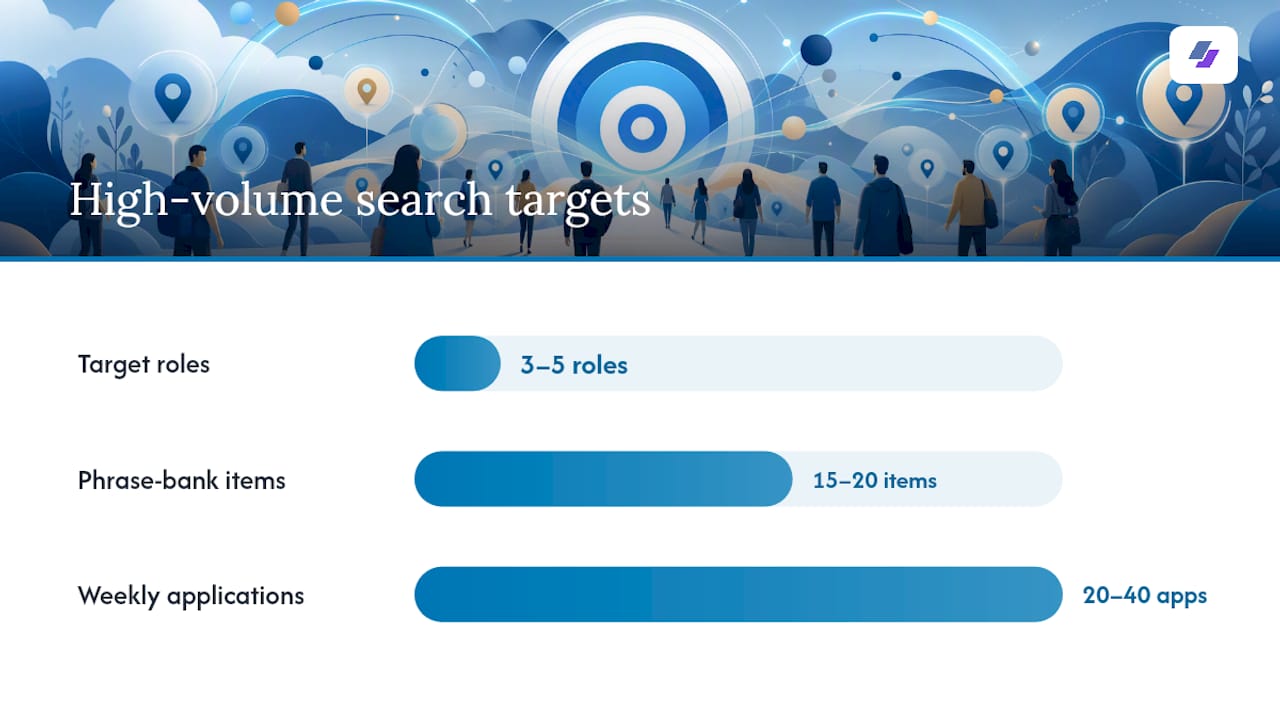
- Direction — Define three to five target roles or titles. Vague direction is why generic resumes happen in the first place.
- Proof — Build resume base versions with quantified results for each role family, then keep one master document with every accomplishment you might need.
- Access — Set job board filters (location, seniority, salary range) so you’re not wasting cycles on mismatched postings.
- Apply — Batch your week: research and tailor Monday and Tuesday, submit Wednesday through Friday. Aim for 20 to 40 applications weekly, per LoopCV’s benchmark data.
- Convert — Prep for interviews the moment you submit, not after a callback. Have your story ready before the phone rings.
- Learn — Review your tracker weekly. Which resume version, which industries, which job boards are converting?
A posting moves from discovery (you find it on a job board) to Access (you check it against your filters) to Apply (tailored resume goes out within 24 to 48 hours, while the posting is still fresh) to Convert (you follow up if you haven’t heard back in a week) to Learn (you log the outcome and adjust).
For fast, ATS-friendly tailoring, customizing your resume to each posting is the step most job seekers skip when they’re scaling volume, and it’s the one that determines whether your applications get read at all.
Pro Tip: Keep a “phrase bank” of 15 to 20 quantified accomplishments. Tailoring becomes a matter of selecting and reordering, not writing from scratch.
When Should You Choose Quality Over Volume?
Not every role deserves the same effort. Split your time by tier.
- Priority roles (30% of effort): dream companies, strong referral potential, or roles matching a rare skill. Deep tailoring, custom cover letter, LinkedIn outreach to the hiring manager.
- Strong-fit roles (50% of effort): good match, no special connection. Tailored resume, standard cover letter, quick submission.
- Background roles (20% of effort): decent fit, lower priority. Base resume with light keyword adjustment, submit and move on.
Pause and shift toward quality when you see red flags: a response rate under 5% after 30-plus applications, three or more rejections at the interview stage, or radio silence from roles that match your background well. John Clements’ research on job search strategy found that piling on volume past a certain point without tailoring actually lowers your odds of an offer.
Favor quality first when the role is senior, requires a niche certification, pays well above market, or you have a warm referral. Volume works best for broad, mid-level roles where your qualifications overlap with many postings.
What Metrics Should You Track in a High-Volume Search?
Track four funnel stages: applied, screened, interviewed, offered. Without this, you can’t tell whether 40 applications a week is working or just generating noise.
| Funnel Stage | Realistic Benchmark |
|---|---|
| Applications per hire (employer side) | About 180, per Pathascent’s execution framework |
| Applicant to interview rate | Roughly 3% |
| Interview to offer rate | About 27% |
Your tracker needs seven columns: company, role, date applied, resume version used, source (job board, referral, direct), status, and next action. Update it daily, review it weekly.
If your interview rate sits well under 3% after 50-plus applications, the problem usually isn’t volume. It’s tailoring, targeting, or resume format.
What Tools and Tactics Help You Scale Responsibly?
Three tool categories matter here: ATS checkers that flag formatting problems before you submit, resume-tailoring tools that speed up keyword matching, and a tracking sheet or lightweight CRM to manage the funnel.
Do:
- Use automation for research and application logistics (finding postings, pre-filling contact forms)
- Use AI tools to draft keyword-matched resume variants quickly, then review before sending
- Automate your tracker updates where your job board integrates with a spreadsheet
Don’t:
- Let auto-apply bots submit without a human reviewing formatting first. Anthropos’s overview of autofill tools notes that personalization still separates a callback from a rejection
- Skip ATS formatting checks; Robert Half’s job market outlook points out that AI-driven hiring tools are only getting more common on the employer side too
- Reuse one resume across ten unrelated roles just to hit a weekly number
Build your templates once: three to five resume base versions, two cover letter frameworks, and five outreach message snippets for recruiters and hiring managers. Reuse and adjust, don’t rebuild from scratch each time.
What Do the Research Numbers Say About Application Volume?
The figures worth memorizing: employers see about 180 applicants per hire, roughly 3% of applicants reach an interview, and about 27% of interviewed candidates get an offer, according to Pathascent’s execution framework. That framework, Direction, Proof, Access, Apply, Convert, Learn, treats each stage as a lever you can improve independently.
A sample week built on these numbers: Monday, research and filter 30 postings. Tuesday through Thursday, tailor and submit 25 to 30 applications. Friday, follow up on week-old submissions and log outcomes in your tracker.
Why Discipline Beats Speed in a High-Volume Search
The instinct to blast out applications comes from anxiety, not strategy. What actually moves the needle is treating volume as a dial you turn up only after your resume and targeting are solid. A search that runs on quantified proof points and a tracked funnel will outperform one that runs on hope and a single generic resume, every time.
Pace yourself. A sustainable weekly rhythm beats a frantic 100-application week that burns you out by day three.
How JobAlign Helps You Scale Without Losing Quality
Jobalign fits directly into the Apply and Proof steps of this system: it syncs with your LinkedIn profile, pulls your real experience and skills, and generates a tailored, ATS-optimized resume for each individual posting instead of one generic version you reuse fifty times. That means you can hit your weekly application target without the tailoring bottleneck that usually forces job seekers to choose between volume and quality.
Since most resumes get filtered before a human ever reads them, having software handle the keyword matching and formatting for every application saves the hours that manual tailoring demands. Start your next batch of applications with JobAlign’s resume generator and see how quickly a tailored resume comes together.
Frequently Asked Questions
What is a high volume job search, exactly? It’s a job search strategy where you submit applications to a large number of relevant openings each week, typically 20 to 40, using tracked filters and tailored resumes rather than one generic document sent everywhere.
Is mass job search the same as spray-and-pray applying? No. Mass job search or high-volume job hunting can include tailoring and tracking; spray-and-pray means submitting the same untailored resume to everything with no filters or follow-up, which tends to lower your response rate.
How many jobs should I apply to per week? Most sources suggest 20 to 40 applications weekly for an active, scaled search, up from the 10 to 20 a typical manual job seeker submits, according to LoopCV.
Does applying to more jobs hurt my chances? It can, if you skip tailoring. Research from John Clements shows volume without customization tends to lower your effective offer probability past a certain point.
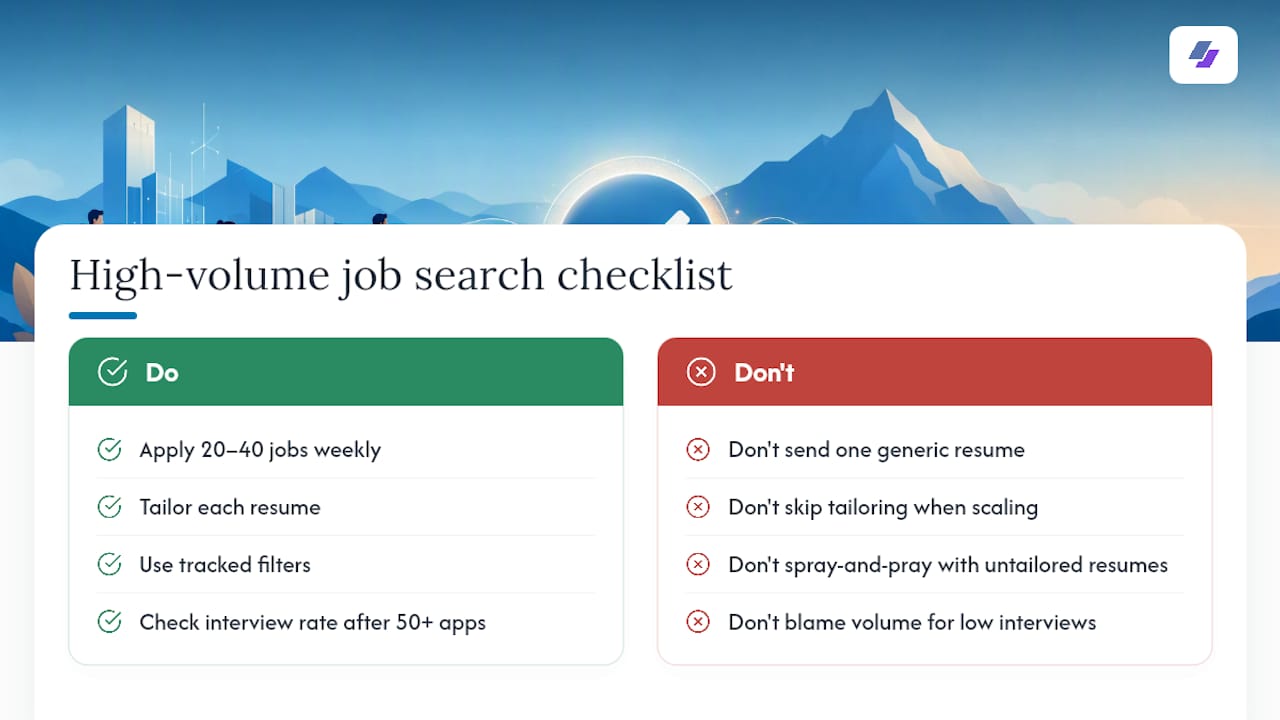
How do I know if my high-volume search is working? Track your funnel weekly. If your interview rate stays well under the roughly 3% benchmark after 50-plus applications, the fix is usually your resume or targeting, not your total application count.
Sources
- Smarter Job Search Strategies for 2026 | John Clements
- How Many Jobs Should You Apply to Per Week? (Data-Backed Benchmarks)