What Is Graduate Employability, and How Do You Prove It?

Graduate employability means being job-ready in ways an Applicant Tracking System (ATS) and a hiring team can both verify: an ATS-optimized, tailored resume, measurable projects or internships, and a repeatable process for matching your application to each job posting. It is not a personality trait or a vague sense of “potential.” It is a set of visible, checkable signals.
Two things you can do in the next hour:
- Pull 8 to 15 exact keywords from a job posting and place them in your summary, skills section, and bullet points.
- Move your education and academic projects above your work history if you graduated in the last two years.
JobAlign’s internal data shows roughly 75% of resumes get filtered before a human ever opens them, and its own optimization process claims an 87% ATS pass rate for resumes it tailors. That gap between “sent” and “seen” is the whole game for a new graduate.
Key Takeaways
Graduate employability is measured by whether an ATS and a human reviewer can both verify your job readiness through a tailored resume, quantified experience, and a repeatable application process.
| Point | Details |
|---|---|
| Definition | Graduate employability means ATS-visible job readiness: tailored resumes, measurable projects, and a repeatable application workflow. |
| Filtering reality | Around 75% of resumes are rejected by ATS before a human reviewer ever sees them. |
| Resume order | Lead with education and projects, formatted like job entries, ahead of unrelated work history. |
| Tailoring process | Extract 8 to 15 keywords, place them across your summary and bullets, then verify with a parse check in 10 to 15 minutes. |
| Beyond the resume | Soft skills, internships, networking, and continuous upskilling round out employability once you clear the ATS filter. |
Table of Contents
- What Is Graduate Employability From an ATS Perspective?
- How Should a Graduate-First Resume Be Structured?
- How Do You Tailor a Resume in Under 15 Minutes?
- What Formatting Rules Do ATS Systems Actually Require?
- How Do You Verify Your Resume Before Submitting?
- Your Seven-Day Plan to Raise Your Interview Rate
- What Does Employability Mean Beyond the Resume?
- Which Soft Skills Matter Most to Employers?
- Do Internships and Volunteering Really Move the Needle?
- How Do Networking and Career Services Improve Your Odds?
- What Challenges Do Graduates Face, and How Do You Get Past Them?
- Why Does Upskilling Matter After You Graduate?
- An Editorial Take on What Actually Moves the Needle
- Get Your Resume Application-Ready Today
- Frequently Asked Questions
- Sources
What Is Graduate Employability From an ATS Perspective?
Employability, in practical terms, is what a machine and a recruiter can both confirm about you in under 30 seconds. An ATS does not read your resume the way a person does. It parses text into fields (job titles, dates, skills, education) and scores the match against the posting’s requirements.
Roughly 75% of resumes never reach a human reviewer, filtered out by ATS scoring systems before anyone reads them. Large employers rely on this filtering because they receive far more applications than any recruiter could screen manually.
The scoring usually weighs:
- Keyword match against the job description’s required skills and qualifications.
- Job title alignment, even when your actual title differs slightly from the posting’s language.
- Years of experience, calculated from the dates you list.
- Skills detected in a dedicated skills section, not just buried in a paragraph.
For graduates, this is good news in disguise. You are not competing on years of experience. You are competing on keyword precision, and that part is fixable in one sitting.
How Should a Graduate-First Resume Be Structured?
Order matters more than most graduates assume. A recent graduate with a strong GPA and two internships should not bury that education under a retail job from sophomore year. ATSChecker.ai’s guidance for recent graduates recommends leading with education because both ATS and human skims weight recent academic credentials heavily for entry-level roles.
Here is the order that works for most new graduates:
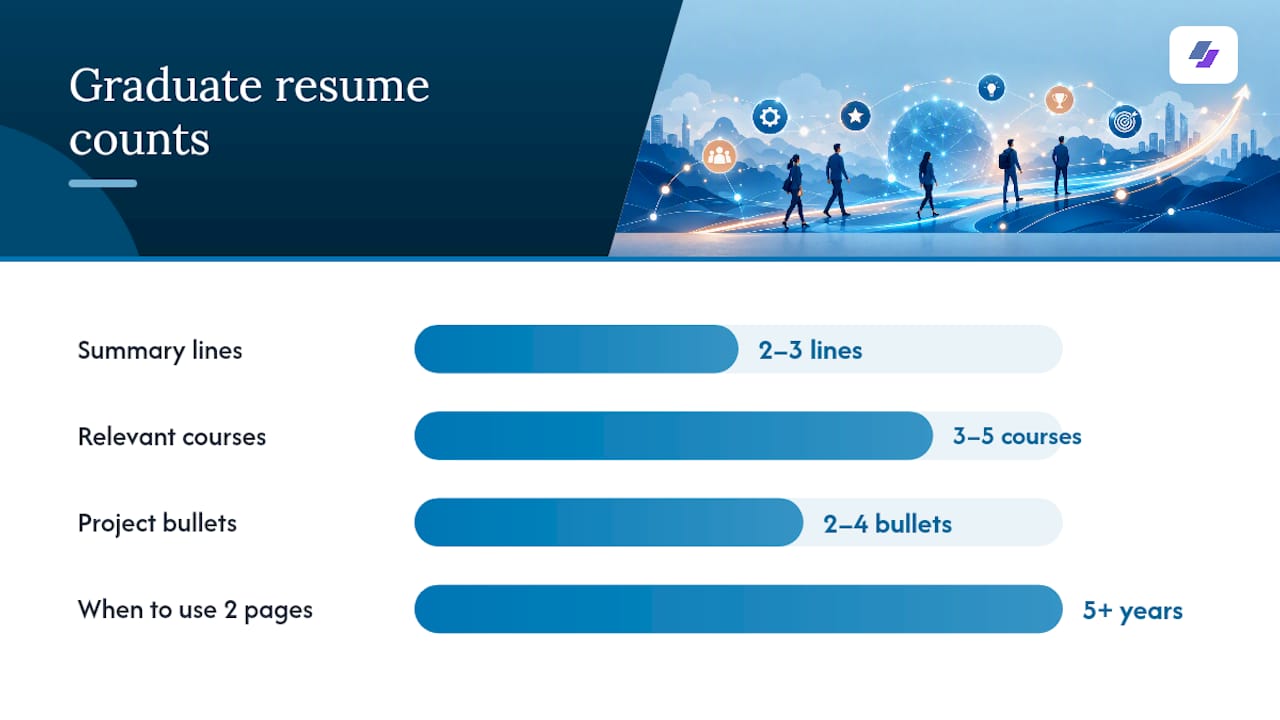
- Contact info and summary. Two to three lines naming your target role and top qualifications.
- Education. Degree, school, graduation date, GPA if 3.3 or higher, and 3 to 5 relevant courses.
- Projects and internships, formatted as experience. Title, organization or course name, dates, and 2 to 4 bullets using an XYZ structure (“Reduced processing time by 20% by automating X using Y”).
- Skills. A clean, scannable list matching the language of the job posting.
- Additional experience. Retail, food service, or unrelated jobs, kept brief.
The key trick: an ATS cannot tell the difference between a class project and a paid job if you format them the same way. List a project title, a date range in MMM YYYY, MMM YYYY format, and quantified outcomes, and it reads as legitimate experience.
Pro Tip: Skip the objective statement. Write a three-line summary that names your target job title verbatim, since ATS title-matching often looks for that exact phrase.
Keep it to one page unless you have five or more years of relevant internships and leadership roles combined. Cut coursework that does not relate to your target job. A general “Data Structures” listing helps a software engineering application; it does nothing for a marketing one.
How Do You Tailor a Resume in Under 15 Minutes?
Tailoring is mechanical work, not creative writing. ATS Verification’s tailoring guide breaks it into four repeatable steps that raise your match score without turning your resume into keyword soup.
- Extract 8 to 15 real keywords from the job description. Look for skills, tools, and qualifications repeated more than once.
- Surface those keywords in your summary line, your skills section, and 2 to 4 bullet points where they fit naturally.
- Re-order your skills list so the ones matching the posting sit at the top.
- Run a quick parse check before submitting, confirming the ATS reads your keywords correctly.
The whole process takes 10 to 15 minutes once you have a base resume built.
Two rules keep this from becoming stuffing. Repeating “project management” eight times on a 400-word resume reads as manipulation, not qualification. Second, corroborate each keyword across sections. If “SQL” appears in your skills list, it should also show up in a project bullet where you actually used it.
Build 2 to 3 base resume variants (one per role type you’re targeting) so you’re not starting from zero every time. During heavy application weeks, you swap keywords and reorder sections rather than rewriting from scratch.
What Formatting Rules Do ATS Systems Actually Require?
Formatting mistakes are the most common reason a qualified graduate gets filtered out before anyone reads a single bullet point. Indeed’s ATS-friendly template guidance recommends simple, explicit formatting over anything visually clever.
- Use a single-column layout. Multi-column designs often scramble the reading order when parsed.
- Stick to standard section headers: Work Experience, Education, Skills. Creative labels like “My Journey” confuse the parser.
- Avoid headers, footers, text boxes, tables, images, and icons. Parsers frequently skip or misread content placed inside them.
- Use Calibri, Arial, or Times New Roman, and standard round or square bullets, not custom symbols.
- Format dates consistently: MMM YYYY, MMM YYYY.
- Save as .docx when the application allows it. It is generally the safest format for parsing accuracy; PDF works for most modern systems but can occasionally strip formatting on older ATS platforms.
If you built your resume from a flashy Canva or Word template with columns and graphics, that is usually the first thing to fix, before you touch a single word of content.
How Do You Verify Your Resume Before Submitting?
Never submit blind. A quick check catches errors that would otherwise sink an application silently.
- Copy your resume’s raw text into a plain text editor. If sections jumble together or dates disappear, your formatting is breaking the parse.
- Run it through an ATS scanner to confirm your education, projects, and skills are being detected as separate, labeled fields.
- Aim for roughly 70% keyword overlap with the job posting’s required skills, a heuristic ResumeWin’s scoring breakdown points to as a reasonable threshold for clearing automated filters.
- Fill out every field in the application form itself. Platforms like Workday, Greenhouse, Lever, and iCIMS parse resumes differently, and insider breakdowns of ATS filtering note that skipped fields or missing data can stall a candidate even with a strong resume attached.
- Ask for 2 to 3 referrals from alumni or connections at your target companies. Referred candidates often skip a layer of automated screening entirely.
This is also where automation earns its keep. JobAlign’s LinkedIn sync pulls your profile data directly into a tailored, ATS-checked resume, cutting the manual back-and-forth of steps one through four to a couple of minutes per application.
Your Seven-Day Plan to Raise Your Interview Rate
Spread the work across a week instead of trying to fix everything the night before a deadline.
- Days 1 to 2: Build two base resume variants (one per role type) and run both through a parse check. Budget 90 minutes total.
- Days 3 to 4: Tailor and submit three applications using the 10-to-15-minute workflow above. Budget 45 minutes per application.
- Day 5: Update your LinkedIn profile to match your resume language, and request 2 to 3 referrals from your network.
- Days 6 to 7: Submit remaining applications and start a simple tracker logging applications sent, parse score, and response rate.
Track three numbers weekly: applications sent, average parse/match score, and reply rate. If your reply rate stays near zero after 15 tailored applications, the problem is usually keyword match or formatting, not your qualifications.
Pro Tip: Batch your tailoring on Sunday nights. Reviewing five job postings at once makes it easier to spot which keywords repeat across similar roles, so you can build one strong variant instead of five weak ones.
What Does Employability Mean Beyond the Resume?
A resume gets you past the filter. What you actually bring to the job is a broader mix of qualifications, experience, and personal attributes that no keyword scan can fully capture.
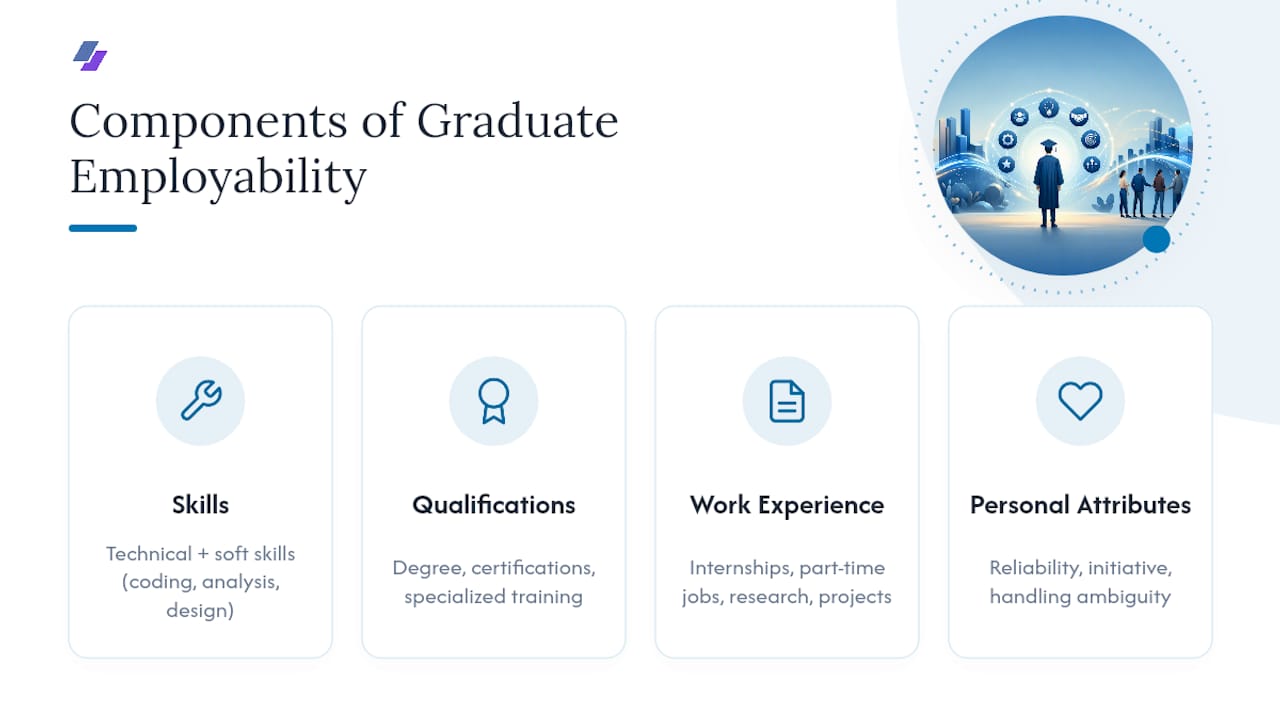
Employability rests on four overlapping pieces. Skills cover both technical ability (coding, data analysis, design software) and the soft skills employers consistently rank as decisive in close hiring decisions. Qualifications include your degree, certifications, and any specialized training that signals baseline competence. Work experience spans internships, part-time jobs, research assistant roles, and class projects, each one evidence you can apply knowledge under real constraints. Personal attributes cover reliability, initiative, and how you handle ambiguity, the traits that show up in interviews and probation periods rather than on paper.
None of these pieces works alone. A graduate with a strong GPA but zero applied experience often struggles in interviews when asked for a concrete example. A graduate with plenty of experience but no credentials may get filtered out by qualification requirements before the interview stage even starts.
The resume is where you translate all four into language an ATS and a recruiter can both parse, but the underlying substance has to actually exist first. Tailoring a resume around a project you can barely describe in an interview creates a mismatch that surfaces fast once you are in the room.
Which Soft Skills Matter Most to Employers?
Technical skills get you shortlisted. Soft skills get you hired and promoted. Employers repeatedly cite four competencies as the difference between a candidate who merely qualifies and one they actively want on their team.
Communication tops the list, covering both writing clearly (the resume itself is a test) and explaining complex ideas simply in an interview. Teamwork shows up in how you describe group projects: did you coordinate, delegate, or just show up? Problem-solving is best demonstrated through specific examples, not the word itself; a bullet point that says “solved problems” says nothing, while one that says “identified a scheduling conflict affecting 40 team members and proposed a fix adopted campus-wide” says everything. Adaptability matters especially for graduates, since most first jobs involve tools, processes, and expectations that no classroom fully prepares you for.
The mistake many graduates make is listing these as standalone resume bullets (“Strong communicator,” “team player”). That language is filler an ATS may still register as a keyword match, but it does nothing for the human reading it. The fix is to demonstrate the skill through a specific result. Instead of claiming teamwork, describe the team, the goal, and the outcome. Instead of claiming adaptability, describe the moment you had to switch approaches mid-project and what happened next.
Soft skills are also where personal attributes and applied experience intersect, which is why internships and group coursework matter so much for building a track record you can actually describe.
Do Internships and Volunteering Really Move the Needle?
Yes, and the mechanism is simple: internships, volunteering, and structured work placements are the fastest way to generate the concrete, quantifiable examples that both resumes and interviews depend on.
A classroom project proves you can follow instructions. An internship proves you can operate inside a real organization with real deadlines, ambiguous instructions, and people who are not grading you on effort. That distinction shows up clearly to hiring managers, which is part of why internship experience carries outsized weight relative to its short duration.
Volunteering fills a similar gap for graduates who could not land a paid internship, particularly in competitive fields. Leading a campus club’s logistics, organizing a fundraiser, or managing a nonprofit’s social media all generate the same kind of XYZ bullet material: a task, an action, and a measurable result. The label matters less than the substance.
Work placements and co-ops offer a middle ground, often longer and more structured than a summer internship, and they frequently convert into full-time offers because the employer has already tested you under real conditions.
The practical lesson: if you graduated without any of these, do not wait for the perfect one before applying. A part-time job, a volunteer role, or a freelance project completed in the last few months can be formatted the same way an internship would be, with a title, a timeframe, and outcomes. What matters to an ATS and a recruiter alike is that the experience is recent, described specifically, and framed as work, not as an afterthought at the bottom of the page.
How Do Networking and Career Services Improve Your Odds?
A referral changes how your application moves through the system, often letting it bypass part of the initial automated screen entirely. That single fact should reshape how much time you spend on networking versus cold applications.
Building a network as a new graduate does not require years of relationship cultivation. It requires consistency. Reach out to alumni from your program working in your target field, ask for 15 minute conversations rather than job requests, and follow up with a specific question rather than a generic “any advice.” LinkedIn is the primary tool for this, and keeping your profile synced with your resume language matters because recruiters cross-check both.
Career services offices are underused by most graduates, often because students associate them with undergraduate resume workshops rather than active job search support. Most offer resume reviews, mock interviews, and access to alumni databases and employer partnerships that never appear on public job boards. If your school has an employer relations team, they frequently know which companies are hiring before those roles go public.
The combination matters more than either alone. A referral gets your resume a second look. A tailored, ATS-ready resume is what makes that second look worth taking.
What Challenges Do Graduates Face, and How Do You Get Past Them?
The most common obstacle is not lack of qualification. It is lack of visibility, and most graduate job search problems trace back to one of three specific issues.
The experience paradox comes first: entry-level postings that require one to two years of experience for a role labeled “entry-level.” The workaround is treating substantial coursework, capstone projects, and internships as experience on your resume, formatted with the same rigor as a job entry.
Application volume without results is the second challenge. Graduates often send 50 or more generic resumes and get almost no replies, then conclude the market is impossible. Usually the resume never cleared the ATS filter in the first place, which is precisely why the tailoring workflow earlier in this piece matters more than raw volume.
Interview inexperience rounds out the list. A graduate might get an interview only to freeze when asked for specific examples. The fix is preparing three to five stories from your internships, projects, or volunteering, each with a clear task, action, and result, before you ever get the call.
None of these problems require years to fix. They require a specific, structured response, which is exactly what a resume tailored around real experience and a short networking effort provides.
Why Does Upskilling Matter After You Graduate?
Employability is not a status you earn once at graduation. It decays if you stop adding to it, and the job market for many skilled roles shifts faster than a four-year degree can track.
A software engineering graduate whose coursework covered a specific framework two years ago may find that framework has already been replaced as the industry standard. A marketing graduate who learned traditional analytics tools may find employers now expect familiarity with newer platforms that did not exist when they enrolled. This is not a reason to panic. It is a reason to treat learning as ongoing rather than finished.
The most efficient path is targeted, not exhaustive. Identify one or two skills that show up repeatedly across job postings you want but do not currently have, then pursue a focused certification or short course rather than a broad, unfocused list of credentials. A single, relevant certificate finished in a few weeks and added to your resume’s skills section often does more for your employability than three half-finished online courses.
Continuous learning also feeds directly back into your resume and interview material. Each new skill or certification becomes another keyword, another bullet point, another concrete example. Employability, in the end, is a compounding asset. The graduates who keep adding to it steadily tend to outpace those who treat the degree as the finish line.
An Editorial Take on What Actually Moves the Needle
Most graduate job search advice treats the resume as a formality after the “real” work of building skills. The data on ATS filtering suggests the opposite: a strong candidate with a poorly parsed resume and a mediocre candidate with a tailored, keyword-matched one often get the same outcome, an interview, for very different reasons. JobAlign’s own figures, including the claim that roughly 75% of resumes get filtered before human review, point to the same conclusion. The mechanical layer of the job search is not secondary to substance. It is the gate substance has to pass through first.
. . What stands out across the tailoring research is how small the fixes usually are: reordering a skills section, renaming a project bullet, swapping a generic header for a standard one. Graduates rarely need a new skill set. They need their existing one translated into a format a machine can read correctly.
Get Your Resume Application-Ready Today
Building and maintaining two or three tailored resume variants by hand, then re-checking each one against a new job posting, adds up fast once you are applying to dozens of roles a week. JobAlign’s LinkedIn resume generator automates that process: it syncs directly with your LinkedIn profile, extracts your experience and skills, and produces a tailored, ATS-optimized resume for each application without you rebuilding the document from scratch every time.
The platform’s tailoring engine is built around the same keyword-matching principles covered above, applied automatically rather than manually. If you want to see the output format before committing, JobAlign’s ATS-optimized resume templates show the education-first, single-column structure recommended throughout this guide, ready to fill in with your own projects and internships.
Frequently Asked Questions
What is graduate employability in simple terms? It is your ability to prove, through a tailored resume, relevant experience, and demonstrable skills, that you are ready for a specific job, in a format both an ATS and a hiring manager can verify.
How to improve employability quickly if you have no work experience? Format academic projects, class assignments, and volunteer work as job entries with titles, dates, and quantified outcomes. ATS systems generally cannot distinguish a well-formatted project from paid employment.
What affects employability most for a recent graduate? Keyword match on your resume, relevant internships or projects, soft skills demonstrated through concrete examples, and referrals all play a measurable role in whether you get an interview.
What graduate employment skills matter most to employers? Communication, teamwork, problem-solving, and adaptability consistently rank as the deciding factors once a candidate clears the technical qualification bar.
How long should tailoring a resume actually take? Following a structured four-step process, most graduates can tailor a base resume to a new job posting in 10 to 15 minutes without starting from scratch.
Are PDFs safe for ATS, or should you use Word? A .docx file is generally the safest choice for parsing accuracy, though most modern ATS platforms handle PDF resumes correctly as long as the layout avoids columns, tables, and text boxes.
Sources
- How ATS resume systems actually work in 2026 (and the 7 things they score you on)
- How to Tailor a Resume to a Job Description (Without Stuffing) | ATS Verification
- Atschecker