What Is a Fractional Professional Resume?

A fractional professional resume is an outcome-first, modular impact document that leads with the problems you solve and the measurable results you deliver, not a chronological work history. The BLUF here: write outcome-first, build it modular, and treat every line like a pitch to a buyer, not a summary for HR.
Here’s the shift in miniature:
- Before: “Served as interim VP of Marketing for a Series B SaaS company, 2023 to 2024.”
- After: “Rebuilt demand generation for a Series B SaaS company in 4 months, driving a 32% increase in qualified pipeline on 15 hours a week.”
One line reports tenure. The other proves value. That’s the entire game.
Key Takeaways
A fractional professional resume works because it leads with quantified outcomes and modular proof of impact, not chronological tenure.
| Point | Details |
|---|---|
| Lead with outcomes | Open with a hook formula: who you help, how, and the measurable result. |
| Structure it modular | Group signature results, services, and engagements into scannable blocks, not a strict timeline. |
| Label roles clearly | Use “Fractional” in titles and summaries so both ATS and recruiters recognize the work type. |
| Aggregate short engagements | Combine results across multiple short-term clients into one signature outcome statement. |
| Use JobAlign to speed production | JobAlign syncs LinkedIn data and generates ATS-optimized, tailored resume variants for each pitch. |
Table of Contents
- What Fractional Work Actually Looks Like
- Why a Fractional Resume Reads Differently Than a Corporate One
- The Hybrid, Modular Resume Structure
- How to Rewrite Bullets So They Sell Outcomes
- ATS Rules for Fractional Titles and Keywords
- Building a One-Page Fractional Impact Document
- Resources to Build This Faster
- Frequently Asked Questions
- Sources
What Fractional Work Actually Looks Like
“Fractional” means part-time, retainer-based, or project-based executive work, most often filling a leadership seat a company can’t yet justify hiring full-time for. Think fractional CMO, fractional CFO, fractional COO, or fractional Head of People, typically part-time executive positions that deliver strategic leadership without a full-time commitment.
Common patterns look like this:
- 10 to 20 hours a week across one to three clients simultaneously
- Engagements running three to twelve months, sometimes renewing indefinitely
- Retainer pricing or scoped project fees instead of a single salary
- A mandate tied to a specific outcome (launch a channel, fix the close process, stand up a hiring function)
Companies hire fractional talent because it’s faster than a full executive search, cheaper than a full-time salary plus equity, and it buys senior expertise for a problem that doesn’t need a permanent seat. That buyer logic is exactly why the resume format has to change.
Why a Fractional Resume Reads Differently Than a Corporate One
A traditional resume sells your career trajectory. A fractional resume sells your next 90 days. Those are different pitches, and a resume built for the first one usually fails the second.
Corporate resumes lean on job titles, tenure, and a chronological ladder. Buyers hiring fractional talent care less about how long you stayed somewhere and more about how fast you can create measurable impact once you start. They’re evaluating whether you can run a full function on partial hours, not whether you climbed a ladder.
That said, some traditional credibility signals still carry weight:
- Recognizable client names or company categories (even without full names, if under NDA)
- Specific, quantified metrics tied to your work
- A clear methodology or point of view on how you operate
Pro Tip: If you can’t name the client, name the category. “Series A fintech” or “80-person DTC brand” still tells a buyer exactly who you serve.
The Hybrid, Modular Resume Structure
Build the fractional resume in blocks, not a straight timeline. Order matters: buyers scan top to bottom, so put the strongest proof first.
- Hook / value statement. Use a simple formula: “I help [client type] achieve [outcome] by [approach], resulting in [measurable result].” This single line, done well, does more to earn a second look than an entire paragraph of credentials.
- Core services. List three to five things you actually do, written as offerings, not job duties.
- Signature results. Three to five quantified outcomes, pulled from across all your engagements, presented before anyone reads your work history.
- Selected engagements. Group by function or industry rather than strict chronology, each with a scope line (hours per week, duration, retainer or project).
- Working style. State your typical hours per week, preferred engagement length, and whether you work solo or bring a small team.
This is the multi-role resume format applied to fractional work: modular sections a buyer can scan in under a minute, with proof stacked before biography.
How to Rewrite Bullets So They Sell Outcomes
Every fractional bullet should answer one question: what changed because you showed up? Compare these side by side.
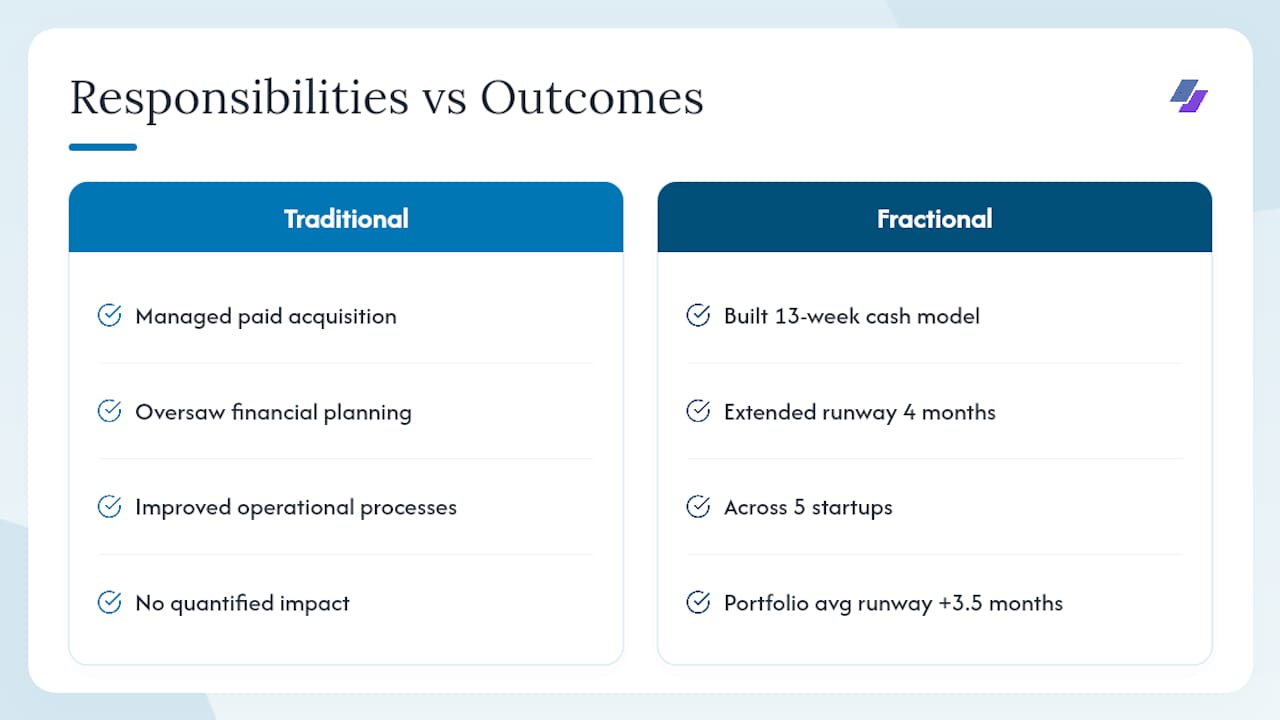
Marketing. Before: “Managed paid acquisition and content strategy for e-commerce clients.”
Finance. Before: “Oversaw financial planning and reporting for a growth-stage startup.” After: “Built a 13-week cash flow model that extended runway by 4 months ahead of a $3M raise.”
Operations. Before: “Improved operational processes and vendor management.”
When you’ve run five short engagements instead of one long one, don’t list five thin bullets. Aggregate: “Delivered cash flow modeling and fundraising support across 5 startups, extending average runway by 3.5 months per client.” One signature result built from a portfolio beats five scattered ones.
Label each entry with role, client type, scope, and duration in a single line, right under the heading, so a scanning reader gets context in two seconds. For more rewrite patterns, see ready-to-use bullet examples.
ATS Rules for Fractional Titles and Keywords
Your resume still has to clear a filter before a human sees it, and roughly 75% of resumes get rejected by ATS before a recruiter ever opens them. Fractional candidates face an extra wrinkle: nonstandard titles can confuse keyword matching if you’re not deliberate.
- Use the word “Fractional” directly in your title and summary. “Fractional CMO” reads clean to both ATS and human scanners, and explicit labeling improves discoverability during keyword searches.
- Mirror the exact role and industry keywords from target job postings in your summary, services list, and bullet text, not just buried in a skills section.
- Stick to standard fonts, a single column where possible, and save as a text-readable PDF. Two pages is acceptable for senior candidates, but only if every line earns its place.
Balancing buyer language with ATS parsing is the hard part. A line like “Drove pipeline growth as Fractional VP of Growth” satisfies both audiences simultaneously.
Building a One-Page Fractional Impact Document
A resume and an impact document solve different problems. Use a one-page impact document when you’re pitching a founder or board member directly, or doing cold outreach where attention lasts about ten seconds. Save the two-page resume for formal applications and recruiter-facing searches where a fuller record matters.
A strong impact document reads like a portfolio of engagements, built around outcomes rather than history. Essential sections:
- The hook, one line, top of page
- Three to five signature results, bolded numbers
- A short service menu
- Two or three mini-case snippets (client type, problem, result, in one line each)
Pro Tip: Name the file with your specialty, not just your name. “Fractional_CFO_CashFlow_ImpactDoc.pdf” tells a founder what’s inside before they open it.
Keep it a clean, single-page PDF under 2MB, easy to skim on a phone screen during a first outreach message.
Resources to Build This Faster
Getting the formatting, keyword placement, and modular structure right by hand takes time most fractional professionals don’t have between client work. JobAlign syncs directly with your LinkedIn profile, pulls your existing experience, and generates ATS-optimized resume variants tailored to each opportunity.
For fractional professionals juggling multiple client pitches, that means:
- Automatic extraction of your engagement history from LinkedIn, ready to reformat into modular sections
- ATS-aware keyword placement without manual guesswork on every application
- Tailored resume generation per job posting, so a new pitch to a new buyer doesn’t mean starting from scratch
A Note From Johan
Fractional work rewards people who like solving one sharp problem instead of managing everything. If you’re testing this path, send your resume draft to two people you’ve actually worked with and ask what’s confusing before you send it anywhere else.
Turn Your LinkedIn Profile Into a Fractional Pitch
Rewriting a resume by hand into a modular, outcome-first format eats hours you’d rather spend on client work. JobAlign pulls your LinkedIn history automatically, restructures it around measurable results, and applies ATS-optimized formatting so your fractional titles and keywords still get parsed correctly. Try the free LinkedIn resume builder to generate a sample impact document in minutes and see your engagement history reframed as proof of performance instead of a plain timeline.
Frequently Asked Questions
What is a fractional professional resume, in one sentence? It’s an outcome-first, modular document that leads with quantified results and service offerings rather than a chronological job history, built to sell a buyer on your next engagement.
How is a fractional resume different from a normal resume? A traditional resume tracks career progression over time. A fractional resume proves speed of impact and measurable outcomes, since buyers are hiring for a specific problem, not a career narrative.
Should I use “Fractional” in my job title on the resume? Yes. Labeling roles explicitly as “Fractional CMO” or “Fractional COO” helps both ATS systems and recruiters correctly categorize your experience during keyword searches.
Is a two-page resume acceptable for fractional executive roles? Two pages works for senior candidates as long as every section adds value; a one-page impact document is better for cold outreach or pitching founders directly.
How do I show impact from several short-term clients on one resume? Aggregate similar results into a single signature statement (for example, average runway extension across five clients) instead of listing five thin, separate bullets.