Applying to Your First Job Out of College: A Week-One Plan

This week: build an ATS-ready one-page resume, set three job targets, and send 10 tailored applications using a 20 to 30 percent customization rule for each one. That single move matters because a large portion of resumes never reach a human reviewer(https://jobalign.app/en/ats-resume-keywords.html) — they get filtered by Applicant Tracking Systems before anyone reads them. Grads typically send around 23 applications before landing an offer, so treat volume and precision as partners, not opposites.
Here’s your checklist for the next seven days:
- Rewrite your resume into a one-page, ATS-readable format with standard headings.
- Optimize your LinkedIn headline and About section to match your target roles.
- Pick three job titles or industries and pull 10 real postings.
- Send 10 applications, each customized 20 to 30 percent to the job description.
- Message two people in your target field for a 15-minute conversation.
Pro Tip: Apply within 48 hours of a posting going live. Early applicants get more attention before a recruiter’s inbox fills up, and jobs posted more than three weeks ago often skew toward ghost listings.
Key Takeaways
Landing a first job out of college works best when you pair a tailored, ATS-ready resume with consistent weekly application volume and real networking outreach.
| Point | Details |
|---|---|
| Apply within 48 hours | Early applicants get noticed before recruiter inboxes fill and postings go stale. |
| Customize every resume | Change 20 to 30 percent of each resume, including three to four mirrored keywords. |
| Track relentlessly | Log posting date, source, customization notes, and follow-up date for every application. |
| Expect a multi-month search | Budget three to four months and roughly 23 applications before an offer typically arrives. |
| Use JobAlign for tailoring | Sync LinkedIn to generate ATS-optimized resumes fast and hit the customization target at scale. |
Table of Contents
- How to Apply to Your First Job Out of College in 4 Weeks
- What Should Your Resume Include for Entry-Level Jobs?
- How Do You Build Experience Before Getting Hired?
- How Do You Prepare for Entry-Level Job Interviews?
- How Long Does It Take to Land Your First Job?
- What Mistakes Do New Grads Make When Applying?
- Your First Job Is a Starting Point, Not a Verdict
- Speed Up Tailoring With JobAlign’s LinkedIn Sync
- Where to Go for Deeper Guidance
- Sources
How to Apply to Your First Job Out of College in 4 Weeks
A first job search rewards structure over hustle. Spray-and-pray applications waste time; a precision approach built around tailored materials and consistent tracking gets more callbacks with less effort.
Here’s the month broken into stages:
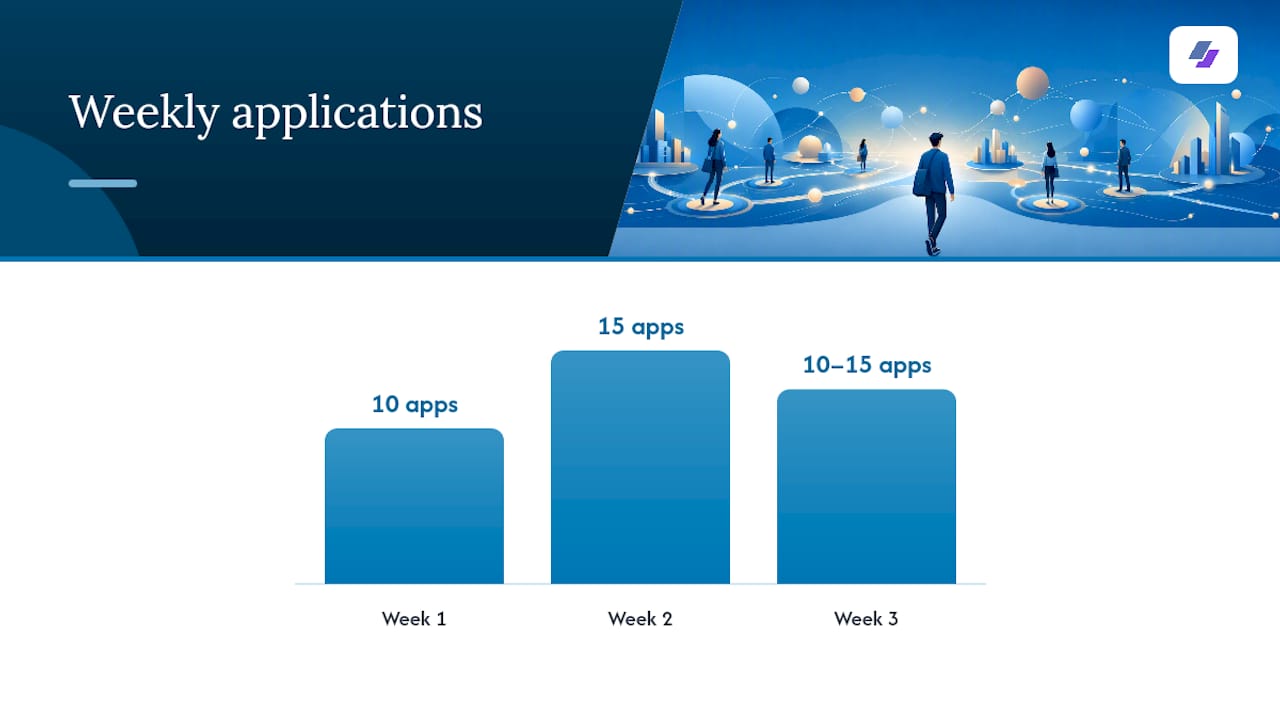
- Week 1: Build your foundation. Finalize your resume template, optimize LinkedIn, and send 10 applications to your first-choice roles.
- Week 2: Widen the net and start networking. Send 15 applications, reach out to five people for informational chats, and ask your career center for referrals.
- Week 3: Practice interviewing while applying. Keep applying to 10 to 15 roles, but shift energy toward mock interviews and refining your STAR stories.
- Week 4: Follow up and negotiate. Chase every pending application, revisit early rejections for feedback, and prepare to evaluate offers.
Daily, budget about 45 minutes for tailoring resumes, 15 minutes for one networking message, and 20 minutes for interview practice once interviews start landing. That’s under 90 minutes a day, sustainable even alongside a part-time job.
Track every application in a simple spreadsheet with columns for posting date, source (LinkedIn, Indeed, company site), what you customized, and your planned follow-up date. This turns a chaotic search into a dataset you can actually analyze.
Watch three numbers: applications sent, response rate, and interviews scheduled. If you’ve sent 20 applications with zero responses, the problem is usually your resume or your targeting, not your effort.
Traction is measurable, not a feeling.*
What Should Your Resume Include for Entry-Level Jobs?
Open with a two- or three-line summary that states your target role, your strongest skill area, and one measurable outcome. Skip the objective statement your career center told you to write in 2019. It’s dead weight.
Section order for entry-level candidates: contact info, summary, education (yes, above experience if you’re under a year out of school), experience, projects, skills. Recruiters scanning your resume for six seconds want to see your degree and GPA fast if they’re strong.
For ATS formatting, follow these rules without exception:
- Use standard headings: “Experience,” “Education,” “Skills.” No creative labels.
- Skip tables, text boxes, columns, and graphics. ATS parsers choke on them.
- Keep it to one page. Save the second page for after your first promotion.
- Mirror keywords from the job posting exactly, including acronyms and their spelled-out versions.
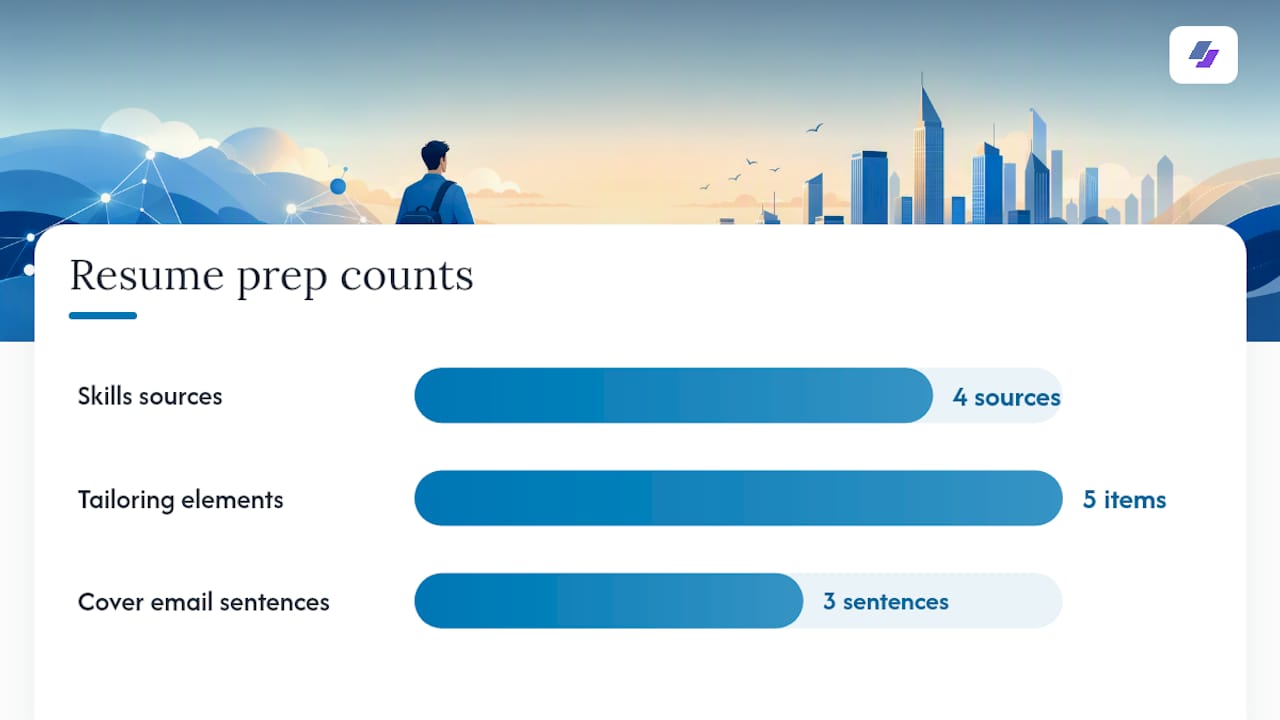
Build your skills inventory from four sources: academic projects, part-time jobs, extracurricular leadership, and any AI-tool fluency (ChatGPT, Excel automation, data visualization tools). Each item becomes a bullet with a verb, an action, and a number.
Tailor five things per posting: your summary line, three to four keywords pulled straight from the description, bullet order (put the most relevant bullet first), and your top metric. That’s it. You don’t need to rewrite the whole document each time.
What to send alongside your resume: a short cover email (three sentences, no more) that names the role, your top qualification, and your enthusiasm, plus a portfolio link if your field calls for one (design, writing, data). A full cover letter still matters for roles that ask for one directly or for companies you’re deeply targeting.
Pro Tip: Syncing your LinkedIn profile through a tool like JobAlign and letting it match keywords automatically cuts tailoring time dramatically. One user cohort saw ATS-acceptance odds increase significantly after keyword optimization(https://jobalign.app/en/ats-resume-keywords.html) — that gap is the entire game.
How Do You Build Experience Before Getting Hired?
You don’t need a job offer to start building proof of skill. Short-term roles and side projects are how many grads bridge the gap between diploma and offer letter.
Options worth pursuing this month:
- Freelance a small project on a platform in your target field (writing, design, spreadsheets, code).
- Volunteer for a nonprofit’s marketing or data needs.
- Extend your capstone project with one more analysis or feature.
- Take on a micro-internship (often 5 to 40 hours, paid, project-based).
Present unpaid or short work the same way you’d present a job: name the tools you used, the outcome you drove, and the skill it proves. A three-week data-cleaning project for a professor becomes “Cleaned and analyzed a 10,000-row dataset in Excel, identifying three data quality issues that changed the study’s conclusions.”
Turn any project into a 60 to 90 second interview story: what the problem was, what you did, what changed because of it.
How Do You Prepare for Entry-Level Job Interviews?
Every interview answer should follow the STAR structure: Situation, Task, Action, Result. Pick four or five stories from your coursework, jobs, or projects that cover teamwork, conflict, failure, and leadership. You’ll reuse these across nearly every interview you get.
For common entry-level questions like “Tell me about yourself” or “Why this role,” keep your answer under 90 seconds and end on what you contributed or learned, not just what happened.
- Write out your five STAR stories in bullet form, not full paragraphs, so you sound natural, not memorized.
- Record yourself answering three questions out loud and watch it back once.
- Do one mock interview with a career center advisor or a friend who’ll give honest feedback.
- Say yes to the harder, unfamiliar question in practice. Volunteering for stretch situations now builds the instinct you’ll need on the job later.
After every interview, send a follow-up email within 24 hours thanking the interviewer by name and referencing one specific thing you discussed. Keep it to four sentences.
When an offer comes, ask about start date flexibility, the salary band, and learning or mentorship opportunities before you counter. A reasonable first counter is a specific number backed by market research, not a vague “more.”
- Ask for 24 to 48 hours to consider any offer before responding.
- Counter with one clear number, not a range.
- Negotiate learning opportunities if the salary is fixed.
Pro Tip: Practice your STAR stories out loud, not just in your head. The gap between “I know this story” and “I can say this story smoothly under pressure” is bigger than most grads expect.
How Long Does It Take to Land Your First Job?
Expect a search that runs three to four months from first application to signed offer, sometimes longer depending on field and market conditions. That’s normal, not a sign something’s wrong.
Costs to plan for: professional headshots ($0 to $50 if you use your college’s free service), interview travel, and occasionally a certification fee for technical roles. Most of these have free alternatives: virtual interviews cut travel costs to zero, and your college career center usually offers free resume review and mock interviews you’re already paying for through tuition.
- Use your career center’s free services before paying for anything.
- Favor virtual first-round interviews to save on travel.
- Budget quality over pure volume once you’re past 15 to 20 applications a week.
The average job seeker sends around 23 applications before an offer. If you’re at application 15 with no interviews, that’s a tailoring problem, not a rejection of you personally.
What Mistakes Do New Grads Make When Applying?
Six mistakes account for most of the wasted effort in a first job search: sending the same resume everywhere, ignoring ATS formatting, skipping follow-up, avoiding networking, applying to ghost jobs, and not tracking anything.
Quick fixes for each:
- Generic resume: apply the 20 to 30 percent customization rule to every submission.
- ATS blind spots: strip tables, graphics, and unusual fonts before uploading.
- No follow-up: send a one-line note a week after applying if you haven’t heard back.
- No networking: message one person per day in your target industry.
- Ghost jobs: run a 5-signal check: posting age over three weeks, identical listings across multiple boards, vague job titles, no clear hiring manager, and stale company reviews.
- No tracking: log every application the day you send it, not a week later when details fade.
Before you hit submit on any application, run through this: Does my resume mirror the job description’s language? Did I check the posting date? Do I have a follow-up date on my calendar? If any answer is no, fix it first.
Your First Job Is a Starting Point, Not a Verdict
Your first role out of college feels enormous right now, but it rarely determines where your career actually goes. Skills transfer. Judgment transfers. The habit of learning fast transfers. What matters most in year one isn’t a perfect title, it’s whether you’re stacking real capability and staying curious enough to take on the assignment nobody else wants.
Speed Up Tailoring With JobAlign’s LinkedIn Sync
Hitting the 20 to 30 percent customization rule across 10 or 15 applications a week is the hard part of this whole plan, and it’s exactly what JobAlign was built to solve. Sync your LinkedIn profile once, and JobAlign pulls your real experience and skills, matches them against each job description’s keywords, and generates an ATS-optimized PDF resume in minutes instead of hours.
Test it in under 30 minutes: sync your LinkedIn profile, pick a template, generate your first resume, and download it. For a new grad applying to a dozen roles a week, that means a dozen genuinely tailored resumes instead of one generic version with a swapped-out company name. Try the free resume builder and see your first ATS-ready draft today.
Where to Go for Deeper Guidance
For more depth beyond this playbook, bookmark the application-tracking approach above and explore:
- Job Application Guide for Graduates: 2026 Playbook
- How to Build a Resume Without Work History
- Entry Level Cybersecurity Jobs: Where to Apply and Get Hired for role-specific paths
- 10 Job Search Tips for Fresh Graduates
Sources
- LinkedIn grads guide 2026: starting your career in the AI era | CareerCentral (Pitt)
- 10 things new grads should know before their first job | Quartz
- 4 Pieces Of Advice For Every Grad Starting Their First Job | Forbes
- How to find your first job: 10 essential steps (2026 guide) | FoundRole
- 10 Job Search Tips for Fresh Graduates Entering the Job Market (2026 Edition) | Talentlab