What Does Career Pivoting Mean for Your Next Move?

A career pivot means making a purposeful shift into a new role, function, or industry while carrying your existing skills, network, and expertise forward with you. That last part is the whole point: you’re not starting over. You’re repurposing career assets you already built, which is what separates a pivot from a total career reboot.
Here’s what to expect going in:
- Timeline: most pivots typically take several months to a couple of years, depending on how far you’re jumping.
- Trade-offs: you may experience temporary setbacks in title or salary to establish yourself in a new field.
Key Takeaways
A career pivot succeeds when it repurposes existing career capital into a new role, rather than discarding it to start over.
| Point | Details |
|---|---|
| Pivot preserves career capital | Unlike a full career change, a pivot carries forward skills, network, or domain knowledge into the new role. |
| Match strategy to pivot type | Forced pivots need speed; anticipatory and exploration pivots allow slower, low-risk experimentation. |
| Budget for short-term costs | Expect a transition period that could last several months to a few years with a possible temporary dip in seniority or pay. |
| Audit career capital first | Map knowing-why, knowing-how, and knowing-whom before targeting specific roles. |
| Test resumes like a hypothesis | Tailor keywords per job description and compare callback rates across resume versions. |
Table of Contents
- What Is a Career Pivot vs. a Career Change?
- The Five Types of Career Pivots You Might Be Making
- Are You Ready to Pivot? Signs, Costs, and Timing
- How to Plan and Execute a Career Pivot, Step by Step
- Getting Your Resume and LinkedIn Profile to Match Your New Direction
- The Pivot Rarely Goes in a Straight Line
- Sources
What Is a Career Pivot vs. a Career Change?
The line between a pivot and a full career change comes down to discontinuity. A pivot extends your trajectory sideways or diagonally, keeping some thread of skill, industry knowledge, or network intact. A change breaks that thread entirely. The Cambridge Dictionary defines a career change simply as a move to a different type of job or profession, with no requirement that anything carries over.
Consider three examples:
- A financial analyst moving into fintech product management is a pivot. She keeps her quantitative reasoning and industry relationships, just applies them differently.
- A nurse becoming a full-time novelist is a career change. Almost nothing transfers except discipline and time management.
- A teacher moving into corporate training is a boundary case. It looks like a pivot (same skill: instruction) but feels like a change (new industry, new incentive structure).
Use pivot framing whenever you can point to at least one asset, a skill, a credential, a relationship, that survives the jump. If you can’t, you’re planning a change, and that calls for a different kind of runway and risk tolerance.
The Five Types of Career Pivots You Might Be Making
Not all pivots run on the same clock or carry the same risk. Knowing which type you’re in shapes how fast you move and how much you experiment before committing.
- Forced pivot: triggered by a layoff or industry contraction. Speed matters more than perfection here. You lean on existing contacts and apply fast rather than spend months exploring.
- Anticipatory pivot: a planned move into a growth sector before your current field declines. This gives you room to build skills gradually, often while still employed.
- Growth pivot: staying in the same field but changing function, like an engineer moving into engineering management. The decision usually hinges on whether it’s a genuine promotion or a lateral shuffle in disguise.
- Boredom or exploration pivot: driven by restlessness rather than urgency. Low stakes mean you can run small experiments, a side project or a certificate, before making any real commitment.
- Hybrid or portfolio pivot: combining a primary role with freelance work or a side venture, letting you test a new direction without fully abandoning your current paycheck.
This taxonomy, described by career strategist Anna Burgess Yang, matters because a forced pivot and a boredom pivot call for opposite playbooks: one needs urgency, the other needs patience.
Are You Ready to Pivot? Signs, Costs, and Timing
Internal signals usually show up first: values misalignment, chronic boredom, or burnout that doesn’t resolve after a vacation, highlighting why AI Is Coming for Your Job. Here’s What to Do. emphasizes adaptability and reskilling for career readiness. External signals follow, shrinking demand in your current industry, or a sudden opening in an adjacent field you’re positioned to enter.
Before you leap, run this checklist:
- Financial runway: can you cover 3 to 6 months of reduced income if the transition takes longer than planned?
- Transferable skills audit: have you listed what actually carries over versus what you’d need to learn from scratch?
- Minimum viable network: do you know at least two or three people already working in the target field?
Realistically, budget months to two years depending on how far the jump is, and expect a possible dip in seniority or pay while you establish credibility in the new lane. Stanford researchers studying career pivots note that successful pivoters accept short-term setbacks as the cost of gaining a foothold, rather than a sign they made the wrong call.
Pro Tip: Before quitting anything, run a “weekend test”: spend one Saturday doing the actual tasks of your target role, whether that’s a freelance project, a volunteer gig, or shadowing someone. It reveals more about fit than a dozen informational interviews.
How to Plan and Execute a Career Pivot, Step by Step
A pivot without a plan is just a hope. Here’s the sequence that actually works.
- Articulate your why. Write down the specific problem with your current path and a measurable goal for the new one. “I want more autonomy” is vague. “I want a role where I ship a product end to end” is testable.
- Audit your career capital. Stanford GSB’s framework breaks this into three pillars: knowing-why (your motivation and identity), knowing-how (your skills), and knowing-whom (your network). Map what’s portable and what’s missing.
- Research and validate target roles. Run informational interviews and small paid or unpaid projects before committing. This is where a lot of assumed interest quietly dies, which is useful information, not failure.
- Fill critical gaps strategically. Don’t get a full second degree if a short course or a certificate closes the gap. Target the two or three skills that actually block your candidacy.
- Reposition your brand and your story. Rewrite your resume bullets, your LinkedIn headline, and your interview narrative so your past experience reads as relevant, not incidental. GSB researchers frame this as re-authoring your professional story so hiring managers connect the dots you already see.
- Apply, iterate, and use referrals. Applications through a warm introduction get read differently than cold submissions. Track your callback rate by resume version, not just by job title.
Pro Tip: Set a milestone at 90 days: five informational interviews completed, one skill gap closed, and one tailored resume tested against real applications. If none of those three are true, your plan needs adjusting, not abandoning.
Getting Your Resume and LinkedIn Profile to Match Your New Direction
A chronological resume tells a hiring manager where you’ve been. A hybrid, skills-forward resume tells them where you’re going, which is exactly what a pivot requires. Lead with an achievements section that reframes your domain experience in the target field’s language before the ATS or the recruiter ever gets to your job titles.

The translation work is the hard part. “Managed a $2M budget” becomes “allocated resources across competing priorities,” a phrasing that reads naturally in finance, operations, or product roles alike. Every application needs its own keyword set pulled from that specific job description, not a single all-purpose version. Testing more than one narrative matters: a resume that leads with leadership might land interviews for one role type and go nowhere for another, and you won’t know which until you A/B test the versions against real applications.
Doing this manually for every application is exactly the bottleneck that stalls most pivots. Jobalign syncs directly with your LinkedIn profile, pulls your relevant experience, and generates a tailored, ATS-optimized resume for each job in minutes rather than hours.
The Pivot Rarely Goes in a Straight Line
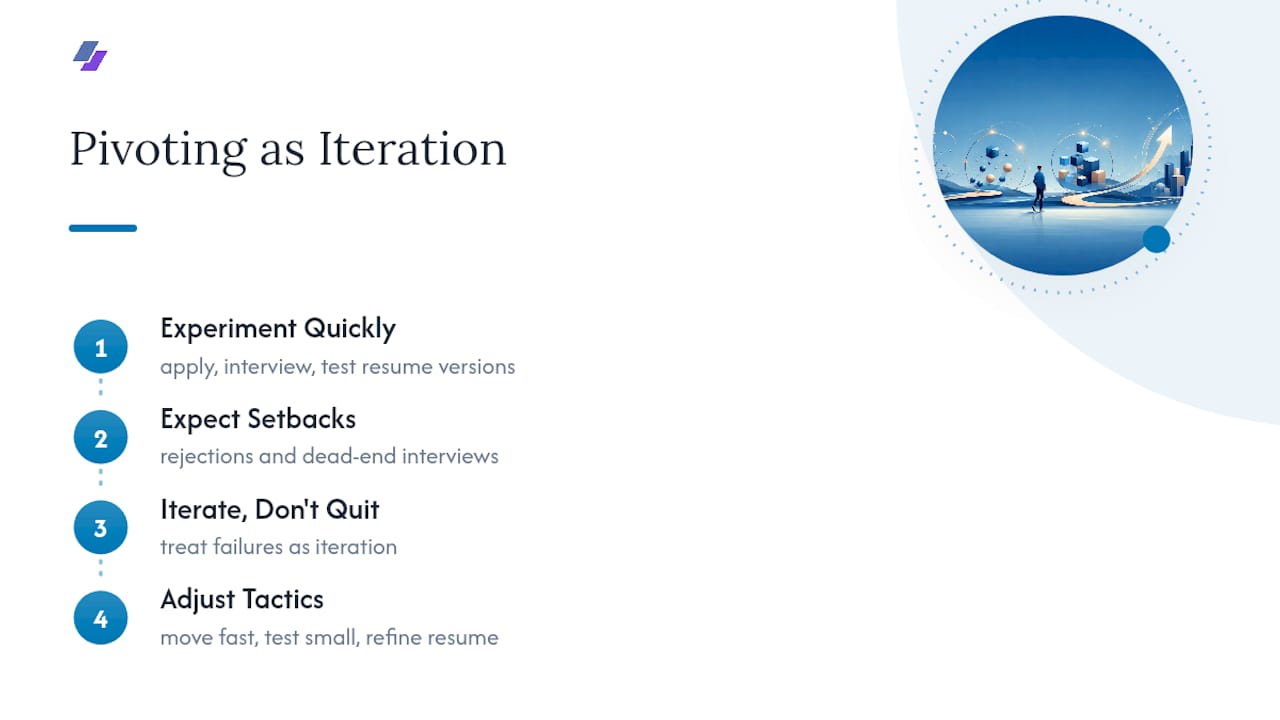
Most pivots wobble before they work. Expect a rejected application or two, an informational interview that goes nowhere, a resume version that flops. That’s iteration, not failure.
Move fast, test small, and adjust. Speed beats perfection, and the resume tactics above are where that speed actually gets applied.
— Johan
Sources
For deeper research on the concepts covered here, Stanford GSB’s strategies cover pivot execution, the Annual Reviews analysis grounds career capital theory, and the Learn & Work glossary outlines common pivot drivers.
- Career Pivot vs. Career Change: What’s the Difference and Which One is Right for You?
- Five Strategies for Making a Career Pivot | Stanford Graduate School of Business