Why Multiple Job Applications Need Different Angles

Yes, every application to the same company should use a distinct angle. Sending the same resume twice signals unfocused interest to recruiters and scores poorly against different ATS keyword sets.
- Recruiter signal: Identical submissions read as a lack of role clarity; a tailored professional summary shows deliberate intent.
- ATS matching: Each job description contains a unique keyword set. One resume cannot rank well against two different scoring grids.
- Role fit: Different roles require different proof points. What makes you compelling for a product manager role is not what makes you compelling for a program manager role.
The sections below explain the recruiter and ATS mechanics behind this, then give you a repeatable workflow to act on it.
Table of Contents
- Why different application angles matter to recruiters and ATS
- When does applying to more than one role at the same company make sense?
- How to tailor each application in a repeatable workflow
- How to manage multiple applications without appearing unfocused
- Common mistakes that hurt your chances with multiple applications
- A faster workflow using tools to produce tailored applications at scale
- Key Takeaways
- The signal recruiters actually read
- JobAlign takes the manual work out of tailoring at scale
- Useful sources and further reading
Why different application angles matter to recruiters and ATS
Recruiters who see two near-identical resumes from the same candidate in the same hiring cycle draw a quick conclusion: this person does not know what they want. According to Indeed’s career guidance, multiple divergent applications create negative impressions unless each one is clearly tailored to its role. That perception alone can get both applications deprioritized before a human even reads them carefully.
ATS behavior compounds the problem. Every job description has a distinct keyword profile. A data analyst posting might weight “SQL,” “Python,” and “dashboard reporting,” while a business analyst posting at the same company weights “requirements gathering,” “stakeholder management,” and “process mapping.” A single resume optimized for one set will rank poorly against the other. Tailoring your resume to mirror the job description’s language in the summary, bullets, and skills section is what moves you up the ATS ranking for each role independently.
What hiring teams actually look for: When a recruiter opens two applications from the same candidate, the question is not “why did they apply twice?” It is “do they understand what each role actually requires?” A customized professional summary that names the role, reflects its top three priorities, and connects them to a measurable result answers that question before the recruiter has to ask it.
Employers typically scan a resume for about 6–10 seconds before deciding whether to read further. That window is too short to recover from a generic opening. The top third of your resume is your only reliable real estate, and it needs to speak directly to the role in front of the recruiter, not to every role you have ever wanted.

When does applying to more than one role at the same company make sense?
The short answer: yes, you can apply to multiple roles at the same company, but the number and selection matter. Two or three targeted applications is a reasonable ceiling for most candidates. Beyond that, internal recruiters start to notice a pattern that reads as mass-applying rather than genuine interest.
Use this decision checklist before submitting a second or third application:
- Are the roles in distinct functions, or are they essentially the same job with a different title? Applying to two versions of the same role wastes your time and the recruiter’s.
- Are you genuinely qualified for each role, or are you stretching on one of them? A weak application alongside a strong one can undermine both.
- Does each role fit a coherent career narrative? If you can explain in one sentence why you are pursuing both, you are probably fine. For practical guidance on narrowing your target roles and crafting a focused career narrative, see Strategic Planning: Tech Roadmap for Tomorrow’s Leaders. If you cannot, reconsider.
- Does the company show internal mobility signals (cross-functional teams, posted internal transfer policies, a culture of lateral moves)? Those signals mean recruiters are more accustomed to multi-role candidates.
Diversifying your job search across broad aggregators, industry-specific boards, and company career pages helps you prioritize which roles at a given employer are genuinely worth a tailored submission. Not every open role deserves your time. Apply where your qualifications are a clear match, not where you are hoping the recruiter will see potential you have not yet demonstrated.
A quick qualification check for each role: read the required qualifications, not just the preferred ones. If you meet at least 70% of the required criteria, the application is worth tailoring. Below that threshold, the ATS will likely filter you out before a human sees the resume.

How to tailor each application in a repeatable workflow
Tailoring does not mean rewriting your resume from scratch for every role. It means making targeted edits that shift the emphasis and language to match each job description. Tailoring is translation, not invention: you are presenting genuine experience in the employer’s own language.
Start with a role-level mapping. Read the job description and identify the top three priorities the employer is signaling. These are usually the first three responsibilities listed, the skills repeated more than once, or the qualifications flagged as required. Match each priority to a specific achievement in your background.
Then make these targeted edits for each application:
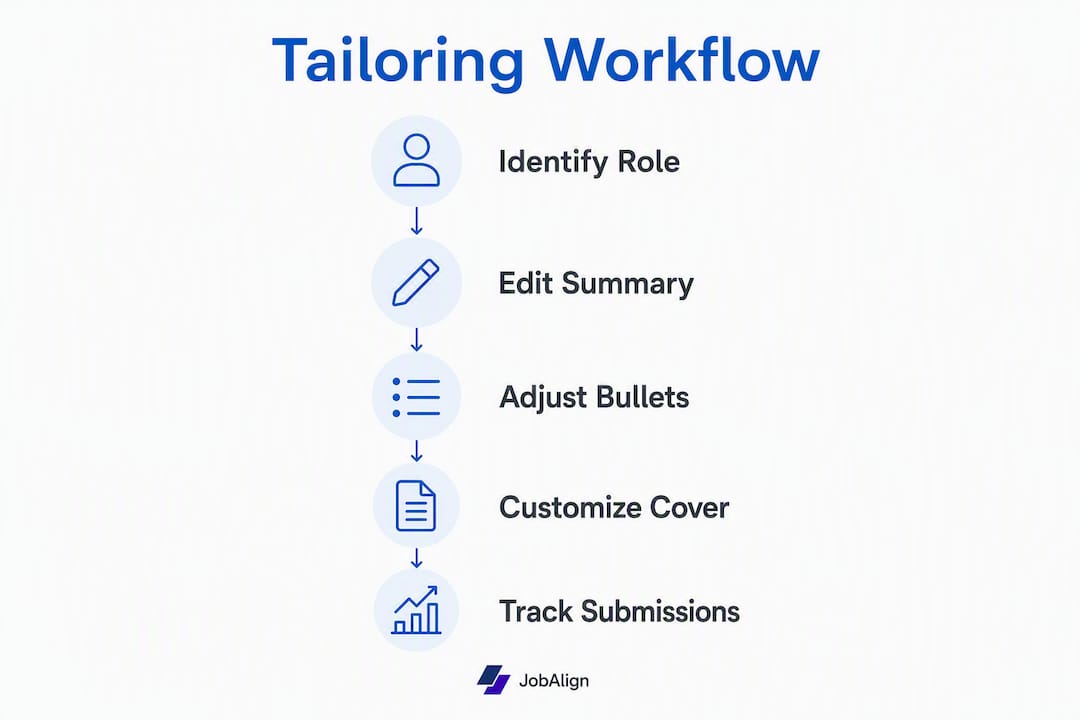
- Professional summary: Rewrite the first two sentences to name the role and reflect its top two priorities. This is the single highest-ROI edit you can make. A strong targeted summary signals role clarity in the first three seconds.
- Top three bullet points: Reorder and reword your most relevant bullets to lead with the language the job description uses. If the posting says “cross-functional collaboration,” your bullet should use that phrase, not “worked with other teams.”
- Skills section: Swap in the exact keywords from the job description. ATS systems match on exact strings, not synonyms.
- Cover note subject line or application title: Name the specific role. “Application for Senior Product Manager, Growth” outperforms “Application for Open Position” every time.
- Cover note opening: One sentence connecting your most relevant achievement to the role’s top priority. Keep it under 75 words.
Two micro-examples at the same company:
Role A: Data Analyst Summary angle: “Data analyst with 4 years of experience building SQL dashboards and Python pipelines for e-commerce teams. Reduced reporting cycle time by 30% at [Company X] by automating weekly KPI pulls.”
Role B: Business Analyst Summary angle: “Business analyst with 4 years translating stakeholder requirements into process improvements for e-commerce operations. Led a cross-functional initiative that cut order-processing errors by 22%.”
Same candidate, same company history, two completely different angles. The first leads with technical output; the second leads with stakeholder process. Both are honest. Neither would score well in the other role’s ATS.
Pro Tip: When time is limited, edit the summary and top three bullets first. Partial tailoring focused on those elements produces the largest lift in interview conversion. The skills section is second priority; everything else is a bonus.
For the cover letter, customized cover notes that connect a specific achievement to the role’s stated need consistently outperform generic letters. Keep it short, specific, and role-named.
How to manage multiple applications without appearing unfocused
Organization is what separates a candidate who looks intentional from one who looks scattered. A simple tracker prevents you from sending the wrong version of your resume, forgetting which recruiter you spoke to, or applying to the same role twice.
Tracker fields to maintain for each application:
| Field | What to record |
|---|---|
| Role title | Exact title as posted |
| Requisition ID | From the job posting URL or listing |
| Date applied | Actual submission date |
| Tailored file name | e.g., “Resume_DataAnalyst_CompanyX_v2.pdf” |
| Top 3 keywords used | The exact phrases you mirrored |
| Recruiter or contact name | From LinkedIn or the posting |
| Current stage | Applied / Phone screen / Interview / Offer |
| Notes | Any specific talking points or follow-up dates |
On timing: Staggering your submissions gives you time to tailor each application properly and reduces the appearance of mass-applying to internal teams. A gap of three to five business days between applications to the same company is a reasonable interval. It also gives you time to learn from any early recruiter contact before the second application goes in.
If a recruiter asks why you applied to multiple roles, here is a script that works: “I’m genuinely interested in [Company Name] and saw two roles that align with different strengths I’ve developed. I tailored each application separately because I think I can contribute in distinct ways to each team. I’m happy to discuss which role feels like the stronger fit based on your current priorities.” That answer signals self-awareness, preparation, and flexibility without sounding desperate.
When reaching out to internal referrals, be specific about which role you are asking them to support. Asking a contact to refer you to “any open role” creates confusion and puts them in an awkward position with the recruiting team.
Common mistakes that hurt your chances with multiple applications
Most candidates who damage their odds with multiple applications at the same company do so through a small set of avoidable errors.
- Sending identical resumes. This is the most common mistake and the most damaging. Recruiters interpret identical submissions as a lack of role clarity. Fix: use your tracker to confirm each file has a role-specific summary and keyword set before submitting.
- Keyword stuffing. Pasting every keyword from the job description into your resume without context reads as manipulation to both ATS and human reviewers. Fix: use each priority keyword once or twice in a natural sentence that demonstrates the skill, not just names it.
- Applying to roles you are clearly underqualified for. A weak application alongside a strong one creates doubt about your judgment. Fix: run the 70–80% required-qualifications check before you start tailoring.
- Using a misleading job title in your summary. Writing “Senior Director” in your summary when your actual title is “Manager” to match a posting is a red flag that surfaces immediately in a background check conversation. Fix: highlight relevant experience honestly and let the framing do the work, not an inflated title.
- Applying to five or more roles at the same company. Beyond two or three targeted applications, the signal flips from “interested candidate” to “desperate applicant.” Fix: be selective. If you genuinely qualify for more than three roles, prioritize by fit and career alignment, then apply to the top two or three.
A faster workflow using tools to produce tailored applications at scale
Manual tailoring works, but it is slow. Automation can handle the repetitive language-matching work and generate role-specific summaries and bullets in minutes, which matters when you are managing multiple applications simultaneously.
Here is a tool-assisted workflow you can run for each role:
- Sync your LinkedIn profile to pull your full work history, skills, and accomplishments into a base document.
- Import the job description into your resume tool and let it analyze the keyword and priority structure.
- Map the top keywords from the job description to your existing experience. The tool flags gaps and matches.
- Generate a role-specific summary and top bullets using the mapped keywords and your actual achievements.
- Review and confirm accuracy. No tool should add skills or experience you do not have. Your job at this step is to verify, not invent.
- Export an ATS-optimized PDF using a clean, machine-readable template.
The result is a tailored resume that reflects your real background, uses the employer’s language, and passes ATS keyword filters without the two-hour manual rewrite. Approximately 75% of resumes are rejected by ATS before a human sees them. A tool-assisted workflow that maps keywords accurately and outputs a clean PDF closes most of that gap.
Pro Tip: Use your tracker to store the tailored file name and the top three keywords for each version. When a recruiter calls, you can pull up the exact resume they are looking at in under 30 seconds.
For a deeper look at using AI to optimize your resume for each specific posting, JobAlign’s step-by-step guide walks through the full process.
Key Takeaways
Each application to the same company needs a distinct angle because recruiters and ATS systems evaluate role fit independently, and a single generic resume cannot score well against two different keyword sets.
| Point | Details |
|---|---|
| Tailor the summary first | Rewriting the professional summary for each role is the single highest-ROI edit and takes under 10 minutes. |
| Mirror the top 3 keywords | Use the exact phrases from the job description in your summary, bullets, and skills section for each application. |
| Limit to 2–3 targeted roles | Applying to more than three roles at one company signals mass-applying; be selective and qualify each role first. |
| Stagger your submissions | Space applications three to five business days apart to allow proper tailoring and reduce recruiter fatigue. |
| JobAlign automates the workflow | JobAlign syncs your LinkedIn profile, maps job-description keywords, and exports an ATS-optimized PDF for each role. |
The signal recruiters actually read
There is a pattern hiring teams notice immediately when a candidate applies to multiple roles at the same company. It is not the number of applications. It is whether the applications feel considered or scattered.
The candidates who stand out are not the ones who applied to the most roles. They are the ones whose materials show they read the job description carefully, understood what the team actually needs, and connected a specific result from their background to that need. A summary that opens with the role’s title and its top priority, backed by one quantified achievement, does more work in seven seconds than a two-page resume that tries to cover everything.
Here is the part most candidates miss: if a recruiter asks during a phone screen why you applied to two roles, that question is an opportunity, not a trap. The right answer is specific and confident. “I applied to both because I have direct experience with the core requirement of each, and I tailored each application to reflect that. I’m happy to discuss which role is the stronger fit for your team right now.” That answer closes the conversation cleanly and positions you as someone who thinks strategically about fit, not someone who is just hoping something sticks.
The candidates who get tripped up are the ones who cannot explain the difference between the two roles they applied for, or who sent the same resume to both. Preparation is the tell. If you can speak to each role’s priorities without looking at your notes, your application was probably tailored well enough.
JobAlign takes the manual work out of tailoring at scale
Tailoring two or three resumes for the same company is manageable by hand. Doing it consistently across every application in your search, without errors, without keyword gaps, and without accidentally reusing the wrong version is where most candidates slip.
JobAlign connects directly to your LinkedIn profile, pulls your real experience and skills, analyzes each job description, and generates a tailored, ATS-optimized resume for that specific role. No fabricated skills, no generic summaries, no reformatting a Word document for the fifth time this week. The output is a clean PDF built on expert-designed templates that ATS systems can parse correctly. JobAlign reports an 87% success rate in passing ATS filters, compared to the industry-wide reality that approximately 75% of resumes never reach a human reviewer.
You can generate your first tailored resume for free. See how it handles a real job description at jobalign.app.
Useful sources and further reading
- Tailoring Your Resume – Center for Career Readiness, University of Arizona: Practical checklist for mirroring job description priorities, including how to reorder bullets and quantify achievements.
- How To Tailor Your Resume To a Job Description – Indeed Career Advice: Step-by-step guidance on keyword mirroring, summary customization, and ATS matching.
- Applying to Multiple Jobs at the Same Company – Indeed Career Advice: Recruiter perspective on how multiple applications are perceived and when tailoring is non-negotiable.
- Diversify Your Job Search Strategy – UPenn Career Services: Framework for prioritizing roles across broad, mid-tier, and company-specific sources.
- The Role of Professional Summary Explained for Job Seekers – JobAlign Blog: How customizing the professional summary increases credibility and strategic positioning.
- How to Write a Targeted Resume Summary – JobAlign Blog: Specific examples and templates for role-based summaries, directly applicable to multi-role applications.
- Create a Unique Resume for Every Application – JobAlign Blog: Walkthrough on producing multiple tailored resumes efficiently using a tool-assisted workflow.
- ATS Resume Guide – JobAlign: Covers ATS filter mechanics, keyword placement, and template selection for machine-readable output.